The Tower Tarot Card Meaning
 Start your free daily reading
Free · One card a day · No credit card needed
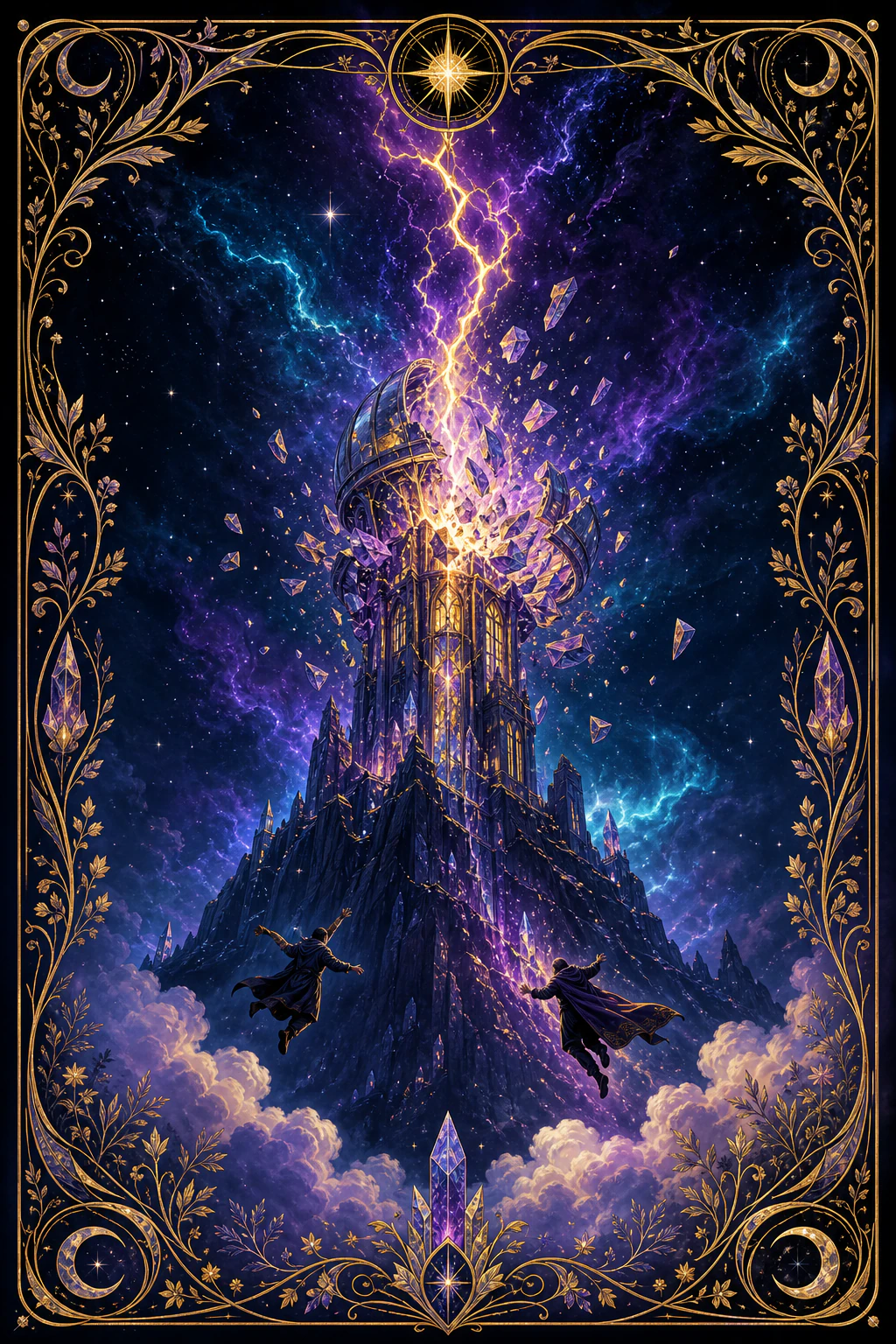
Lightning strikes a stone tower, the crown at its top is knocked loose, and two figures fall through dark air. It is the least comfortable image in the deck and the tradition has always been direct about that. What the card asks is not what is going to happen, but what a structure in your life would reveal if it stopped holding.
Upright The Tower
Upright, this is a card about the moment a thing that was assumed turns out to be a thing that was built. Every structure in a life — a job, an arrangement, a version of yourself you present at dinner — was assembled at some point, usually for reasons that made sense, often by someone younger than you are now. The image is dramatic because assembly is invisible until something interrupts it. It is worth saying plainly what the card is not. It is not a forecast, and a shuffled deck knows nothing whatsoever about your circumstances. Read as reflection, the Tower is an invitation to look at whichever parts of your life feel load-bearing and ask, calmly and in your own time, which of them you actually chose. Traditional readings emphasise suddenness, and the abruptness in the picture is real enough. But most people who describe a Tower period afterwards describe recognition rather than catastrophe: seeing all at once something they had partly known for a long while. The card sits closer to honesty than to disaster. The difficulty inside it is mostly the difficulty of admitting what you already suspect.
Reversed The Tower
Reversed, the card is usually read as the same charge delayed, muffled or turned inward. No lightning arrives from outside; the questioning happens quietly, over months, with nothing visible from the street. Some readers call this the harder version, on the grounds that a slow reckoning gives you many opportunities to talk yourself out of it. There is a second reading worth holding alongside. Reversal can describe the period after a rupture rather than before one — the part where the noise has stopped, there is rubble, and the question is what to do with the afternoon. That stage is rarely dramatic and rarely discussed, which is some of why it is difficult. Neither version predicts anything. Both are places to ask one specific question: what have you been maintaining out of momentum? Some things deserve maintaining. Others have been kept upright by nothing except the effort of keeping them upright, and the reversed Tower is a fair moment to notice the difference without deciding anything today. If the card unsettles you, that response is information too, and it is allowed to be the whole of the reading.
The Tower in love and relationships
In relationships of any kind, the Tower is not a verdict on anyone's connection. It touches the theme of assumptions finally being spoken aloud: the arrangement that was never agreed to, only fallen into; the thing both people have been careful not to say in the same room. Sometimes the honest reading here is small. A conversation you have rehearsed and not had. A friendship organised around a shared complaint that neither of you believes any more. A family role assigned to you when you were nine. The card does not say that speaking would break anything. It says that a structure which cannot survive being described was resting on silence, and that is worth knowing gently rather than dramatically. If a relationship in your life is genuinely difficult or unsafe, that belongs with people you trust and with proper support, not with a card.
The Tower in work and study
In working life, the Tower sits with the moment a plan stops matching the person following it. Working lives are built in advance, usually on information you had at twenty-two, and they are rarely reopened for review. The reflection here is unglamorous. Which parts of your working life are held up by genuine interest, and which by the fact that you already said you would? A title kept because leaving it would require explaining. A course continued because stopping would cost more to describe than to finish. Nothing in the card recommends walking out of anything. It is better used as an audit than an alarm. You might write down the three things that currently keep your work standing and notice how you feel about each one in turn, which is enough for the card to have done its part.
Resources and security
On the theme of security, this card is honest and a little bracing. The crown falling from the top of the tower is an old image about the distance between what you have and what you are, and about how quietly a sense of self can relocate into the things that keep it safe. As reflection only: there is something in asking what part of your steadiness comes from the arrangement and what part comes from you. Not because arrangements are unreliable, but because it is a good question to have already answered. Nothing here is a claim about your circumstances, and any real decision about them belongs to you and to people properly qualified to advise.
Attention and wellbeing
As a card about attention, the Tower notices what happens when a great deal is held at once. Structures need maintaining, and maintaining costs energy that rarely appears on any list. You might take an inventory of what you are currently holding upright — commitments, arrangements, standards you set yourself in a more capable season. Not in order to abandon them, only to see the size of the pile written down somewhere other than your head. Rest, in this card's terms, is not a reward for finishing. It is the thing that makes it possible to look at something difficult without flinching. If the card has left you tense, put it down and come back another day; nothing about it is urgent.
Yes or no?
It depends
It depends, though not evasively. The Tower resists a clean yes or no because it tends to reframe a question rather than answer it. Consider whether what you asked is the thing you actually want to know.
Symbolism in the card
The Rider–Waite–Smith Tower shows a narrow stone keep on a bare peak, struck by a single bolt of lightning that dislodges a golden crown from the top. Two figures fall headfirst, one crowned and one not, while small flames shaped like the Hebrew letter yod scatter down both sides of the card against a black sky. The image descends from much older material. In the Marseille tradition it is La Maison Dieu, the house of God, and earlier Italian decks sometimes named it for the arrow or for fire from heaven. Medieval readings connected it to the Tower of Babel and to the general iconography of pride corrected, which is why the crown matters more than the masonry does: what is knocked off is the emblem of authority, not the building. Smith's choice to leave the tower standing is often overlooked. The structure cracks and burns, and in the picture it does not fall. Whatever else the card is about, the deck itself declines to draw a total ruin.
The Tower as today's card
Meeting this card as the single card of the day is uncomfortable for most people, and the first useful thing is to notice that the discomfort belongs to the image rather than to the day. A card cannot know your morning. Held as reflection, it makes a reasonable prompt: pick one thing you are currently propping up, and look at it for a minute. Not fix it, not decide about it. Look at it. Some days the honest response to the Tower is to put the deck away and make a cup of tea. That counts as a reading rather than an avoidance, particularly if the week has already asked a great deal of you.
In a three-card spread
Set in the past, the Tower tends to refer to something already survived. It helps to be specific about what actually happened and what you have since rewritten, because the retold version is often more frightening than the original was. In the present, it describes a live tension between what is being maintained and what is being noticed. That is a description rather than a diagnosis, and the surrounding cards tend to soften or sharpen it. In the future position, hold it strictly as a question and not an outcome. Nothing here forecasts anything. The useful form is: if a structure in this situation were examined honestly, what would you rather find, and what would you rather not?
Keywords
- Change
- Upheaval
- Chaos
- Awakening
Journal prompts
- What in your life is currently held up by effort rather than by wanting it?
- Which thing that you already half-know have you not said out loud yet?
- When something fell apart before, what turned out to have been underneath it?
Cards read alongside The Tower
- The Star — Hope, faith, purpose, renewal, spirituality.
- The Devil — Shadow self, attachment, addiction, restriction, sexuality.
- Ten of Swords — A painful ending, exhaustion, surrender, and a new dawn.
- Eight of Cups — Walking away, seeking truth, withdrawal, and transition.
- All 78 tarot card meanings — the full major and minor arcana in one place.
Combinations with The Tower
- The Tower and The Devil tarot combination
- The Tower and The Star tarot combination
- The Tower and Temperance tarot combination
- The Tower and The Moon tarot combination
- The Tower and Death tarot combination
- The Tower and The Sun tarot combination
- All 231 major arcana combinations
The Tower by position
- The Tower as feelings tarot meaning
- The Tower as intentions tarot meaning
- The Tower as outcome tarot meaning
- The Tower as advice tarot meaning
- The Tower as an obstacle tarot meaning
- The Tower as action tarot meaning
- The Tower as a person tarot meaning
- The Tower as how someone sees you tarot meaning
- The Tower for a yes or no question tarot meaning
- All card meanings by position
Curious what The Tower means for your question? Turn a card on the home page — no account needed.
Draw a card freeOne card, one honest question, most evenings.
Start your free daily readingFree · One card a day · No credit card needed
Go deeper than one card
A personalized deep reading works a full spread around your question — The Tower included, if it falls to you. Deep readings run from the $1.99 Single Card Illumination and the $7 Three-Card Path, delivered straight away, to the $19 Five-Card Compass and the $29 Celtic Cross Atlas, composed in depth and delivered within 2–4 hours.
The $29 Celtic Cross Atlas, ten cards read position by position → · All reading options →
Prefer a rhythm to a one-off? Sparkle Pro ($8.99/month or $59/year) draws a three-card past, present and future spread for you every day. There is also a free eight-phase moon ritual guide to pair with today's card.
To sit with this card longer, the tarot journaling guide has prompt sets for daily draws, moon phases, and more — including journal prompts for every major arcana card.
Tarot content is for entertainment and personal reflection, not professional advice.