The Star Tarot Card Meaning
 Start your free daily reading
Free · One card a day · No credit card needed
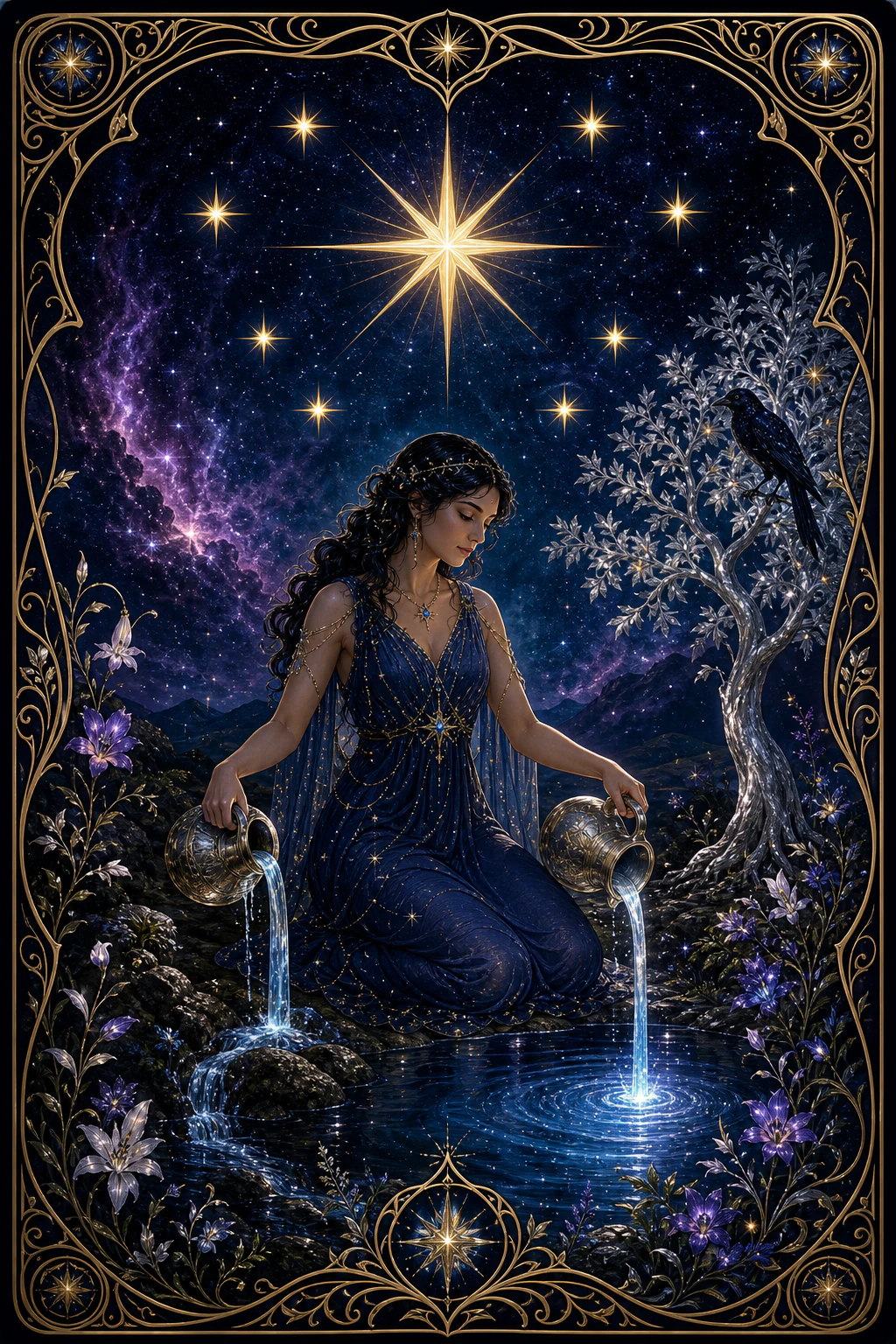
A woman kneels at the edge of a pool under a wide night sky, one knee on the grass and one foot resting on the water's surface. She pours from two vessels, one onto the earth and one back into the pool. Above her a single eight-pointed star burns among seven smaller ones, and nothing in the scene is hurried.
Upright The Star
Upright, this is the deck's quietest card, and its quietness is the substance rather than the decoration. Whatever came before, the noise has stopped. The figure is not celebrating and not recovering in any dramatic sense; she is doing something slow by water at night, unobserved, and the picture treats that as sufficient. Older commentators call the card hope, which is accurate and slightly too grand. What it actually depicts is the return of ordinary attention after a period when there was no room for it — noticing the temperature of the air, taking an interest in something small, finding you have opinions again about how a room should be arranged. She is naked, which the tradition reads as having nothing left to defend. It is a strange kind of ease and most people recognise it only in hindsight. Sitting with this card, the honest question is not whether things are better. It is whether you have let yourself register the parts that already are, since a habit of bracing outlives the thing it was braced against by a considerable margin. The star does not instruct her. It is simply lit, and she works underneath it.
Reversed The Star
Reversed, the usual account is discouragement, and that word covers too much ground to be useful on its own. Two distinct things sit under it. One is the flat interval where nothing is wrong and nothing is interesting either — the vessels emptied, the pool the same as yesterday, the general grey competence of getting through a week. This is not despair and does not respond to being treated as such. It usually responds to smallness: one specific thing looked at closely, rather than a resolution. The other is a more pointed difficulty, where hope has started to feel like a risk. Anyone disappointed carefully enough learns that wanting nothing in advance costs less. That arithmetic is sound in the short run and expensive over years, and the reversed card is a fair place to notice the price without being told to cheer up. There is a third reading worth keeping in the pocket. Reversal sometimes describes hope pointed at something that cannot hold it — a plan, a person, a date circled on a calendar — with the intensity of the wanting standing in for evidence. None of these are predictions. All of them make better questions than conclusions.
The Star in love and relationships
For connection of any kind, this card belongs to the part that follows honesty rather than the part that precedes it. Something has been said, or survived, and what is left is two people being fairly plain with each other in low light. Its version of intimacy is unperformed. Nobody is trying, in the sense of trying to be seen a particular way, and that is precisely the condition most people find hardest to arrive at and easiest to recognise once there. If you are alone, the card sits with a different question: what you would want if you were not trying to want the sensible thing. Preferences get pruned quietly over the years, usually for good reasons, and it is worth occasionally checking which of yours are genuinely yours. Where a connection has recently been difficult, this image offers no verdict on it. It offers a pool, a night, and an unhurried hour.
The Star in work and study
In working life, this card sits with vocation rather than progress. The figure is engaged in something unwitnessed and repetitive, which describes most real craft accurately and most career advice not at all. If you have been measuring your work by the parts other people can see, now is a fair point at which to ask what the unobserved portion consists of, and whether you like it, since that is the portion you actually live in. The card also touches the period after an ending — a project finished, a role left, a plan abandoned — where the next thing has not announced itself and the temptation is to fill the space quickly out of discomfort rather than interest. Two vessels are being poured here, one into the ground and one back into the water. Neither is being stored. You might ask which parts of your life you have been replenishing lately, and which you have only drawn from.
Resources and security
This card approaches security through sufficiency rather than accumulation. The scene contains a pool, some grass, a sky and two jugs, and it is not a picture of scarcity — it simply has no interest in surplus. As a reflection, consider what the minimum version of your life would actually look like, described honestly rather than romantically, and which parts of it you would be relieved by. Most people discover that a portion of what they carry is insurance against a fear they no longer hold, kept out of habit. Noticing that is not a recommendation to change anything, and nothing here constitutes guidance about your affairs. The pouring in the image is worth one further thought: what returns to the source, and what soaks away.
Attention and wellbeing
As a card about rest, this one is more specific than it first appears. She is not asleep. Rest, in the terms of this picture, is a period of low stimulation in which attention slowly comes back — closer to a walk than a holiday, and available on a Tuesday. You might identify the last time you were unoccupied without a screen involved, and whether that interval had any deliberate cause. Water and night sky both belong to the same theme: the deliberate reduction of input. None of this is a claim about your health, only a note that attention behaves like weather and does not restore itself while something is still talking.
Yes or no?
Yes
Yes, though gently and without a schedule attached. This card leans toward the option that would let you breathe out. It describes a direction of feeling rather than an event, and it promises nothing about timing.
Symbolism in the card
Seventeen in the major sequence, drawn by Pamela Colman Smith as a kneeling nude beside a pool, her left knee on the ground and her right foot resting on the surface of the water without sinking — a small impossibility that generations of readers have taken as the card's central claim about faith and the unconscious. She holds two vessels: the right pours onto the earth in five streams, the left returns water to the pool. Overhead, one great eight-pointed star is surrounded by seven smaller ones, a configuration usually connected to the classical planets and, further back, to the star of Ishtar. Behind her a tree carries a bird, generally identified as an ibis and associated with Thoth, keeper of writing and measure. The Marseille version showed much the same arrangement, and older Italian decks grouped Star, Moon and Sun together as celestial cards following the Tower's destruction. The nakedness is the detail worth pausing on. In an era of heavily robed figures, Smith's choice reads as a deliberate statement about having nothing further to conceal.
The Star as today's card
In a morning draw, the request is small and quite specific: leave something unfilled. An hour without a plan, a journey without headphones, a meal eaten without a second activity running alongside it. Days that begin under this image are not necessarily calm ones, and the card is not a promise about your afternoon. It works better as a bias — a slight preference, held through the day, for whichever version of a situation involves less noise. By evening ask what you noticed today that would ordinarily have gone past unregistered. That is the entire practice, and it fits inside any schedule, including a bad one.
In a three-card spread
Drawn into the first position, the Star often refers to a stretch of quiet that you may have logged as unproductive at the time and which turns out, from here, to have been where something reassembled. Occupying the middle, it describes present conditions more than present events: a lull, a low sky, a period without much score to report. Neighbouring cards tend to say what the lull is for. In the last position, the honest handling is to strip out any promise. Read it as an enquiry — if this situation grew calmer rather than more decided, what would you do with the room, and have you already made plans for room you do not yet have?
Keywords
- Hope
- Faith
- Renewal
- Purpose
Journal prompts
- What have you been bracing for that stopped being likely some time ago?
- Name something you replenish and something you only ever draw from.
- If nobody asked what you had achieved this week, what would you have wanted to do with it?
Cards read alongside The Star
- The Moon — Illusion, fear, anxiety, subconscious, intuition.
- Temperance — Balance, moderation, patience, purpose.
- The Hermit — Soul-searching, introspection, being alone, inner guidance.
- Nine of Cups — Contentment, satisfaction, gratitude, and wishes fulfilled.
- All 78 tarot card meanings — the full major and minor arcana in one place.
Combinations with The Star
- The Star and The Tower tarot combination
- The Star and The Moon tarot combination
- The Star and The Devil tarot combination
- The Star and The Sun tarot combination
- The Star and Temperance tarot combination
- The Star and Judgement tarot combination
- All 231 major arcana combinations
The Star by position
- The Star as feelings tarot meaning
- The Star as intentions tarot meaning
- The Star as outcome tarot meaning
- The Star as advice tarot meaning
- The Star as an obstacle tarot meaning
- The Star as action tarot meaning
- The Star as a person tarot meaning
- The Star as how someone sees you tarot meaning
- The Star for a yes or no question tarot meaning
- All card meanings by position
Curious what The Star means for your question? Turn a card on the home page — no account needed.
Draw a card freeOne card, one honest question, most evenings.
Start your free daily readingFree · One card a day · No credit card needed
Go deeper than one card
A personalized deep reading works a full spread around your question — The Star included, if it falls to you. Deep readings run from the $1.99 Single Card Illumination and the $7 Three-Card Path, delivered straight away, to the $19 Five-Card Compass and the $29 Celtic Cross Atlas, composed in depth and delivered within 2–4 hours.
The $29 Celtic Cross Atlas, ten cards read position by position → · All reading options →
Prefer a rhythm to a one-off? Sparkle Pro ($8.99/month or $59/year) draws a three-card past, present and future spread for you every day. There is also a free eight-phase moon ritual guide to pair with today's card.
To sit with this card longer, the tarot journaling guide has prompt sets for daily draws, moon phases, and more — including journal prompts for every major arcana card.
Tarot content is for entertainment and personal reflection, not professional advice.