Ten of Swords Tarot Card Meaning
 Start your free daily reading
Free · One card a day · No credit card needed
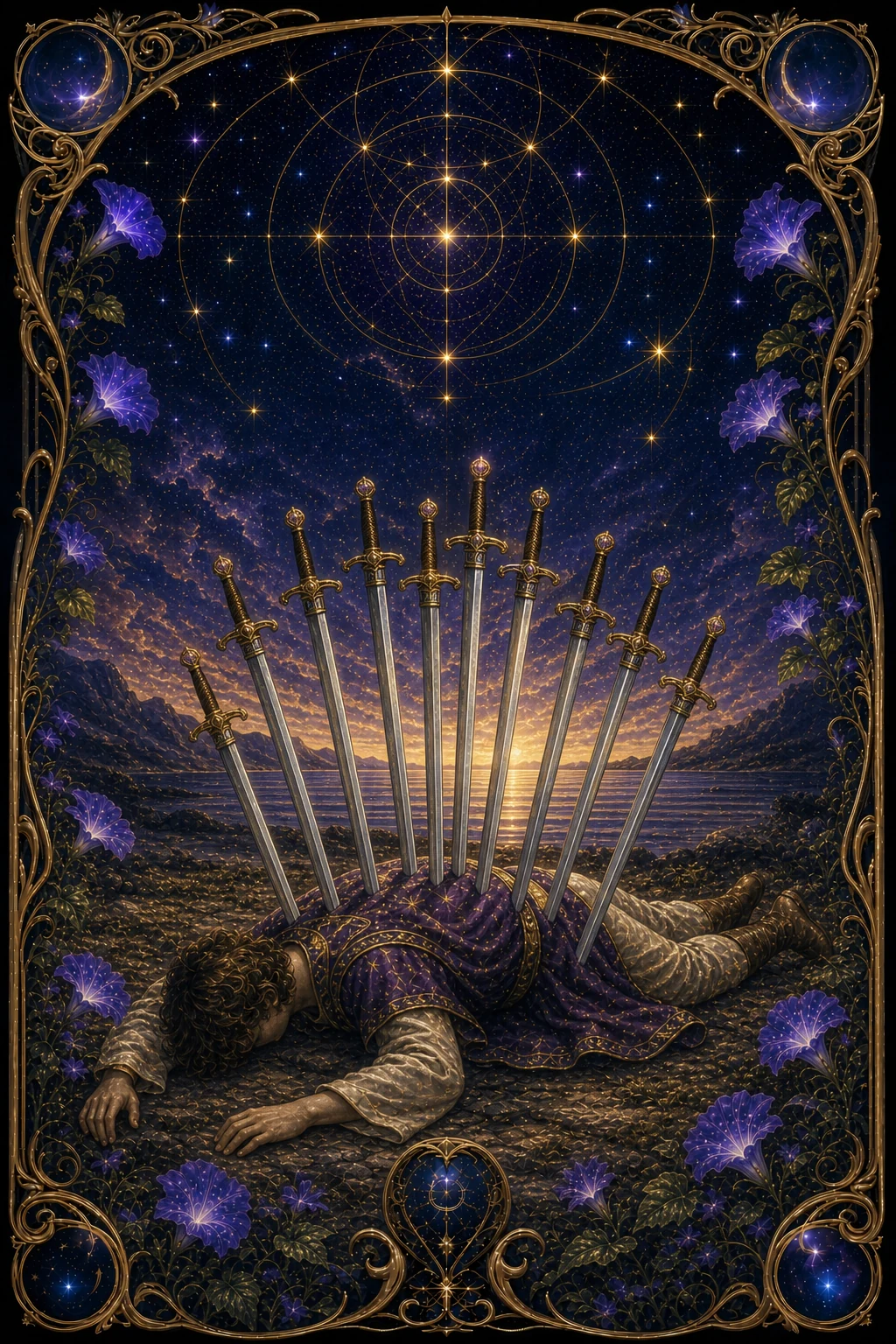
A figure lies face down at the edge of still water with ten swords in the back, while along the horizon the black sky has already begun to turn gold. It is the most overstated image in the deck. The question it raises is what you would say about an ending if you were not performing it.
Upright Ten of Swords
Start with the count. One sword ends a person; ten is a stage direction. The tradition draws this card as excess on purpose, and readers who sit with it for any length of time tend to notice the comedy underneath the horror — the sky is already lifting, the water is perfectly calm, the figure's hand is arranged in a gesture of blessing, and somebody has gone to the trouble of laying out the entire cutlery drawer. That is not a trick. It is the deck being honest about how endings feel from inside them, which is always more total than they later turn out to have been. Read as reflection, the Ten sits with the particular relief that arrives when something you have been keeping alive is finally allowed to be over. Exhaustion has a dignity in this card, and so does the end of pretending. It is not a prediction; a deck of cards knows nothing about your circumstances or about anyone's conduct toward you. Where it earns its place is as a question about finality: which situation have you been describing in absolute terms, and what would it sound like described plainly instead? If something in your life is genuinely serious, the right place for it is with people who can actually help.
Reversed Ten of Swords
Two readings are traditional here and they sit at opposite ends of the same process. In the first, the reversed Ten is the ungainly business of getting up. Nobody draws that part. The picture has no panel for the weeks of ordinary admin that follow anything ending — the address changed, the equipment returned, the explanation given for the ninth time to somebody who means well. It is undignified and it is also the actual recovery, most of which looks like errands. In the second reading, the card describes a refusal to let something conclude: a situation kept technically alive by small acts of maintenance, so that nobody has to say the sentence out loud. That version is more comfortable and considerably more expensive. A third note is worth adding, since this card gets handed to people in bad weeks. Reversal is sometimes read as a caution against making a scene of one's own difficulty, and that reading is ungenerous. People are allowed to find hard things hard. The card is better used to ask what is genuinely finished and what you have merely stopped attending to, because those are not the same thing.
Ten of Swords in love and relationships
In connection, the Ten is often reached for as a card of betrayal, and that needs handling carefully, because a card cannot know what anybody has done. What it holds more honestly is the moment a story about a relationship stops being tellable in the old way. Sometimes that concerns another person. Just as often it concerns a version of the connection you have been maintaining privately, long after the other party moved to a different one. There is a specific tiredness that comes from keeping a shared past intact single-handed. If you recognise it, the card offers no instruction, only the observation that the sky in the picture is already changing while the figure is still face down and has not noticed. Where a relationship involves genuine harm, the right company for that is people you trust and qualified support, not a reading.
Ten of Swords in work and study
In working life, the Ten belongs to the project that has been over for some time and has not been told. Institutions are excellent at keeping dead things technically running: the meeting that persists, the initiative nobody has cancelled because cancelling requires a memo. There is a personal version too, in which a role stopped fitting a while ago and the effort now goes into maintaining the appearance rather than doing the work. The reflection here is unsentimental. What in your working life would you not restart if it ended tomorrow? That can be answered honestly on paper without committing you to anything, and the answer tends to be clearer than months of deliberation. The dawn in the picture does quiet work: it places the ending and the morning in the same frame, which is the more accurate arrangement.
Resources and security
Around questions of security, the Ten touches the aftermath rather than the event: the particular flatness that follows a costly stretch, when the immediate trouble has passed and the energy has not come back. That gap is real and rarely discussed, because the story usually ends at the resolution. Held as reflection: consider whether you are still living by rules you set during a lean period that has since ended, and whether anybody ever told you it was over. Habits outlast their reasons. No part of this is financial guidance; decisions of that kind belong with you and anyone suitably qualified you trust.
Attention and wellbeing
On the subject of energy, this card is about the end of a long carry. There is a kind of tiredness that only shows up once the demanding thing has stopped, which catches people out when relief does not feel like energy. It rarely does. Recovery is slower and duller than that, and it does not run to a schedule anyone can set. What belongs here is rest and rhythm of an ordinary kind — the day with nothing in it, the earlier evening, the low week that is not a failure of will. If the flatness is persistent rather than passing, that is worth raising with a doctor or someone else qualified; a card has nothing useful to add there.
Yes or no?
No
No, though the card is less interested in refusal than in completion. Read it as a prompt to check whether your question concerns something already finished, in which case a yes or no is beside the point.
Symbolism in the card
Ten swords enter the prone figure's back in a neat vertical row from shoulder to calf, beneath a red cloak covering the lower body. The ground is a flat shore and the water beyond is entirely still, which is unusual for a card of this reputation. The sky above is solid black and breaks along the horizon into a wide band of yellow, taken by most readers for dawn rather than dusk. The right hand is folded in a benediction sign, two fingers extended, the same gesture the Hierophant gives from his throne — an odd and deliberate borrowing. Low hills stand in the far distance. The Marseille version, once again, has no figure at all: only ten blades laid in a pattern with a small flower at the centre. Waite's own comment on the card is famously brief and warns readers off the melodramatic interpretation, insisting that it does not mean violent death. The tradition undercuts its own picture, which is worth knowing before the picture undercuts you.
Ten of Swords as today's card
As the day's card, this one alarms people, and the first thing to say is that the alarm belongs to the drawing rather than to your day. Ten swords is a picture, not a weather report. Taken as reflection, it works as a prompt for finishing something small and overdue: the message left unsent, the file left open, the thing that has been ninety per cent done since March. There is a version of this day that consists entirely of closing tabs, and it is not a wasted one. If the card lands during a genuinely hard week, put it down without ceremony. Nothing in a deck obliges you to sit with an image you have no room for.
In a three-card spread
Read as the past, the Ten usually concerns a stretch already lived through, and the interesting question is not what happened but what the account of it has hardened into. Retellings tend to grow more final over time. As the present, it describes an ending's texture rather than its facts, and the surrounding cards generally supply the detail about what is actually concluding. Where it lands on the future, decline the forecast outright; no card knows anything about what is ahead, and this one in particular should not be allowed to pretend. Use it instead as a question about completion: what would you like to have finished cleanly, rather than left running quietly in the background?
Keywords
- Ending
- Exhaustion
- Surrender
- Renewal
Journal prompts
- What have you been keeping alive that is already over?
- If it ended tomorrow, which part would you honestly not restart?
- What does your usual account of an old ending leave out?
Cards read alongside Ten of Swords
- Six of Swords — Transition, moving forward, release, and calmer waters.
- Five of Cups — Loss, regret, grief, and noticing what still remains.
- Nine of Swords — Anxiety, worry, fear, and thoughts that disturb the night.
- The Sun — Positivity, fun, warmth, success, vitality.
- All 78 tarot card meanings — the full major and minor arcana in one place.
Combinations with Ten of Swords
- Nine of Swords and Ten of Swords tarot combination
- Ten of Swords and Page of Swords tarot combination
- Eight of Swords and Ten of Swords tarot combination
- Ten of Swords and Knight of Swords tarot combination
- Seven of Swords and Ten of Swords tarot combination
- Ten of Swords and Queen of Swords tarot combination
- All 2,772 minor arcana combinations
Ten of Swords by position
- Ten of Swords as feelings tarot meaning
- Ten of Swords as intentions tarot meaning
- Ten of Swords as outcome tarot meaning
- Ten of Swords as advice tarot meaning
- Ten of Swords as an obstacle tarot meaning
- Ten of Swords as action tarot meaning
- Ten of Swords as a person tarot meaning
- Ten of Swords as how someone sees you tarot meaning
- Ten of Swords for a yes or no question tarot meaning
- All card meanings by position
Curious what Ten of Swords means for your question? Turn a card on the home page — no account needed.
Draw a card freeOne card, one honest question, most evenings.
Start your free daily readingFree · One card a day · No credit card needed
Go deeper than one card
A personalized deep reading works a full spread around your question — Ten of Swords included, if it falls to you. Deep readings run from the $1.99 Single Card Illumination and the $7 Three-Card Path, delivered straight away, to the $19 Five-Card Compass and the $29 Celtic Cross Atlas, composed in depth and delivered within 2–4 hours.
The $7 Three-Card Path, three cards read as one movement → · All reading options →
Prefer a rhythm to a one-off? Sparkle Pro ($8.99/month or $59/year) draws a three-card past, present and future spread for you every day. There is also a free eight-phase moon ritual guide to pair with today's card.
To sit with this card longer, the tarot journaling guide has prompt sets for daily draws, moon phases, and more.
Tarot content is for entertainment and personal reflection, not professional advice.