The Devil Tarot Card Meaning
 Start your free daily reading
Free · One card a day · No credit card needed
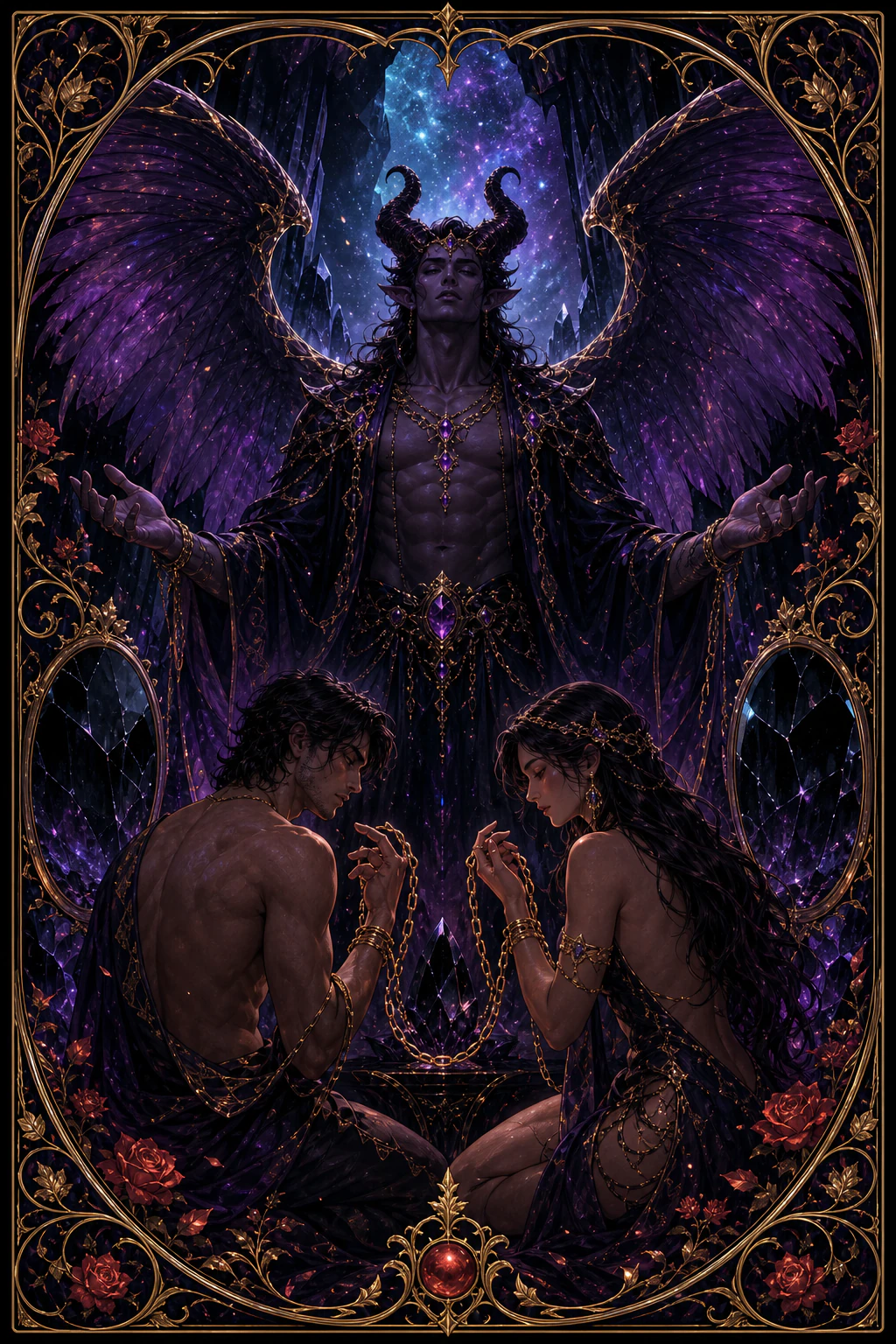
A horned figure crouches on a black half-cube, an inverted pentagram set above its brow, one hand raised and the other holding a lowered torch. Beneath it a man and a woman stand collared and chained. Look at the chains for a moment and the whole picture changes: the loops hang slack, wider than the heads they circle.
Upright The Devil
Upright, this card describes an arrangement rather than a villain. Something in your life is being held in place by a trade you made once and have not re-read since — the long hours that purchase a particular kind of standing, the argument you return to because winning it feels like evidence, the habit that marks the end of a working day. Each of those began as a solution to something real. That is the part older moralising accounts skip, and it is the part worth keeping. Nothing holds a person unless it delivers, in some crooked currency, a thing they wanted. Traditional readings reach for the word bondage, and the drawing immediately qualifies it. Chains are present, and they are loose; the two figures could lift them clear without much effort. Whether that reads as reassurance or as the bluntest line in the deck depends on how long you have stood where you are. What the card actually asks for is a plain accounting: name what this thing costs you, name what it hands back, and let both sentences stand without the softening you would use in company. If something in your life genuinely has hold of you, that is work for people who know you and for qualified support. A card is not equipped for it and does not pretend to be.
Reversed The Devil
Turned over, the usual reading is loosening — a collar noticed, a bargain finally said out loud, the small unglamorous moment when a person stops explaining and starts describing. Reversal here rarely arrives as triumph. More often it looks like tiredness of a specific kind: the exhaustion of maintaining a story about why the situation is fine. When that story runs out of energy, what is left is simply the situation, which is easier to look at than the effort of not looking. There is a second and less flattering version, and honest readers keep it in view. Reversed cards can describe the same material pressed further down rather than lifted off. Secrecy belongs here — the thing not mentioned to anyone, kept private because describing it would make it real enough to have an opinion about. Neither reading is a verdict, and neither predicts anything whatsoever. Both work better as an inventory taken slowly. You might list what you would have to give up in order to be free of a particular pattern, including the parts you would miss, since the missing is the whole reason the pattern has lasted.
The Devil in love and relationships
Between people, this card touches the arrangements nobody agreed to but everybody follows. The couple in the picture are chained to the same block, which is a specific kind of image: not two people who hate each other, two people whose difficulty is joint property. Most long connections accumulate something like this — a subject permanently off the table, a role each person plays because the alternative would require a conversation, an intensity mistaken for closeness because it is the only thing that reliably produces feeling. Naming it is not the same as ending it. Plenty of people look squarely at the shape of their attachment and choose it again, with better information and less resentment, and the card has nothing against that outcome. It only declines to let the shape stay invisible. Where a relationship involves harm, fear or control, no card belongs anywhere near the decision. Please take that to people you trust and to proper support.
The Devil in work and study
Work is where this card's bargains are easiest to see and hardest to admit, because they are so often rewarded. A role can pay you in money, in identity, in the relief of being needed, and the last two are the ones that keep people seated long after the first stops being persuasive. Ask what your working life gives you that would be difficult to obtain elsewhere. Sometimes the answer is genuinely good, and the card merely confirms that you know why you stay. Sometimes it is the ambient hum of being needed, which is a real need and a poor reason to have skipped four years of evenings. The figures on the plinth are not chained to a workplace; they are chained to a block that neither of them has tried to lift. In career terms the block is usually a sentence — I cannot leave until, nobody else can do this properly. Sentences are worth testing occasionally.
Resources and security
On the subject of security, the card is interested in appetite rather than arithmetic. Wanting more is not the difficulty; the difficulty is a want that has become automatic, so that acquiring stops registering as a choice and runs instead as a background process. Consider which of your material wants you could describe the origin of, and which simply arrived. Then there is the separate question of what money has been asked to do besides its own job — settle a childhood argument, prove a point to someone who stopped paying attention years ago, stand in for a rest never taken. None of this is guidance about your own circumstances; those stay with you, and with anyone qualified you choose to consult.
Attention and wellbeing
As a reflection on habit, this card is unusually practical. Habits are not moral events; they are grooves worn by repetition, and they deepen fastest when a day has nothing else in it. You might look at where in your week the automatic behaviour reliably shows up — the hour, the room, the mood that precedes it — because pattern is easier to work with than willpower. Attention is the whole of what the card asks for here: noticing the moment before, rather than the moment after. Nothing in this section is advice about your body, your mind or your health, and it cannot be. If a habit has become something you cannot set down, please talk to someone qualified, who can do what a picture of a horned figure cannot.
Yes or no?
It depends
It depends, and the hesitation is the reading. This card tends to reveal that the question was framed by the very arrangement you are asking about. Try rewriting the question first, then ask again.
Symbolism in the card
Card fifteen in the Rider–Waite–Smith deck shows a winged goat-headed figure perched on a black half-cube, bat wings spread, an inverted pentagram fixed to its forehead and a torch held downward in its left hand. The right hand is raised in a gesture that mimics a blessing. Below, a man and a woman stand naked with small horns and tails of their own, collared, the chains running to an iron ring in the front of the cube. The design owes an obvious debt to Éliphas Lévi's Baphomet illustration of 1856, which had made the composite goat-figure fashionable in nineteenth-century occult circles. The Marseille card called it simply Le Diable and gave the two attendants the same loose bindings. Pamela Colman Smith's contribution is largely in the detail of those chains and in the couple's expressions, which are notably untroubled. The half-cube is worth attention as well: a solid form with most of itself missing, an old visual note for a partial understanding of the material world mistaken for the whole of it.
The Devil as today's card
Pulled for the day ahead, this one tends to produce a flinch, followed by a mental list of everything the reader has ever done badly. That list is not the card. More useful is to pick one small automatic thing — the first hour of the morning, the way you answer a particular name on the screen, whatever you reach for at six o'clock — and observe it once without editing. Not stopping it. Watching it. Mornings that begin here often go perfectly ordinarily, which is worth knowing, given the reputation. If the drawing has unsettled you, put the deck aside; the reflection keeps.
In a three-card spread
Falling behind you, this card usually points to a bargain you have already stepped out of, and the interesting question is what replaced it, since something generally does. Sitting in the middle, it describes a live exchange — a thing currently being paid for, with the surrounding cards often indicating the currency. Where it lands in the final slot, resist reading it as fate, because nothing here forecasts your circumstances. The useful shape is conditional: if this situation continued along its present grain, what would you have quietly agreed to by the end of it, and would you agree to it with your eyes open? The chains are loose in every position on the table.
Keywords
- Shadow
- Attachment
- Restriction
- Materialism
Journal prompts
- What does a difficult arrangement in your life actually give you? Answer it generously before you answer it critically.
- Which sentence beginning 'I can't leave until' have you been repeating longest?
- If nobody would comment either way, what would you set down this month?
Cards read alongside The Devil
- The Lovers — Love, harmony, relationships, and values alignment.
- Eight of Swords — Restriction, self-doubt, perspective, and finding freedom.
- Four of Pentacles — Security, control, conservation, and holding on tightly.
- Seven of Cups — Choices, imagination, illusion, and wishful thinking.
- All 78 tarot card meanings — the full major and minor arcana in one place.
Combinations with The Devil
- The Devil and Temperance tarot combination
- The Devil and The Tower tarot combination
- The Devil and Death tarot combination
- The Devil and The Star tarot combination
- The Devil and The Hanged Man tarot combination
- The Devil and The Moon tarot combination
- All 231 major arcana combinations
The Devil by position
- The Devil as feelings tarot meaning
- The Devil as intentions tarot meaning
- The Devil as outcome tarot meaning
- The Devil as advice tarot meaning
- The Devil as an obstacle tarot meaning
- The Devil as action tarot meaning
- The Devil as a person tarot meaning
- The Devil as how someone sees you tarot meaning
- The Devil for a yes or no question tarot meaning
- All card meanings by position
Curious what The Devil means for your question? Turn a card on the home page — no account needed.
Draw a card freeOne card, one honest question, most evenings.
Start your free daily readingFree · One card a day · No credit card needed
Go deeper than one card
A personalized deep reading works a full spread around your question — The Devil included, if it falls to you. Deep readings run from the $1.99 Single Card Illumination and the $7 Three-Card Path, delivered straight away, to the $19 Five-Card Compass and the $29 Celtic Cross Atlas, composed in depth and delivered within 2–4 hours.
The $29 Celtic Cross Atlas, ten cards read position by position → · All reading options →
Prefer a rhythm to a one-off? Sparkle Pro ($8.99/month or $59/year) draws a three-card past, present and future spread for you every day. There is also a free eight-phase moon ritual guide to pair with today's card.
To sit with this card longer, the tarot journaling guide has prompt sets for daily draws, moon phases, and more — including journal prompts for every major arcana card.
Tarot content is for entertainment and personal reflection, not professional advice.