The Sun Tarot Card Meaning
 Start your free daily reading
Free · One card a day · No credit card needed
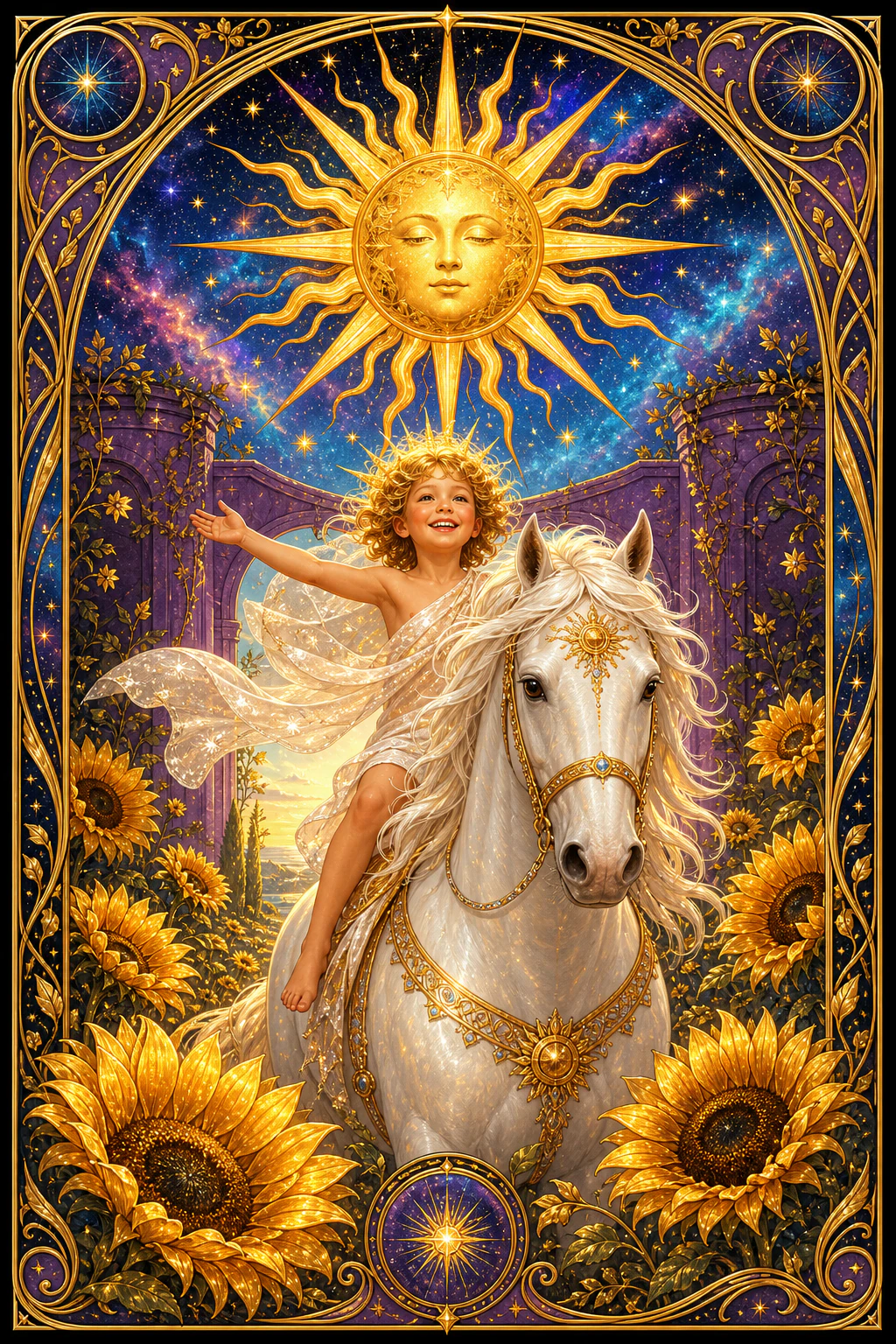
A child rides a white horse in an open field, arms loose, a great red banner streaming overhead. Behind them a low wall carries four tall sunflowers, all turned toward the light. The sun itself fills the top of the card with a plain human face, and the whole scene is drawn without any shadow worth mentioning.
Upright The Sun
Upright, this card is uncomplicated in a deck that generally is not, and the temptation is to distrust it on those grounds. Plenty of readers do. It depicts clarity and warmth without conditions attached — a situation you can see all of, a day that does not require managing, a version of yourself that is not currently performing anything. The child rides without a saddle and does not appear to have considered falling. That is not naivety exactly; the walled garden is behind them and the field is open, so something has already been left. What the card raises, sat with honestly, is how comfortable you actually are with things being fine. A surprising number of capable people find plain contentment slightly unnerving and will locate a problem within about four minutes of not having one, which is a habit acquired for good reasons and worth examining in daylight. The sunflowers are the quiet instruction in the picture: they are turned toward the source rather than toward each other or the viewer. Whatever in your life you would describe as the source of ordinary gladness — a person, an hour, a piece of work — the card asks whether you have been facing it or merely keeping it in the general vicinity.
Reversed The Sun
Reversed, the light dims rather than vanishes, and most readings gather around a muted or postponed brightness. One familiar version is gladness held at a distance: things are genuinely well and you cannot quite feel them, either because the good news is recent and you have not caught up with it, or because enjoying something has become entangled with the fear of losing it. That is a common and unglamorous state, and the card offers no cure for it beyond noticing that the dimming is happening on your side of the window. A second version concerns display. Reversal sometimes describes brightness performed rather than felt — the cheerful account given to everyone who asks, maintained so consistently that the maintenance is now its own labour. There is no requirement to be well in public. A third and gentler reading is simply delay: a warmth that has not arrived yet, with the card marking the interval rather than promising an end to it. None of these describe your circumstances or predict them. They are three different questions, and you probably already know which one you picked up when you read them.
The Sun in love and relationships
In connection, this card describes the unguarded register — being known without editing, and the specific relief that comes with it. It suits new warmth and it suits old warmth equally, which few cards manage. What it points at is visibility rather than intensity: the difference between being adored and being seen accurately, and the fact that most people say they want the second while arranging their lives around the first. There is something in asking who in your life has the accurate version of you, and whether you have made that easy or difficult for them. The card is also a fair prompt about simple enjoyment. Long attachments accumulate maintenance, negotiation and shared logistics, and the plain pleasure of somebody's company can go unmentioned for years while remaining entirely intact underneath. Saying it out loud costs very little.
The Sun in work and study
For work, the card sits with visible competence and the ease that arrives after a long stretch of doubt. Something you laboured over has become straightforward, or a piece of your working life has stopped being a puzzle and started being a craft. The reflection worth having concerns recognition, since the banner in the picture is held openly and the child is not modest about the ride. Many people are markedly better at doing good work than at letting it be attributed to them, having learned that claiming things is unseemly. That lesson is worth re-reading as an adult. The card also puts the question of what your work is for, in the ordinary sense — not purpose in the inflated register, simply whether the thing you spend your hours on produces anything you would look at with plain satisfaction. Some days the answer is a small one and that counts.
Resources and security
In material terms, the theme here is the enjoyment of what already exists, which is a different faculty from acquiring and does not develop automatically alongside it. Plenty of people improve their circumstances substantially without ever updating the internal thermostat, so the sense of pressure remains constant while the numbers move. Consider what in your material life you have stopped noticing because it arrived slowly. Warmth, a reliable roof, food that you chose. The sunflowers grow on the near side of a wall, which is a domestic detail rather than a grand one. This section constitutes no advice about your affairs; a decision of that kind is yours to make, ideally with someone qualified in the room.
Attention and wellbeing
As a reflection on energy, this card belongs with daylight, movement and the outdoors in the least prescriptive sense available. The scene contains a field, a horse and a child who is plainly not indoors. If your days have been spent largely under artificial light and mostly seated, the card is a mild nudge rather than a programme: one part of the day moved outside, or a walk taken because it is pleasant rather than because it counts toward something. Attention has a well-documented fondness for open ground and slow motion. Nothing above amounts to health guidance, and no claim is being made about your body — only a note that habits made of small pleasures tend to outlast habits made of discipline.
Yes or no?
Yes
Yes, and this card gives it more plainly than most. It leans toward the open, uncomplicated option — the one you would choose if you were not looking for the catch. It still describes a leaning, not an outcome.
Symbolism in the card
Card nineteen shows a naked child crowned with a wreath and a single red feather, riding a white horse bareback across open ground, holding a large orange-red banner that trails behind. A grey wall runs across the middle distance with four sunflowers rising above it, their heads turned toward the sun. The sun occupies the upper third with a calm human face and alternating straight and wavy rays, an old convention distinguishing light from heat. The white horse repeats an image the deck uses elsewhere for a force that carries rather than obeys. Earlier decks handled the card variously: the Marseille version placed two children together beneath the sun, and some Renaissance packs showed a single figure holding the disc aloft. Smith's decision to give the rider no reins is the detail most worth noticing, since every other mounted figure in the deck holds something. The red feather has a deliberate echo of the one worn by the Fool, quietly linking the beginning of the sequence to this point in it.
The Sun as today's card
Taken for the day, the Sun is best used literally, which is unusual for a major. Go outside at some point. Say the appreciative thing to the person rather than thinking it at them. Do the piece of work you actually enjoy first, on the grounds that virtue can wait an hour. No good day is being forecast, and none could be — days are made of traffic and other people. What it offers is a slight tilt toward taking the good parts at face value when they occur, rather than filing them for later assessment. If the day turns out ordinary, that is not the card failing. Ordinary is mostly what the picture depicts.
In a three-card spread
Sitting behind you, the Sun often refers to a period of straightforward gladness that later events have made it hard to credit, and there is some value in restoring the original account. In the central slot, it reads the present as clear — which the flanking cards may complicate, though clarity is worth taking at its word first. As the last of the three, hold it strictly as an enquiry and not a result, since nothing on a table of cards knows anything about your circumstances. A workable form is this: if this situation became simpler rather than more complicated, what would you actually do with the simplicity, and would you trust it?
Keywords
- Positivity
- Success
- Vitality
- Joy
Journal prompts
- What is going well that you have not let yourself say plainly?
- Who has the accurate version of you, and how did they get it?
- What did you enjoy today that you would not have listed as an achievement?
Cards read alongside The Sun
- The World — Completion, integration, accomplishment, travel.
- Six of Cups — Nostalgia, innocence, generosity, and happy memories.
- The Star — Hope, faith, purpose, renewal, spirituality.
- Ten of Cups — Emotional fulfillment, family harmony, love, and lasting joy.
- All 78 tarot card meanings — the full major and minor arcana in one place.
Combinations with The Sun
- The Sun and The Moon tarot combination
- The Sun and Judgement tarot combination
- The Sun and The Star tarot combination
- The Sun and The World tarot combination
- The Sun and The Tower tarot combination
- The Sun and The Devil tarot combination
- All 231 major arcana combinations
The Sun by position
- The Sun as feelings tarot meaning
- The Sun as intentions tarot meaning
- The Sun as outcome tarot meaning
- The Sun as advice tarot meaning
- The Sun as an obstacle tarot meaning
- The Sun as action tarot meaning
- The Sun as a person tarot meaning
- The Sun as how someone sees you tarot meaning
- The Sun for a yes or no question tarot meaning
- All card meanings by position
Curious what The Sun means for your question? Turn a card on the home page — no account needed.
Draw a card freeOne card, one honest question, most evenings.
Start your free daily readingFree · One card a day · No credit card needed
Go deeper than one card
A personalized deep reading works a full spread around your question — The Sun included, if it falls to you. Deep readings run from the $1.99 Single Card Illumination and the $7 Three-Card Path, delivered straight away, to the $19 Five-Card Compass and the $29 Celtic Cross Atlas, composed in depth and delivered within 2–4 hours.
The $29 Celtic Cross Atlas, ten cards read position by position → · All reading options →
Prefer a rhythm to a one-off? Sparkle Pro ($8.99/month or $59/year) draws a three-card past, present and future spread for you every day. There is also a free eight-phase moon ritual guide to pair with today's card.
To sit with this card longer, the tarot journaling guide has prompt sets for daily draws, moon phases, and more — including journal prompts for every major arcana card.
Tarot content is for entertainment and personal reflection, not professional advice.