Six of Cups Tarot Card Meaning
 Start your free daily reading
Free · One card a day · No credit card needed
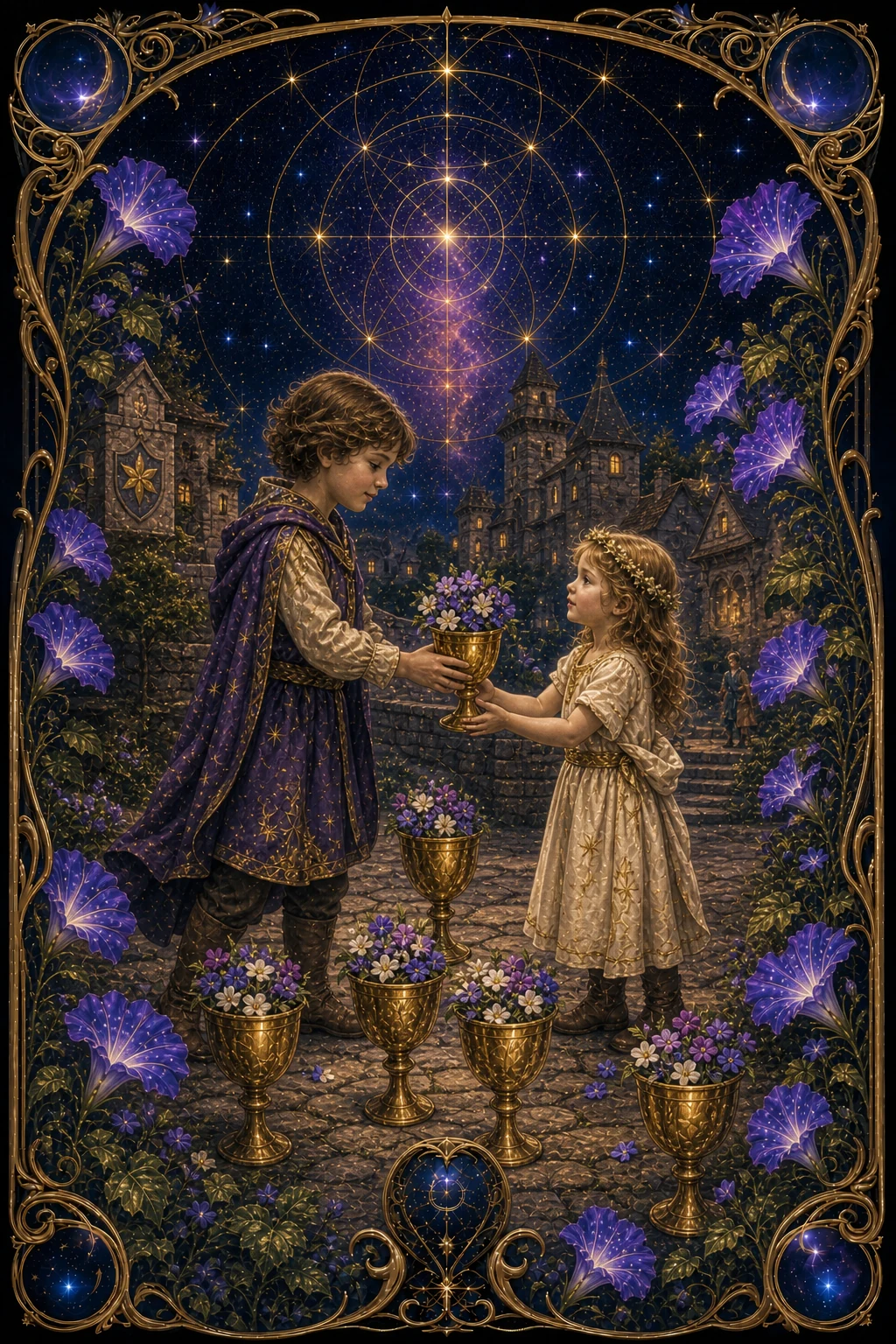
In a walled village courtyard, a small figure offers a cup filled with white flowers to another, and five more flowering cups stand about the yard. An old guard walks away down the path. The Six asks what your memory keeps handing you, and what it leaves out.
Upright Six of Cups
Nostalgia is the word attached to this card, and it is worth remembering that the word was coined as a medical term for homesickness before it softened into something we buy. The picture is soft. Flowers in cups, low sun, a courtyard with walls, a figure walking off duty. What is being depicted is not the past itself but the feeling of the past being handed to you, which is a different substance altogether and considerably better edited. The upright card is generous about this. Memory that warms you is a genuine resource, and people who can reach a good hour from twenty years ago carry something that helps on ordinary Tuesdays. But the card also puts the exchange at the centre: one figure gives, one receives, and the giving is deliberate. That suggests a use for the past rather than a residence in it. You might consider which of your memories you actually visit and which merely play. There is also the question of what the walls are for. Courtyards are pleasant and enclosed, and enclosure is a comfort that becomes a boundary at some point nobody announces.
Reversed Six of Cups
Inverted, the courtyard tightens. The commonest reading is being stuck in the past, which is true enough and too blunt to be useful alone. In practice this reversal usually describes one of two arrangements. The first is a story about an earlier time told so many times that it now has a fixed shape and admits no new information — the golden year, the terrible year, the place where everything was simpler. Stories like that are load-bearing and want examining slowly rather than dismantling. The second is a present measured against a past quietly improved by comparison, so that nothing current is permitted to be enough. Reversal can also point the other way, toward somebody who declines the past entirely and refuses to look back at all. That is generally read as maturity and is sometimes a locked door. There are rooms it costs something to keep locked. What the reversed Six raises, without insisting on it, is the possibility of visiting your own history as an adult, on foot, with the option of leaving. It says nothing about anybody else, and nothing at all about who might appear in your life.
Six of Cups in love and relationships
On the subject of care, the Six is about tenderness carried forward rather than about anyone's arrival or return. That should be said directly: nothing here indicates that a person from your past will reappear, and no card can indicate such a thing. What the picture actually shows is a gesture — something grown, put into a cup, and offered without a stated reason. That is a decent description of how affection tends to be expressed by people who are not fluent in saying it. The reflection available concerns your own earliest dialect of care: what you learned love looked like before you had any say in it, and how much of it you are still using. Some of it will have travelled well. Some was assembled by a child doing their best with the information available, and has been running unexamined ever since.
Six of Cups in work and study
In work, the Six points backward rather than up. It sits with old skills, abandoned subjects and the version of a career you were interested in before the practical considerations arrived. Many people have a discarded competence in a drawer — an instrument, a language, a technical thing they were good at in their twenties — and the Six is a fair prompt to look at it with no obligation whatsoever to monetise it. There is a second, more mundane application: institutional memory. Every workplace runs partly on people who remember why something was built the way it was, and that knowledge is rarely written down anywhere and leaves with whoever leaves. Being the person who remembers is quiet, unpaid and genuinely valuable. So is asking the person who remembers, before the question stops being answerable.
Resources and security
Security, in this card's terms, concerns inheritance in the widest sense — not estates, but habits. Attitudes to spending, saving, generosity and worry are among the most reliably transmitted things in any family, and most people run their adult arrangements on a settings file written before they were ten. As reflection only: consider one financial habit of yours and try to name whose it originally was. The exercise is often uncomfortable and occasionally freeing, since a habit with an author can be discussed, whereas a habit that feels like a personality cannot. None of this is guidance about money, which is a matter for you and for people qualified to advise.
Attention and wellbeing
Considered as a card about energy, the Six notices how restorative familiarity can be. Old music, a walked route from years ago, food cooked the way it was cooked in a house you no longer live in — these work on a person in ways that are hard to argue with and easy to forget to use. The suggestion is small and unfashionable: put one deliberately familiar thing into a difficult week. A caution attaches, and it is mild. Comfort that reliably works can become the only place you go, and the courtyard has walls. Noticing the ratio is enough; the card proposes no correct one.
Yes or no?
Yes
Yes, in the tone of something already known rather than newly decided. Where your question touches the past, let the answer point at your own relationship to it, and at nobody else.
Symbolism in the card
The Six shows a walled courtyard in warm light. A small figure in a hooded red-brown cloak holds out a large cup filled with white five-petalled flowers to a smaller figure standing before them; five further cups, each planted with the same white blooms, are arranged across the flagstones and on a low pedestal. Behind, a halberdier walks away up a path toward a manor house, a detail Waite does not explain and which readers have taken either as the departure of supervision or as the ordinary business of a household continuing. The flowers are usually identified as a stylised lily or cinquefoil; five petals recur throughout Smith's work as a mark of the human and the earthly. Waite's own gloss speaks of flowers of childhood and of looking back into the past, unusually sentimental for him. The Marseille version of this number is, as ever, a display of vessels and foliage without figures. Everything narrative here — the village, the offering, the walking guard — belongs to Smith's staging.
Six of Cups as today's card
As a single card, the Six suits days with a backward tilt: an anniversary, a return to a place, the sort of morning where an old song does more than it should. Its practical suggestion is generosity without occasion. Send the photograph. Tell somebody the thing you remember about them that they would not imagine you had kept. Return the borrowed book. None of this is significant and all of it lands. If the day has instead brought a heavier memory, the card carries no obligation to sit with it; you are allowed to notice a thing and put it down again, which is a skill rather than an evasion.
In a three-card spread
Placed first, this card is nearly redundant and therefore worth reading precisely: not that there was a past, but that a particular part of it remains active in how you arrange things now. In the middle position it describes memory operating in the present, sometimes helpfully and sometimes as a filter over what is actually in front of you. The neighbours usually indicate which. Placed last, do not read it as anyone's return, since a card cannot know that and does not claim to. Ask instead: what from earlier in your life would be worth carrying deliberately into whatever follows, rather than by default?
Keywords
- Nostalgia
- Innocence
- Generosity
- Memories
Journal prompts
- Which story about your own past has stopped taking in new information?
- What did you learn care looked like, and who taught you?
- What could you give away today for no stated reason?
Cards read alongside Six of Cups
- The Moon — Illusion, fear, anxiety, subconscious, intuition.
- Four of Cups — Contemplation, apathy, reevaluation, and an unseen offer.
- Ten of Cups — Emotional fulfillment, family harmony, love, and lasting joy.
- The Hierophant — Spiritual wisdom, religious beliefs, conformity, and tradition.
- All 78 tarot card meanings — the full major and minor arcana in one place.
Combinations with Six of Cups
- Five of Cups and Six of Cups tarot combination
- Six of Cups and Seven of Cups tarot combination
- Four of Cups and Six of Cups tarot combination
- Six of Cups and Eight of Cups tarot combination
- Three of Cups and Six of Cups tarot combination
- Six of Cups and Nine of Cups tarot combination
- All 2,772 minor arcana combinations
Six of Cups by position
- Six of Cups as feelings tarot meaning
- Six of Cups as intentions tarot meaning
- Six of Cups as outcome tarot meaning
- Six of Cups as advice tarot meaning
- Six of Cups as an obstacle tarot meaning
- Six of Cups as action tarot meaning
- Six of Cups as a person tarot meaning
- Six of Cups as how someone sees you tarot meaning
- Six of Cups for a yes or no question tarot meaning
- All card meanings by position
Curious what Six of Cups means for your question? Turn a card on the home page — no account needed.
Draw a card freeOne card, one honest question, most evenings.
Start your free daily readingFree · One card a day · No credit card needed
Go deeper than one card
A personalized deep reading works a full spread around your question — Six of Cups included, if it falls to you. Deep readings run from the $1.99 Single Card Illumination and the $7 Three-Card Path, delivered straight away, to the $19 Five-Card Compass and the $29 Celtic Cross Atlas, composed in depth and delivered within 2–4 hours.
The $7 Three-Card Path, three cards read as one movement → · All reading options →
Prefer a rhythm to a one-off? Sparkle Pro ($8.99/month or $59/year) draws a three-card past, present and future spread for you every day. There is also a free eight-phase moon ritual guide to pair with today's card.
To sit with this card longer, the tarot journaling guide has prompt sets for daily draws, moon phases, and more.
Tarot content is for entertainment and personal reflection, not professional advice.