Ten of Cups Tarot Card Meaning
 Start your free daily reading
Free · One card a day · No credit card needed
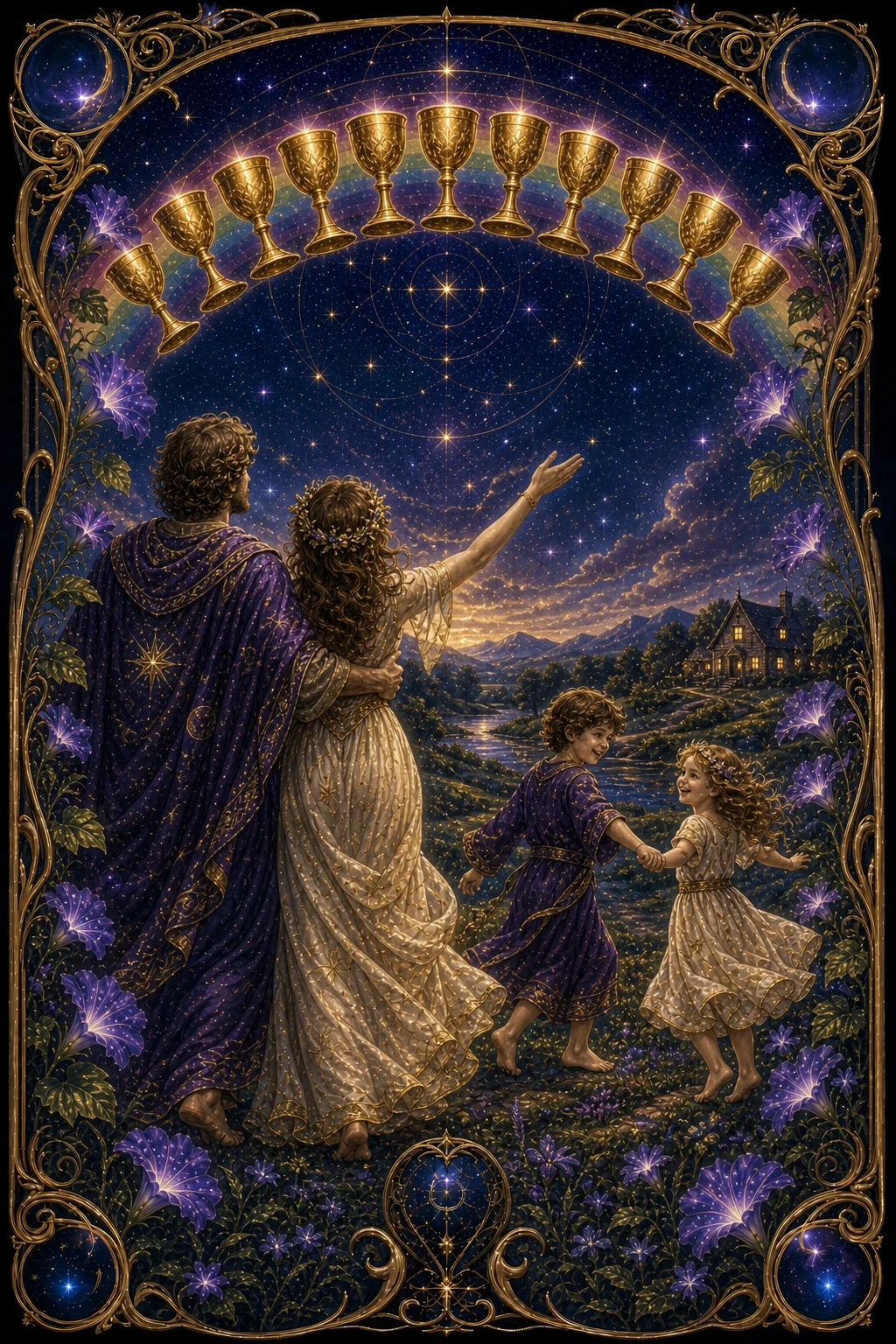
A rainbow made of ten cups arcs across the sky above a green riverbank. Beneath it two adults stand with their arms raised and their backs to us, and two children dance a little apart, not looking up at all. A house sits on the rise beyond. The card asks what your picture of a good life contains, and who drew it.
Upright Ten of Cups
Everyone in this card is posed and everyone is facing away. That is worth registering before anything else, because it tells you what kind of image you are looking at: not a scene of contentment so much as a picture of one, arranged and held. The rainbow overhead is the deck's most cheerful object and also its least durable, being made entirely of weather and light and lasting about as long as such things do. None of which makes the card cynical. It makes it precise. There is a real difference between a life and an image of a life, and most people carry the image around in some detail while the life goes on beneath it looking scruffier. The card promises nothing about anyone's household, and it is not a statement about what anyone's life should contain or acquire. What it does well is prompt an inventory of the picture itself. Where did yours come from, how old is it, and how much of it is genuinely yours as opposed to inherited from a childhood, an advert, or a friend whose circumstances differ from yours in every material respect? Contentment, when it does turn up, is famously undramatic and almost never photographed.
Reversed Ten of Cups
Reversed, the picture and the life come apart, and the tradition offers several ways that happens. The commonest is maintenance: the effort of keeping an appearance intact after it stopped matching what is underneath, which is exhausting in a way that is difficult to describe to anyone who has not done it. There is also the reading where the image itself is the problem, borrowed whole from somewhere else and never once questioned, so that a perfectly good arrangement keeps registering as a disappointment because it fails to resemble a photograph. And there is distance: people occupying the same rooms on separate schedules, each assuming the other is content because nobody has raised it. This card makes no claim about your household, your family or your circumstances, and it cannot. Reversed, its only real use is to ask which version you are currently spending energy on, the picture or the thing, and whether you would recognise the difference if someone pointed at it.
Ten of Cups in love and relationships
For connection of every kind, the Ten sits with the shared picture rather than the shared feeling. Two people can be fond of each other and still be working from different reference images of what a settled life looks like, and the gap tends to appear in small operational disputes about Sundays and holidays and who telephones whose relatives. Naming the picture out loud is unromantic and enormously clarifying. This card says nothing about anyone's status, prospects or household, and it makes no claim about what any life should contain. What it can prompt is a description exercise. If you sketched an ordinary good week in your own life, hour by hour, how much of that sketch depends on anyone else's agreement, and have you ever actually mentioned it to them? The raised arms in the picture are a gesture of salute. Salutes are performed for an audience.
Ten of Cups in work and study
In working life, this card touches the question of what the work is ultimately for. Careers are often built toward a picture rather than a preference, and the picture is usually specific: a certain kind of address, a certain title said at a certain kind of party, a version of yourself your family would find legible. It is worth writing out what a good working week would look like in actual hours rather than in achievements, because the two descriptions frequently disagree. Some people discover their ideal is already substantially in place and unacknowledged. Others find their picture requires a life they would not enjoy living. Neither discovery obliges anyone to do anything. The card is more interested in the accuracy of the image than in any decision you might take about it, and it has no view on what you should choose.
Resources and security
The house on the rise is the most quietly expensive object in the deck. Pictures of a good life tend to have price tags attached, and those tags are often the part that never gets examined because the image is presented as though it came free. Offered as reflection alone, with no financial guidance anywhere in it: which parts of your picture cost money, which cost time, and which cost neither and have simply been postponed? Many people find at least one item on their list is available now and has been for a while. Real decisions about your situation rest with you, and with anyone properly qualified you care to consult.
Attention and wellbeing
The two children in the picture are dancing, badly and without an audience, which is the only unposed thing happening on the card. Read as a remark about attention, with no medical content in it, that is the detail to sit with. Adults tend to retain hobbies and lose play, the distinction being that a hobby has standards and play has none. If you can name something you do purely because it is enjoyable, with no improvement curve attached, that is worth protecting. If you cannot, the card is a reasonable place to notice the absence without dramatising it. Movement helps more than most people credit, and it does not have to be good movement.
Yes or no?
Yes
Yes, with the caution that the card is describing an image rather than an event. It leans warm. Treat it as encouragement to be specific about what you are hoping for, and not as any kind of prediction.
Symbolism in the card
Smith arranges ten golden cups along the curve of a rainbow that spans the upper half of the card, an obvious borrowing from the covenant rainbow of the flood story and its promise of no further ruin. Below, a man and a woman stand with one arm about each other and the other flung upward toward the arc, while two children hold hands and dance to the left, oblivious to the sky. A river runs across the middle distance, trees stand on the bank, and a modest house occupies the rise beyond. The composition deliberately echoes the family group of the Ten of Pentacles while replacing that card's stone archway and heraldry with weather. Older decks give the ten of cups no scene whatsoever, only ten cups in ranks, so the entire tableau is a Rider-Waite-Smith addition of 1909. The figures' raised arms belong to the vocabulary of salute and blessing rather than to ordinary gesture, which is part of why the image reads as staged.
Ten of Cups as today's card
Drawn for a single day, the Ten is less a description of the day than an invitation to look at the frame around it. One practical version: at some point before evening, name three things about your current ordinary life that would have pleased you considerably five years ago. Most people can find them without much digging and are mildly annoyed by how quickly those things became invisible. The card can also arrive on a day that is nothing like a rainbow, which is not a contradiction and not a failure of the card. It has no access to your circumstances. Read on a hard day, the honest use of this image is to look at it briefly and then get on with the day.
In a three-card spread
As a card of the past, the Ten usually indicates a picture you were once given rather than an era you actually lived, and it repays asking who handed it to you. In the middle position it describes the present gap, wide or narrow, between how your life looks in description and how it feels from inside on a Wednesday. The cards on either side tend to show which direction that gap runs. In the last seat it forecasts nothing whatsoever and should not be read as an arrival of anything, particularly anything concerning a household. Held as a question it is more useful: if this situation resolved in the way you privately hope, what would an unremarkable day inside it actually contain?
Keywords
- Fulfillment
- Family
- Harmony
- Joy
Journal prompts
- Describe an ordinary good week in hours rather than achievements. Whose agreement does it need?
- Which parts of your picture of a good life did you choose, and which arrived pre-installed?
- What do you do purely because you enjoy it, with no standard attached?
Cards read alongside Ten of Cups
- Four of Wands — Celebration, harmony, homecoming, and a joyful milestone.
- Six of Cups — Nostalgia, innocence, generosity, and happy memories.
- Ten of Pentacles — Legacy, family wealth, stability, and lasting success.
- The World — Completion, integration, accomplishment, travel.
- All 78 tarot card meanings — the full major and minor arcana in one place.
Combinations with Ten of Cups
- Nine of Cups and Ten of Cups tarot combination
- Ten of Cups and Page of Cups tarot combination
- Eight of Cups and Ten of Cups tarot combination
- Ten of Cups and Knight of Cups tarot combination
- Seven of Cups and Ten of Cups tarot combination
- Ten of Cups and Queen of Cups tarot combination
- All 2,772 minor arcana combinations
Ten of Cups by position
- Ten of Cups as feelings tarot meaning
- Ten of Cups as intentions tarot meaning
- Ten of Cups as outcome tarot meaning
- Ten of Cups as advice tarot meaning
- Ten of Cups as an obstacle tarot meaning
- Ten of Cups as action tarot meaning
- Ten of Cups as a person tarot meaning
- Ten of Cups as how someone sees you tarot meaning
- Ten of Cups for a yes or no question tarot meaning
- All card meanings by position
Curious what Ten of Cups means for your question? Turn a card on the home page — no account needed.
Draw a card freeOne card, one honest question, most evenings.
Start your free daily readingFree · One card a day · No credit card needed
Go deeper than one card
A personalized deep reading works a full spread around your question — Ten of Cups included, if it falls to you. Deep readings run from the $1.99 Single Card Illumination and the $7 Three-Card Path, delivered straight away, to the $19 Five-Card Compass and the $29 Celtic Cross Atlas, composed in depth and delivered within 2–4 hours.
The $7 Three-Card Path, three cards read as one movement → · All reading options →
Prefer a rhythm to a one-off? Sparkle Pro ($8.99/month or $59/year) draws a three-card past, present and future spread for you every day. There is also a free eight-phase moon ritual guide to pair with today's card.
To sit with this card longer, the tarot journaling guide has prompt sets for daily draws, moon phases, and more.
Tarot content is for entertainment and personal reflection, not professional advice.