Four of Pentacles Tarot Card Meaning
 Start your free daily reading
Free · One card a day · No credit card needed
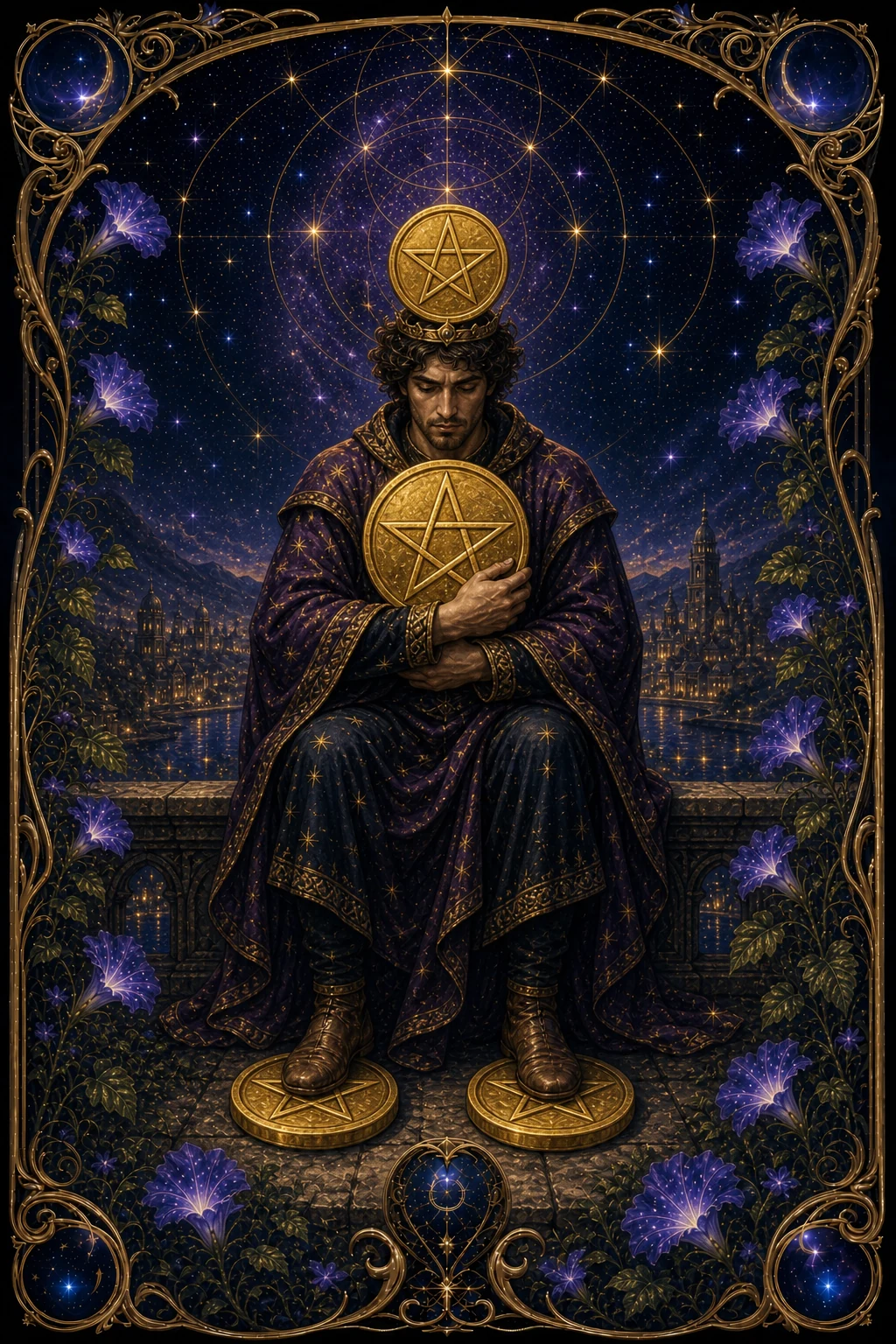
A seated figure in a dark cloak holds one coin against his chest with both arms, balances another on his crown, and rests his feet on two more, with a grey town drawn small behind him. Everything he owns is touching him. The card asks what you are holding, and what the holding makes impossible.
Upright Four of Pentacles
The posture is the argument. This man is not counting or spending; he is in contact with all four coins at once, which requires him to sit exactly where he is sitting. Nothing in the picture says he is wrong. Holding on is what you do when the ground has moved before, and most people who grip learned to grip somewhere, usually early. The card is more interesting when it is read as a description than as a fault. Upright, it concerns the trade between security and mobility, and it is honest that the trade is real in both directions. A tight hold does keep things. It also means both arms are occupied, the crown cannot be taken off, and the feet are not going anywhere. If something you value is currently held firmly — a role, a plan, a version of events, a grievance you have earned — the reflection is not about letting go, which is advice the card does not actually give. It is about knowing the price of the position and whether you still consider it worth paying. The town behind him is drawn small and grey and slightly distant, which is the most eloquent detail in the design. He has his back to it.
Reversed Four of Pentacles
Reversed, the arms open, and the tradition reads that in at least two directions. The generous version describes a loosening: something released, a boundary relaxed, a hold that had become automatic and is now under review. That is often uncomfortable rather than liberating, since a grip maintained for years leaves the hand stiff, and people who unclench frequently describe the first months as exposure rather than freedom. The other version is the opposite failure. Reversed, this card can describe a hold that has gone entirely, and with it any sense of a boundary — the person who cannot say no, whose time and things and attention are permanently available, who has confused generosity with the absence of a door. Both readings share a subject, which is not possessions but limits. Where do you actually end? What is yours to decide and what has become communal by drift rather than agreement? Nothing here forecasts anything about anybody's circumstances, and nothing about it recommends any course of action. Reversed, the Four simply notices that most people set their boundaries once, under old conditions, and rarely reopen the question when the conditions change.
Four of Pentacles in love and relationships
In connections, this card concerns keeping rather than loving. There is a particular way of holding a person that comes from fear of the alternative, and it usually presents as concern rather than as gripping, which is what makes it hard to see from inside. The card is not accusing anyone. It notes that a hold tight enough to guarantee someone's presence tends to make their presence less interesting to both parties. The reverse reflection is just as useful. Some people hold nothing at all, ask for nothing, and call that freedom when it is closer to insurance against disappointment. Neither pattern is a character flaw; both are strategies learned somewhere reasonable. If a connection in your life feels stuck in place, the honest question this card offers is what each of you is protecting, and whether it is still the thing you think it is. Where a situation is genuinely difficult, the right company for it is people you trust and proper support, rather than a deck of pictures.
Four of Pentacles in work and study
In working life, the Four often describes the position defended. A role held past its interest, a specialism guarded, information kept close because holding it is what makes you necessary. All of that is rational behaviour in an insecure environment and the card does not sneer at it. What it raises is cost. Knowledge kept in one head has to stay in that head, which means the head cannot go on holiday, be promoted, or think about anything new. There is a related reflection about the seat itself. The figure is seated on a stool that is barely visible under him, which is to say his position is defined entirely by what he is holding. If your working identity has narrowed to the things you refuse to hand over, that is worth noticing without any obligation to do something about it today. No recommendation about any decision is intended here; the card only describes a posture and lets you decide what it resembles.
Resources and security
This is the card most often used to lecture people about money, which is precisely what it should not be used for. Prudence and grasping look identical on paper and differ entirely in the feeling underneath, and only the person concerned can tell which is operating. As reflection alone, with no guidance offered about anyone's affairs: consider what you would still hold onto if you knew for certain you were safe. That question tends to separate the things kept because they matter from the things kept because keeping is what you do. Whatever the answer, the card makes no claim about your circumstances and no suggestion about any decision, all of which remain entirely yours.
Attention and wellbeing
The image is a study in held tension. Both arms crossed, shoulders up, everything in contact and nothing at rest, which is a posture most people recognise from about four in the afternoon. As a reflection on attention, the Four suggests looking at where you physically hold on during an ordinary day — jaw, hands, the shoulders that live somewhere near the ears — not to diagnose anything, since a card cannot, but because tension is one of the few honest reporters available. Vigilance is expensive to run continuously. Putting something down for an hour is not the same as putting it down, and the hour is often available.
Yes or no?
No
No, leaning toward the option that keeps things as they are. That is not always the wrong answer, but the card asks you to notice whether you chose it or defaulted to it. It forecasts nothing.
Symbolism in the card
Smith draws a crowned figure seated on a plain grey stool at the edge of the card, dressed in a dark red robe with a black cloak, and positions the four pentacles with unusual deliberateness: one clamped to the chest, one balanced flat on the crown of the head, and two beneath the feet. Some occult readers have mapped these to a vertical arrangement of the body — head, heart and the ground beneath — with the coins blocking each point, an interpretation more elegant than anything Waite wrote down. His own note is unsentimental and calls the figure a person who has and holds. Behind and to the left, a small grey town rises with towers and rooftops, close enough to walk to and firmly outside the figure's attention. The number four in this deck generally means structure and stasis, as it does in the Emperor, and the coin suit's medieval associations with merchants gave this card its long-standing reputation for miserliness. The picture itself is more ambiguous than the reputation, since it shows only a man sitting very still with everything he owns in reach.
Four of Pentacles as today's card
As the day's card, this one usually points to something you are gripping without having decided to. It might be a plan for the afternoon that no longer suits the afternoon, or a position taken in an argument that you would now soften if there were a dignified way. A modest use of the day is to hand over one small thing — a task, a piece of information, the last word — and observe what actually happens, which in most cases is nothing. That is useful data. The card also carries permission to keep what you are keeping, provided you can say why, and today is a fine day to try saying it.
In a three-card spread
Behind you, it often refers to a season in which holding on was the sensible response to real conditions, and the habit outlasted them by a considerable margin. It helps to date it. Where the present is read, it describes a current grip, and the neighbouring cards usually reveal whether that is prudence or reflex, since the picture alone will not say. Set ahead of you, it makes a poor prediction and a good question. If nothing in this situation changed, what would you still be holding a year from now, and would you be pleased to find it there or merely unsurprised?
Keywords
- Security
- Control
- Conservation
- Possession
Journal prompts
- What would you still hold onto if you knew you were safe?
- Which of your boundaries were set under conditions that no longer apply?
- What are both of your arms currently occupied with, and what can you therefore not pick up?
Cards read alongside Four of Pentacles
- The Emperor — Authority, establishment, structure, and a father figure.
- Nine of Pentacles — Abundance, independence, refinement, and earned comfort.
- Five of Pentacles — Hardship, isolation, worry, and help within reach.
- The Devil — Shadow self, attachment, addiction, restriction, sexuality.
- All 78 tarot card meanings — the full major and minor arcana in one place.
Combinations with Four of Pentacles
- Three of Pentacles and Four of Pentacles tarot combination
- Four of Pentacles and Five of Pentacles tarot combination
- Two of Pentacles and Four of Pentacles tarot combination
- Four of Pentacles and Six of Pentacles tarot combination
- Ace of Pentacles and Four of Pentacles tarot combination
- Four of Pentacles and Seven of Pentacles tarot combination
- All 2,772 minor arcana combinations
Four of Pentacles by position
- Four of Pentacles as feelings tarot meaning
- Four of Pentacles as intentions tarot meaning
- Four of Pentacles as outcome tarot meaning
- Four of Pentacles as advice tarot meaning
- Four of Pentacles as an obstacle tarot meaning
- Four of Pentacles as action tarot meaning
- Four of Pentacles as a person tarot meaning
- Four of Pentacles as how someone sees you tarot meaning
- Four of Pentacles for a yes or no question tarot meaning
- All card meanings by position
Curious what Four of Pentacles means for your question? Turn a card on the home page — no account needed.
Draw a card freeOne card, one honest question, most evenings.
Start your free daily readingFree · One card a day · No credit card needed
Go deeper than one card
A personalized deep reading works a full spread around your question — Four of Pentacles included, if it falls to you. Deep readings run from the $1.99 Single Card Illumination and the $7 Three-Card Path, delivered straight away, to the $19 Five-Card Compass and the $29 Celtic Cross Atlas, composed in depth and delivered within 2–4 hours.
The $7 Three-Card Path, three cards read as one movement → · All reading options →
Prefer a rhythm to a one-off? Sparkle Pro ($8.99/month or $59/year) draws a three-card past, present and future spread for you every day. There is also a free eight-phase moon ritual guide to pair with today's card.
To sit with this card longer, the tarot journaling guide has prompt sets for daily draws, moon phases, and more.
Tarot content is for entertainment and personal reflection, not professional advice.