Seven of Cups Tarot Card Meaning
 Start your free daily reading
Free · One card a day · No credit card needed
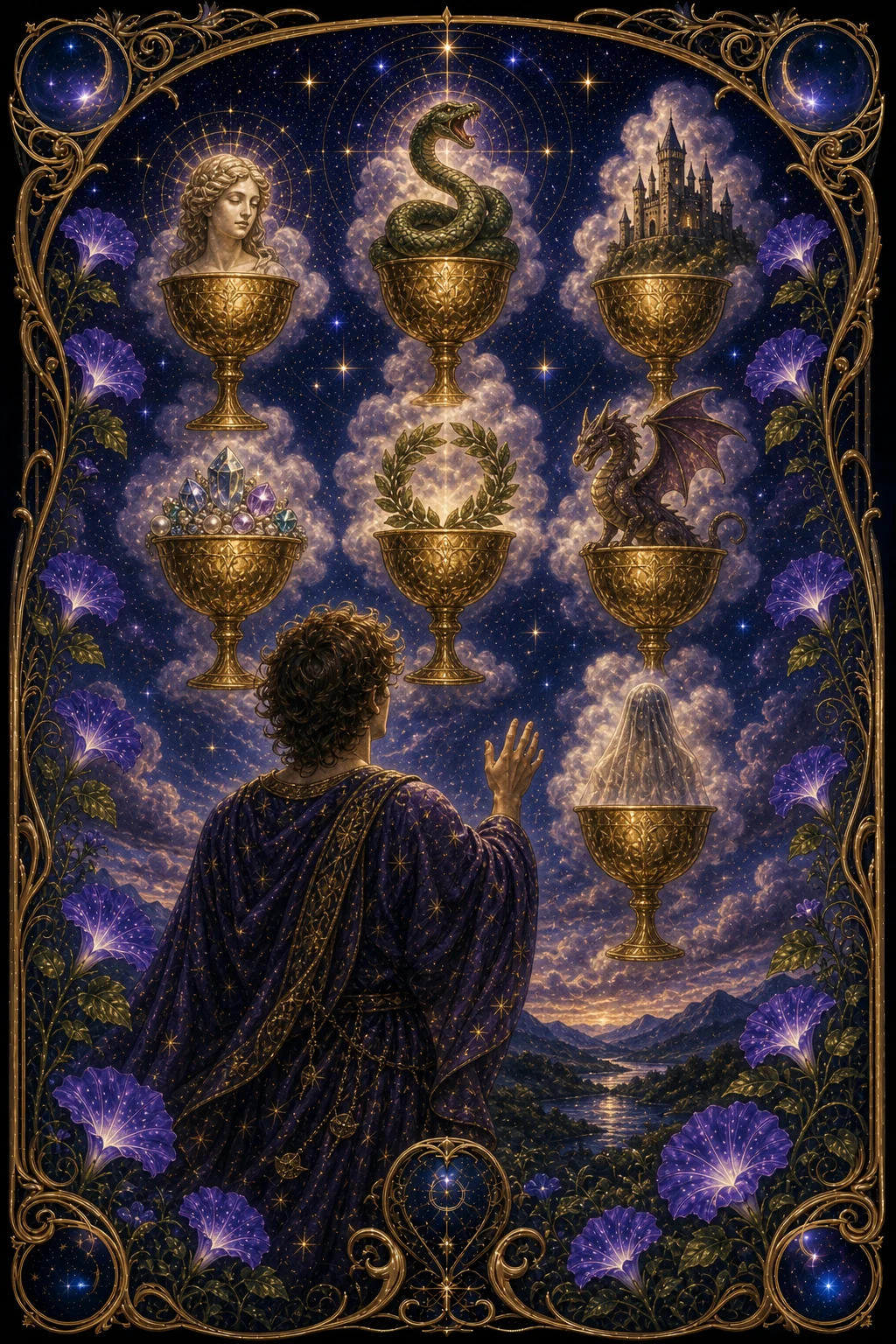
A dark figure stands with raised hands before seven cups floating in cloud, each holding something: a face, a shrouded shape, a snake, a castle, jewels, a wreath, a dragon. Nothing has any weight yet. The Seven asks how you tell a wish from an intention.
Upright Seven of Cups
Sevens complicate their suits, and here the complication is choice without ground. The cups hang in the air. Nothing among them carries a price, a timetable, or any of the friction that arrives the moment a possibility becomes a plan, and that weightlessness is precisely what makes the array so pleasant to stand in front of. Most people keep a version of this cloud, visited at particular hours, usually late. The card is not contemptuous of it. Imagination is where anything begins, and the ability to picture a life other than the one currently running is a genuine faculty rather than a weakness. What the Seven puts pressure on is duration. Standing before the cups is enjoyable in a way that choosing one is not, since choosing collapses six pleasures into a single piece of work. A further point concerns what the figure can actually see. The shapes in the vessels are borrowed from wish and from fear in roughly equal measure, and the tradition has always noted that they are shown as visions rather than objects. Held in the hand for a while, the card raises a question about which of your options have been examined in daylight, and which exist mainly at eleven at night.
Reversed Seven of Cups
Reversed, the cloud usually thins. The standard reading is clarity — the moment the array resolves and one thing becomes obviously more real than the rest — and the sensation, when it comes, is less triumphant than advertised. It mostly feels like a narrowing, sometimes accompanied by a small grief for the options being set down. That grief is legitimate and rarely mentioned. Choosing anything is a loss of everything else, which is why so many capable people become mysteriously slow at the final step. A second reading runs the other way. The inverted Seven can describe a decision made too fast in order to escape the discomfort of holding several open, which produces the appearance of decisiveness and the substance of a flinch. Telling the two apart takes an honest half hour and repays it. A third possibility concerns the shrouded cup, the one whose contents are hidden. Reversal sometimes lifts that cloth, and what lies underneath is frequently something you already suspected about what you actually want. That is uncomfortable rather than dangerous. The card offers no verdict on any option and could not hold one.
Seven of Cups in love and relationships
Where love is concerned, the Seven is about the picture in your head, which is a real thing and not the same as a person. Everyone runs some version of a template — assembled out of families, out of books, out of an old relationship that set the standard in ways never consciously agreed — and it does its work quietly, in the background of every actual encounter. The Seven simply makes the templates visible for a moment. A useful reflection is to notice which of the seven cups your imagination tends to fill: security, rescue, admiration, a particular aesthetic, the settling of an old score. None of these is disreputable. They become expensive only when they go unexamined and the actual people in your life are asked to be seven things at once. The card describes nobody's circumstances and predicts nothing about them.
Seven of Cups in work and study
Professionally, the Seven is the many-tabbed browser of the deck. Retraining, the side project, the move abroad, the business you describe convincingly to friends and have never costed — these can coexist indefinitely, and while they do, not one of them requires anything of you. That is the arrangement's entire appeal, and it is a comfortable thing to mistake for ambition. The Seven suggests a small and deflating exercise: take one option and find out the first actual step. Not the plan, the step. Frequently the step is dull enough to dissolve the fantasy, which is useful information delivered cheaply. Occasionally it turns out to be straightforward and has been available for months. The card takes no position on which of your options is worth anything; it notes only that a possibility examined is a different object from a possibility enjoyed.
Resources and security
As a card touching security, the Seven concerns the difference between a hope and an arrangement. Jewels appear in one of the vessels, and they are drawn as a vision rather than as anything held. Read as reflection only: most people carry at least one imagined future that quietly excuses the present from being organised, and the imagining does no harm until it starts doing the work of a plan. Noticing which of yours is which requires nothing more than saying them out loud in a room. Nothing on this page is financial advice or a nudge toward any decision; that territory is yours, and properly qualified people are the ones to discuss it with.
Attention and wellbeing
On the subject of attention, the Seven describes the specific tiredness of unmade decisions. Options held open are not free; they run continuously in the background and draw on the same supply as everything else, which is why a week of deciding nothing can deplete you as thoroughly as a week of work. The Seven's suggestion is not to decide faster. It is to notice how many things you are currently keeping in the air, and to consider whether any of them could simply be set down without being resolved. Closing an option is restful in a way that people who pride themselves on keeping possibilities open rarely discover until they try it.
Yes or no?
It depends
It depends. The Seven takes more interest in your question than in your answer. Seven possibilities sit on the table; consider whether the one you asked about is the one you actually want.
Symbolism in the card
A dark silhouetted figure, seen from behind, raises both arms before seven golden cups hovering in a bank of cloud. Each holds an apparition: a human head, a veiled and shrouded shape outlined in white, a coiled serpent, a small castle on a crag, a heap of jewels, a laurel wreath, and a dragon or wyvern. Waite's text names them chalices of fantasy, and the arrangement follows the deck's habit of showing an inner state as an external scene. The individual images have accumulated readings over a century — the wreath as achievement, the jewels as wealth, the serpent as wisdom or as temptation depending entirely on the reader's inheritance, the castle as a settled life — but the structure matters more than any single one: seven visions, one viewer, no ground. The shrouded shape is the exception, usually taken to mark the thing that cannot yet be looked at directly. A skull appears on the wreath's cup in some printings, either an intentional shadow across the trophy or an artefact of engraving, and the argument continues.
Seven of Cups as today's card
Alone, the Seven usually describes a day spent slightly above ground level. It suits mornings that begin with plans and end with tabs. The practical version is one question applied once: of everything currently occupying your imagination, which single thing could be made three per cent more real today? Send the enquiry, price the thing, ask somebody who has done it. This is a card that rewards deflation. If the day instead demands nothing but attention to what sits directly in front of you, the Seven has still done its work by pointing out how often the mind was elsewhere.
In a three-card spread
In the first position, the Seven often marks a period of many possibilities, and what matters is which one was actually taken and whether the others were ever real. Hindsight tends to flatter the abandoned ones. In the middle, it describes a live cloud of options and a decision not yet made; neighbouring cards frequently indicate which cup carries the weight. In the final position, keep it as a question and nothing more, because no shuffled deck knows anything about outcomes. A workable form: if this situation kept offering you choices, how would you tell which of them was solid, and whom would you ask?
Keywords
- Choices
- Imagination
- Illusion
- Fantasy
Journal prompts
- Which option have you only ever examined after eleven at night?
- What are you keeping open, and what does keeping it open cost each week?
- If one of your imagined futures got a first actual step today, which would you pick?
Cards read alongside Seven of Cups
- The Moon — Illusion, fear, anxiety, subconscious, intuition.
- The Magician — Manifestation, resourcefulness, power, and inspired action.
- Two of Swords — A difficult choice, stalemate, avoidance, and inner balance.
- Four of Cups — Contemplation, apathy, reevaluation, and an unseen offer.
- All 78 tarot card meanings — the full major and minor arcana in one place.
Combinations with Seven of Cups
- Six of Cups and Seven of Cups tarot combination
- Seven of Cups and Eight of Cups tarot combination
- Five of Cups and Seven of Cups tarot combination
- Seven of Cups and Nine of Cups tarot combination
- Four of Cups and Seven of Cups tarot combination
- Seven of Cups and Ten of Cups tarot combination
- All 2,772 minor arcana combinations
Seven of Cups by position
- Seven of Cups as feelings tarot meaning
- Seven of Cups as intentions tarot meaning
- Seven of Cups as outcome tarot meaning
- Seven of Cups as advice tarot meaning
- Seven of Cups as an obstacle tarot meaning
- Seven of Cups as action tarot meaning
- Seven of Cups as a person tarot meaning
- Seven of Cups as how someone sees you tarot meaning
- Seven of Cups for a yes or no question tarot meaning
- All card meanings by position
Curious what Seven of Cups means for your question? Turn a card on the home page — no account needed.
Draw a card freeOne card, one honest question, most evenings.
Start your free daily readingFree · One card a day · No credit card needed
Go deeper than one card
A personalized deep reading works a full spread around your question — Seven of Cups included, if it falls to you. Deep readings run from the $1.99 Single Card Illumination and the $7 Three-Card Path, delivered straight away, to the $19 Five-Card Compass and the $29 Celtic Cross Atlas, composed in depth and delivered within 2–4 hours.
The $7 Three-Card Path, three cards read as one movement → · All reading options →
Prefer a rhythm to a one-off? Sparkle Pro ($8.99/month or $59/year) draws a three-card past, present and future spread for you every day. There is also a free eight-phase moon ritual guide to pair with today's card.
To sit with this card longer, the tarot journaling guide has prompt sets for daily draws, moon phases, and more.
Tarot content is for entertainment and personal reflection, not professional advice.