Eight of Swords Tarot Card Meaning
 Start your free daily reading
Free · One card a day · No credit card needed
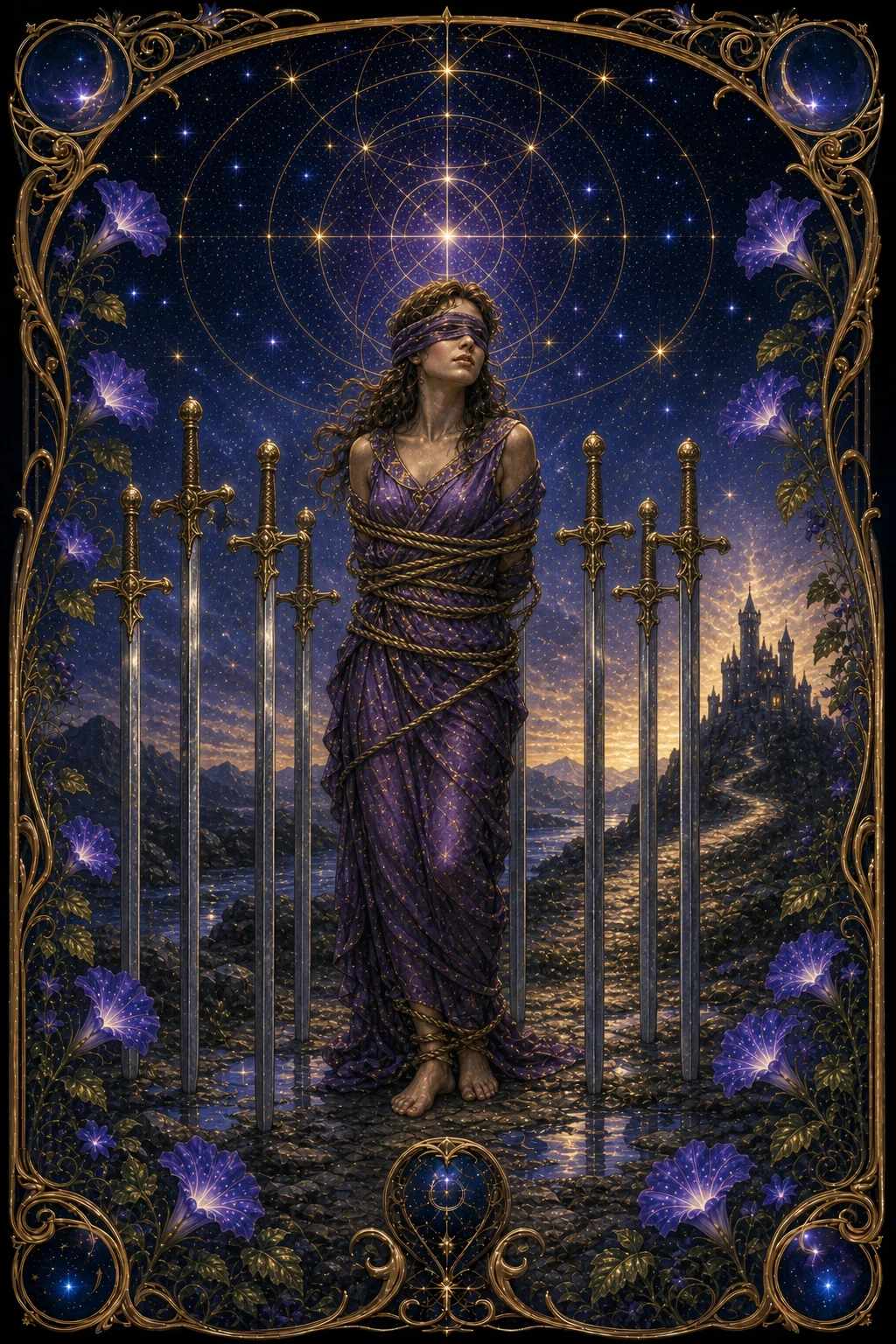
A woman stands in a marsh, bound in loose linen and blindfolded, with eight swords planted upright in the ground around her. Her feet are free and the ground in front of her is open. The card asks which of your limits you have tested lately, and which you have taken on trust.
Upright Eight of Swords
Look at where the swords actually are. They are stuck in the mud in a rough line behind and beside her, and there is a gap in that line wide enough to walk through. Nobody in the picture is holding a weapon, and no gaoler appears anywhere on the card. This is why the tradition reads the Eight as a bind that is partly maintained from the inside: the fence is old, and at some point it stopped needing anyone to build it. That reading is useful, and it is also the one most easily misused, so it is worth handling carefully. Some limits are genuinely external. Money, illness, immigration status, a caring responsibility, another person's behaviour — none of these is solved by a change of attitude, and any card that suggests otherwise is being rude about your circumstances. If your constraint is of that kind, what this card honestly says is not that you imagined it. It is that you deserve better company than a deck of cards while you deal with it. Where the Eight earns its keep is on the smaller, quieter limits: the rules you follow without remembering who set them. Those are worth testing, one at a time, in daylight.
Reversed Eight of Swords
Turned over, the first thing to go is usually the blindfold. Reversal has an unhelpful reputation for meaning that everything has resolved itself, and anyone who has actually left a constricted situation knows the sequence is less tidy than that. Seeing the gap and walking through it are separated by a stretch of time that nobody puts in the story afterwards. That stretch is often where the card sits: you know the shape of the thing, you have said it aloud once, and you are still standing in the mud, because knowing costs nothing and moving costs something. There is a second reading running the other way, where the binding pulls closer instead. That version tends to show up as a narrowing vocabulary — the number of options you can even name shrinking, until a situation with four doors gets described as a situation with none. Counting the doors aloud is a plain thing to do and often useful, and it does not oblige you to open any of them. Reversed, the card works better as an inventory of what is actually holding you than as a verdict on whether you should have got out by now.
Eight of Swords in love and relationships
In connection, the Eight tends to point at rules rather than at people. Most long attachments accumulate a private constitution: subjects that go unmentioned, a particular tone reserved for certain topics, a division of labour nobody remembers agreeing to. Some of those rules protect something real. Others were drafted during a bad month years ago and were never repealed. It can be worth asking which of the things you cannot say in a relationship are truly unsayable, and which have merely gone unsaid for so long that the silence now feels structural. The card also raises the question of who is doing the binding, and the answer is frequently nobody at all, which is stranger and harder than having someone to blame. If what constrains you is another person's control, that is not something to work out alone; trusted people and proper support are the right place for it, and a card is not.
Eight of Swords in work and study
For work and study, this card sits with the sentence that begins 'I can't, because'. Finish that sentence a few times and the endings sort themselves into two piles. One pile contains facts — a visa, a contract, a mortgage, a child's school year. The other contains predictions you once made about how people would react, which have been treated as facts ever since because nobody has checked them. The second pile is where the Eight does its work. It is remarkable how many working limits turn out to be a conversation that has never been had: a question not put to a manager, a rate never named, a course never enquired about because the answer was assumed. None of this is a recommendation to leap. The card is more modest than that. It suggests finding out one real thing about one assumed limit, which is a smaller act than deciding, and usually more informative.
Resources and security
Where this card touches security, it sits on the difference between having few options and believing you have none. Constraint is real, and being short is not a state of mind. But there is a particular fog that settles over money when it stops being looked at directly — the account not opened, the figure never added up, the letter left on the shelf. The blindfold in the picture is not a symbol of poverty; it is a symbol of not looking. As reflection only: consider whether there is one number in your life you have been careful not to know exactly. Nothing above is a claim about your situation, and any real decision there is yours, ideally with someone properly qualified beside you.
Attention and wellbeing
As a reflection on attention, this card notices how much energy a bind consumes even when nothing is happening. Holding still takes effort, and so does the low background work of managing a situation you have decided cannot change. You might look for the places in your week where you are braced rather than busy. The figure's feet are unbound, and the plainest thing the picture suggests is movement of the ordinary kind — a walk, a change of room, a different route home — not as a solution to anything, but because a body that has not moved tends to narrate the world as smaller than it is.
Yes or no?
It depends
It depends, and the dependency is the point. This card asks what in your question is genuinely fixed and what has only been assumed. Settle that first, and the yes or no often stops mattering.
Symbolism in the card
Smith places the figure in a grey marsh, wrapped in red cloth that binds the arms but leaves the legs and feet uncovered, with a white blindfold across the eyes. Eight swords stand point-down in the mud, arranged behind and to one side of her rather than encircling her, and the gap in front is one of the most discussed pieces of negative space in the deck. Shallow water pools around her feet. On the hill above sits a castle, drawn small and grey, and readers have argued for a century over whether it is where she came from or where she is not permitted to go. The suit of Swords belongs to air and to the mind in most modern systems, an association inherited from the Golden Dawn rather than from anything medieval. Older decks give this card no figure at all: the Marseille pattern shows eight curved blades in an interlaced design and leaves the rest to the reader. The bound woman is a twentieth-century invention, and so is the loose knot she is tied with.
Eight of Swords as today's card
Pulled as the card of the day, the Eight works best as a single small experiment. Choose one thing you have described as impossible this week and check one fact about it — the opening hours, the price, whether the person is genuinely unavailable. The point is not to change anything today. It is to find out whether the limit you have been carrying is the current version or an old one. If the day itself is truly hemmed in, and some days are, the card does not require you to fight it. Noticing the difference between a day you cannot change and a day you have not looked at is enough.
In a three-card spread
In the past position, this card often marks a period you have since described as having no options, which may deserve a second look — not to criticise your younger self, who was working with the light available, but to see what was actually on the table. In the present, it names the experience of narrowness rather than proving it; whichever cards sit beside it usually suggest whether the walls are outside or inside. As a future position, keep it firmly as a question. If nothing about the constraint changed, which part of it would you want to have tested by then, and what has stopped you so far?
Keywords
- Restriction
- Doubt
- Perspective
- Freedom
Journal prompts
- Which of your current limits have you actually tested, and when?
- Finish the sentence 'I can't, because' three times. Which of the endings are facts?
- Who set the rule you are following most carefully at the moment?
Cards read alongside Eight of Swords
- Two of Swords — A difficult choice, stalemate, avoidance, and inner balance.
- The Devil — Shadow self, attachment, addiction, restriction, sexuality.
- Six of Swords — Transition, moving forward, release, and calmer waters.
- Seven of Swords — Strategy, secrecy, independence, and acting carefully.
- All 78 tarot card meanings — the full major and minor arcana in one place.
Combinations with Eight of Swords
- Seven of Swords and Eight of Swords tarot combination
- Eight of Swords and Nine of Swords tarot combination
- Six of Swords and Eight of Swords tarot combination
- Eight of Swords and Ten of Swords tarot combination
- Five of Swords and Eight of Swords tarot combination
- Eight of Swords and Page of Swords tarot combination
- All 2,772 minor arcana combinations
Eight of Swords by position
- Eight of Swords as feelings tarot meaning
- Eight of Swords as intentions tarot meaning
- Eight of Swords as outcome tarot meaning
- Eight of Swords as advice tarot meaning
- Eight of Swords as an obstacle tarot meaning
- Eight of Swords as action tarot meaning
- Eight of Swords as a person tarot meaning
- Eight of Swords as how someone sees you tarot meaning
- Eight of Swords for a yes or no question tarot meaning
- All card meanings by position
Curious what Eight of Swords means for your question? Turn a card on the home page — no account needed.
Draw a card freeOne card, one honest question, most evenings.
Start your free daily readingFree · One card a day · No credit card needed
Go deeper than one card
A personalized deep reading works a full spread around your question — Eight of Swords included, if it falls to you. Deep readings run from the $1.99 Single Card Illumination and the $7 Three-Card Path, delivered straight away, to the $19 Five-Card Compass and the $29 Celtic Cross Atlas, composed in depth and delivered within 2–4 hours.
The $7 Three-Card Path, three cards read as one movement → · All reading options →
Prefer a rhythm to a one-off? Sparkle Pro ($8.99/month or $59/year) draws a three-card past, present and future spread for you every day. There is also a free eight-phase moon ritual guide to pair with today's card.
To sit with this card longer, the tarot journaling guide has prompt sets for daily draws, moon phases, and more.
Tarot content is for entertainment and personal reflection, not professional advice.