Ten of Pentacles Tarot Card Meaning
 Start your free daily reading
Free · One card a day · No credit card needed
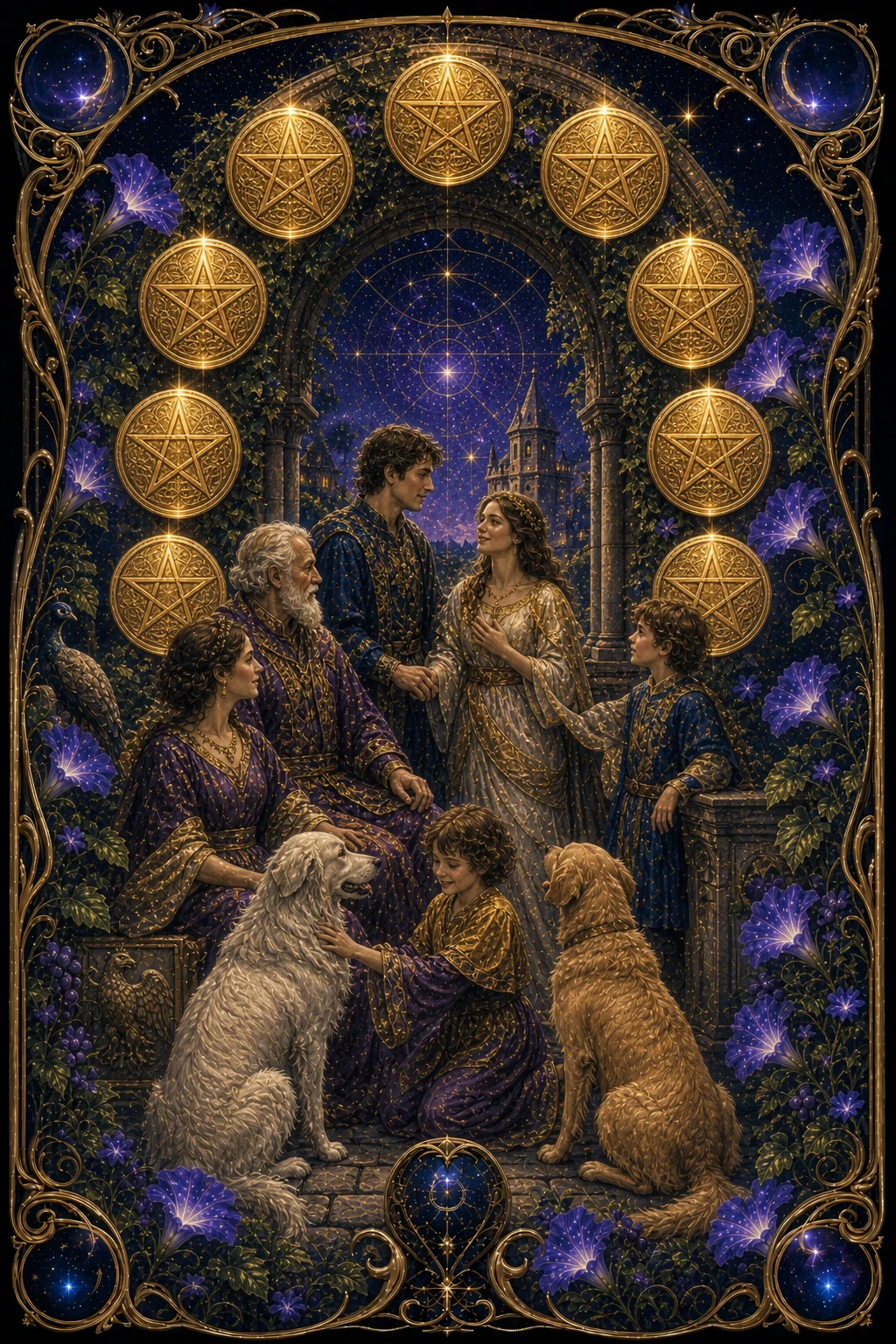
At the right-hand edge of a busy courtyard, an old man in a patterned robe rests both hands on two white dogs while a couple talk under a stone archway and a child reaches out. Ten coins hang across the scene in the Tree of Life pattern, and nobody is looking at anybody else. The card asks what was passed down to you that nobody ever named as an inheritance.
Upright Ten of Pentacles
Upright, the Ten is usually called the card of legacy, and the interesting part is how little of a legacy is ever written down. What actually travels between generations is smaller and stranger than any estate: the way your family says goodbye on the phone, which foods count as a proper meal, the particular register everyone drops into at the table, a grudge held so long that nobody living can source it. You inherited a great deal before anyone consulted you. Sitting with the card, the reflection is about continuity rather than acquisition. Something is being handed on in your direction and something is being handed on through you, and both stay invisible until you meet someone raised differently and discover that your normal was local. There is warmth in the picture and also a mild loneliness. The old man is at the edge, the couple are mid-conversation, the child has hold of a dog. It is a family in the same courtyard rather than a family in the same moment, which is a fair description of most of them. The card promises nobody anything. It asks what you are continuing, and whether you have ever chosen it.
Reversed Ten of Pentacles
Reversed, the archway stops being a shelter and becomes a shape you have to fit through. Traditional readings speak of family tension, of contested arrangements, of a house whose rules were set long ago by people no longer present to explain them. There is also the plainer version: distance. Not every lineage is a place you can go back to, and the card reversed makes room for anyone whose inheritance was mostly instruction on what not to repeat. Something worth holding here is that breaking a pattern is itself a form of continuity, and a laborious one. It requires knowing the pattern well enough to catch yourself producing it, usually at speed, usually in the exact tone of voice you swore you would never use. Reversed, the card can also describe the strain of holding a group together — the person who maintains the calendar, the calls, the sense that everyone is still in touch. That role is rarely assigned out loud and rarely rotated. None of this describes anybody's actual family. It is a place to look at what has been handed to you and to sort it slowly into what you are keeping and what you are not.
Ten of Pentacles in love and relationships
In connection, the Ten is less about romance than about the long shared middle: households, chosen families, groups of friends who have known each other through several versions of themselves. What it points to is the accumulation of small joint customs — the shorthand, the standing arrangement, the annual thing nobody enjoys and everybody attends. These are what make a group feel like a place rather than a set of people, and they are built by repetition rather than by decision. You can, however, be deliberate about it. Every household runs on inherited defaults from at least two other households, most of them unexamined. It is worth asking which of your shared customs you actually chose together, and which one of you simply imported without noticing while the other agreed out of politeness.
Ten of Pentacles in work and study
For work and study, the Ten touches the question of what outlasts you in a place. Every organisation runs on habits older than its current staff, most of them undocumented, some sensible and some the residue of a decision made in 1997 by somebody who has since left. The card sits with anyone who has been somewhere long enough to have become part of the furniture. The reflection here concerns transmission. What do you know that only you know, and have you ever told anyone? The unglamorous parts of institutional memory — who to ask, why the process is like that, what has already been tried — are precisely what nobody writes down. A different question sits underneath: whether you want to be a permanent fixture at all. Continuity is a real pleasure for some people and a slow closing of doors for others. The card describes the condition without recommending it.
Resources and security
This is the most easily misread card in its suit when the subject turns to security. Ten coins across the picture invite a fantasy of wealth arriving from somewhere, and that reading has nothing whatsoever to hold it up. What the image shows is a household partway through an ordinary day, its stability spread among several generations rather than sitting in anybody's hand. As reflection, the honest question is what security has meant in your family — what people worried about, what they never discussed, what they treated as a sign of having made it. Those attitudes are inherited far more reliably than anything else. No part of this describes anybody's real position, and nothing in it should stand in for advice from a qualified person.
Attention and wellbeing
As a reflection on habit, the Ten notices how much of a daily routine is borrowed. How you sleep, what counts as a proper rest, whether sitting down in the afternoon feels allowed — these were generally settled by watching adults long before you had opinions about any of it. Some of those defaults still serve you and some belong to a household with entirely different conditions. It is worth picking one small habit and tracing it back to whoever you learned it from, with no obligation to change anything. The dogs in the picture are the most relaxed figures in the scene, wholly uninterested in the archway and its arrangements, and they are not the worst model available for an afternoon.
Yes or no?
Yes
Yes, in the register of things that hold rather than things that happen. The card leans toward whatever can be sustained by more than one person. If your question was really about permanence, that is the part worth sitting with.
Symbolism in the card
Smith crowds this card more than almost any other. An elderly man in a robe patterned with grapes and crescents sits at the right-hand edge, two white hounds under his hands, while a young couple stand talking beneath a stone archway and a child reaches toward one of the dogs. Above and across them the ten coins are arranged in the shape of the Kabbalistic Tree of Life, the only card in its suit where the pips are laid out as a diagram rather than a scene. The archway carries a coat of arms and a scale, and beyond it a market street is visible, which places the household inside a town rather than apart from one. The old man is inside the picture and outside the group — a compositional choice readers have argued over for a century, taken variously as the ancestor, the observer, or the man who built the arch and is no longer consulted about it. Earlier Italian coin decks gave this number no figures at all. The family, the dogs and the Tree are Smith's, and the card's reputation for legacy rests almost entirely on her staging.
Ten of Pentacles as today's card
Drawn on its own for the day, the Ten usually points outward, to the people you are connected to rather than to anything you are trying to achieve. A call to an older relative. A question you have never actually asked anyone in your family, of the kind that only gets asked when somebody decides to. It also works domestically: the card has a soft spot for the ordinary maintenance of a shared space, and a day spent making a household slightly more habitable is well within its range. If your relationship to family is complicated, the card is not an instruction. Chosen households count, and so does deciding that today is not the day.
In a three-card spread
In the past position, the Ten tends to describe the conditions you grew up inside rather than any particular event — the assumptions of the household, which are always easier to see in other people's families than in your own. In the present, it points to something being maintained collectively, and to your part in that maintenance, which the surrounding cards usually characterise more precisely than this one does. In the future position, keep it firmly hypothetical. Nothing forecasts anything here. Ask instead what you would want to still be true in this situation in ten years, and who else would have to be involved for it to hold.
Keywords
- Legacy
- Family
- Stability
- Success
Journal prompts
- What did you inherit that nobody ever described as an inheritance?
- Which family habit have you kept on purpose, and which one keeps arriving without permission?
- What do you know that only you know, and who would want to be told?
Cards read alongside Ten of Pentacles
- Four of Wands — Celebration, harmony, homecoming, and a joyful milestone.
- Six of Cups — Nostalgia, innocence, generosity, and happy memories.
- King of Pentacles — Prosperity, security, discipline, and material mastery.
- The Hierophant — Spiritual wisdom, religious beliefs, conformity, and tradition.
- All 78 tarot card meanings — the full major and minor arcana in one place.
Combinations with Ten of Pentacles
- Nine of Pentacles and Ten of Pentacles tarot combination
- Ten of Pentacles and Page of Pentacles tarot combination
- Eight of Pentacles and Ten of Pentacles tarot combination
- Ten of Pentacles and Knight of Pentacles tarot combination
- Seven of Pentacles and Ten of Pentacles tarot combination
- Ten of Pentacles and Queen of Pentacles tarot combination
- All 2,772 minor arcana combinations
Ten of Pentacles by position
- Ten of Pentacles as feelings tarot meaning
- Ten of Pentacles as intentions tarot meaning
- Ten of Pentacles as outcome tarot meaning
- Ten of Pentacles as advice tarot meaning
- Ten of Pentacles as an obstacle tarot meaning
- Ten of Pentacles as action tarot meaning
- Ten of Pentacles as a person tarot meaning
- Ten of Pentacles as how someone sees you tarot meaning
- Ten of Pentacles for a yes or no question tarot meaning
- All card meanings by position
Curious what Ten of Pentacles means for your question? Turn a card on the home page — no account needed.
Draw a card freeOne card, one honest question, most evenings.
Start your free daily readingFree · One card a day · No credit card needed
Go deeper than one card
A personalized deep reading works a full spread around your question — Ten of Pentacles included, if it falls to you. Deep readings run from the $1.99 Single Card Illumination and the $7 Three-Card Path, delivered straight away, to the $19 Five-Card Compass and the $29 Celtic Cross Atlas, composed in depth and delivered within 2–4 hours.
The $7 Three-Card Path, three cards read as one movement → · All reading options →
Prefer a rhythm to a one-off? Sparkle Pro ($8.99/month or $59/year) draws a three-card past, present and future spread for you every day. There is also a free eight-phase moon ritual guide to pair with today's card.
To sit with this card longer, the tarot journaling guide has prompt sets for daily draws, moon phases, and more.
Tarot content is for entertainment and personal reflection, not professional advice.