Four of Wands Tarot Card Meaning
 Start your free daily reading
Free · One card a day · No credit card needed
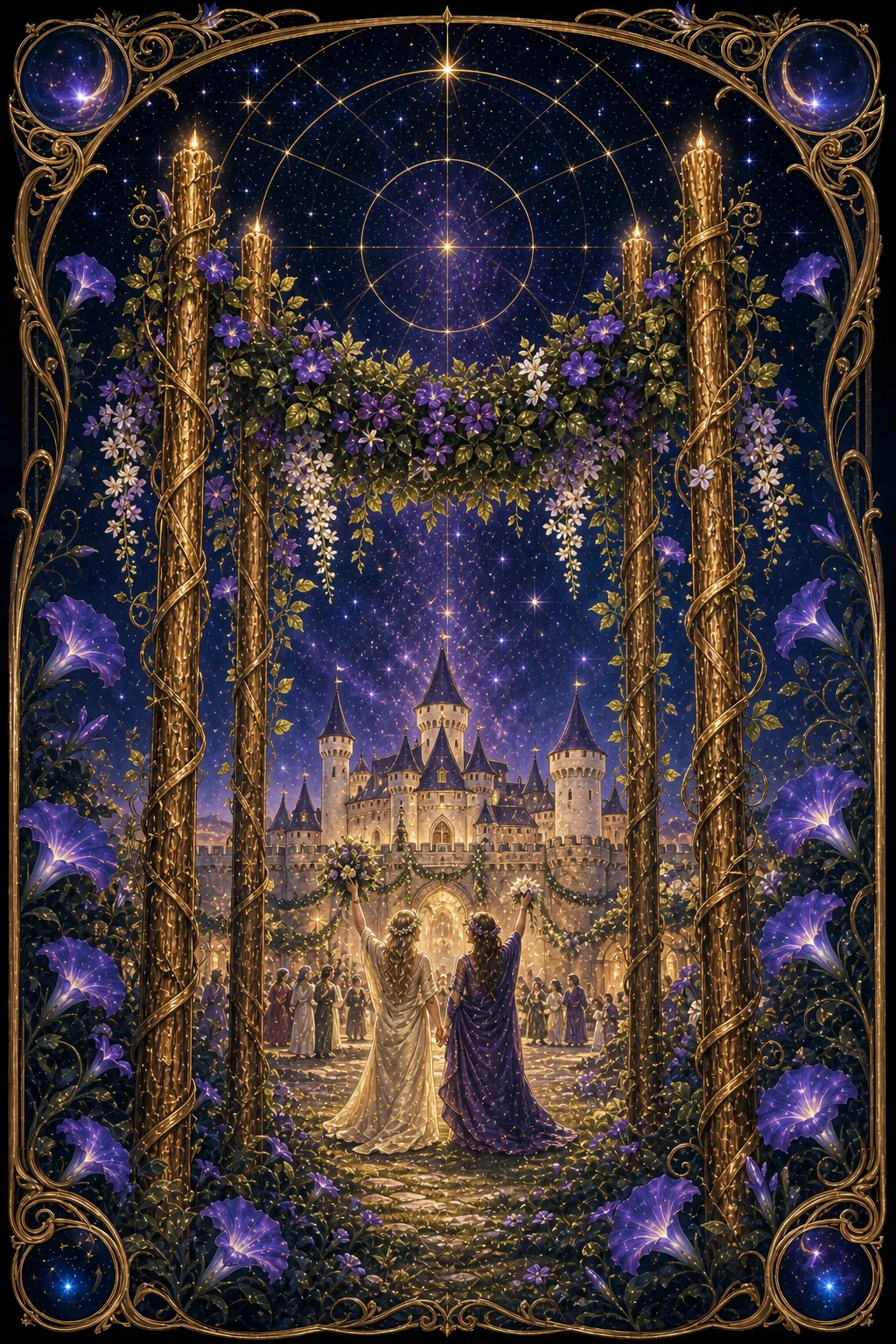
Four flowering staves hold up a canopy of garlands, and beyond it two figures raise bouquets in welcome while a walled town rises behind them. Everything in the picture is arriving somewhere. The card asks what in your life deserves marking, and whether you have let yourself mark it.
Upright Four of Wands
Celebration is one of the few things people are reliably bad at. There is always a reason to postpone it — the thing is not quite finished, the next stage is already visible, someone else did more. The Four stands directly against that habit. It is the deck's picture of the threshold: work that reached a point where it can be seen, a house that has become a home, a group of people who bothered to gather. Notice that the canopy is temporary. Nobody claims this is permanent, and the card is not about arrival at the end of anything. It marks that a stage happened, which older sources treat as a real and necessary act rather than a decoration. Read as reflection, it puts an unsentimental question: what have you completed recently and quietly declined to acknowledge? Most people can list their unfinished work instantly and their finished work not at all. The Four also touches belonging, since marking generally requires witnesses. Ask who you would want standing under the canopy, and whether they know it.
Reversed Four of Wands
Reversed, the garlands stay up but something about the gathering has gone slightly wrong. One familiar reading is the celebration performed rather than felt: a milestone marked out of obligation, in a room where nobody is quite present. Another is the delayed threshold — the move that has not happened, the arrangement never formalised, the good news that keeps not being announced because the right moment refuses to arrive. There is a quieter reading about belonging, and it is usually the one that lands. Reversal can describe standing near a gathering rather than inside it: at the family table, in the team, among old friends, present and somehow not counted. That is a common experience and a lonely one, and it is not a flaw in you. The card resolves nothing. What it offers is the observation that the canopy is held up by four separate poles, none of which is doing the job alone. If something in your life feels unmarked or unwitnessed, this is a reasonable evening to ask who you have stopped telling things to, and how that came about.
Four of Wands in love and relationships
Among the cards concerning connection, this is one of the warmest, and it favours the public and ordinary over the private and intense. Meeting the family. The friendship that has quietly turned into infrastructure. The Sunday nobody photographed. Its subject is stability that has become pleasant rather than merely reliable. Some reflection belongs here on ceremony in the small sense. Relationships of every kind are held together partly by repeated markings — the annual thing, the particular meal, the phrase only the two of you use. If those have thinned out, notice it without assigning blame, since they thin through busyness rather than indifference. What would you mark, if you decided the occasion counted?
Four of Wands in work and study
In work and study, the Four sits with the completed stage rather than the finished career. The module passed, the project shipped, the difficult quarter survived by a team who have already moved on. Organisations are structurally bad at this; they mark launches and ignore everything harder that led to them. Part of the reflection concerns your own record-keeping. If you cannot readily describe what you did this year, that is not modesty, it is a filing problem, and it tends to cost people more than they realise when the time comes to speak about themselves. There is also the question of company. Work done among people you like is a different substance from the same work done alone, and this card is unembarrassed about saying so.
Resources and security
On security, the Four's theme is the difference between having built something and letting yourself live in it. Its picture is a home with the front garden full of people, which is a specific kind of steadiness: not accumulation, but the point where arrangements are settled enough to be enjoyed. Purely as reflection, consider whether you are waiting for one further condition before you allow yourself to feel established, and whether that condition has moved before. None of this touches your own decisions. The question is only where your line for settled currently sits, and whether it is still yours. Settled is a feeling some while before it is a figure, and feelings can be checked.
Attention and wellbeing
Attention, in this card, turns toward gathering and toward rest of a particular kind — the rest that happens in company rather than in solitude. Not everybody is restored that way, and it is worth knowing which you are, since the wrong sort of recovery leaves people more tired than before. The habit the picture suggests is modest: mark something. Finish a stretch of work and stop, rather than rolling straight into the next. Eat with someone. This card's version of care is unglamorous and social, and it is offered as a practice and nothing more. Marking a stage costs an hour and tends to repay the hour for considerably longer.
Yes or no?
Yes
Yes, and unusually warmly for a deck that hedges. The Four leans toward whichever option includes other people. No forecast is implied; take it as encouragement to accept the gathering rather than the quiet evening.
Symbolism in the card
Four staves stand upright in the foreground, tipped with leaves and joined at the top by a heavy swag of flowers and fruit, forming a canopy with nothing beneath it but open ground. Two figures in the middle distance lift bouquets above their heads, a small crowd behind them, with a substantial castle wall and bridge further back. The structure is often read as a chuppah, the canopy under which Jewish weddings are held, a form Waite's circle would have known; the card has carried marriage associations for a long while, though the deck never restricts it to that. Its flowers connect it to harvest imagery elsewhere in the minor arcana. What distinguishes the composition is space: unlike most Wands cards, no one occupies the foreground, and the viewer stands outside the canopy looking in. Whether that reads as invitation or as exclusion has been argued over for a century, and both readings have been useful to people.
Four of Wands as today's card
As the day's card, the Four is a fairly direct suggestion to gather or to mark. Reply to the group message. Accept the invitation you were composing an excuse for. Put the thing you finished last week somewhere you can see it, and resist starting the next one immediately. If today has no gathering available, the smaller version works: acknowledge one completed thing out loud, to one person. It sounds thin written down and is less thin in practice. The card is not asking for a party. It asks you to stop treating every finish as a hinge into the next piece of work. Garlands come down again, which has never been an argument against putting them up.
In a three-card spread
In the position for the past, this card generally points to a threshold already crossed, sometimes one you undersold at the time and have gone on underselling since. Restoring it accurately changes how the rest of the row reads. In the present, it names a stage worth marking, and neighbouring cards tend to show what is being gathered around. Where the row looks forward, keep it as a question, since these cards forecast nothing: what would you like to have marked by the time this chapter closes, and who would you want present when you did? Wherever it lands in the row, this one concerns witnesses more than achievement.
Keywords
- Celebration
- Harmony
- Home
- Milestone
Journal prompts
- What have you finished this year and never once said out loud?
- Who would be under your canopy, and when did you last tell them anything that mattered?
- Which threshold in your life was crossed without any ceremony, and would you give it one now?
Cards read alongside Four of Wands
- Three of Cups — Friendship, celebration, community, and shared joy.
- Ten of Cups — Emotional fulfillment, family harmony, love, and lasting joy.
- The Sun — Positivity, fun, warmth, success, vitality.
- The Hierophant — Spiritual wisdom, religious beliefs, conformity, and tradition.
- All 78 tarot card meanings — the full major and minor arcana in one place.
Combinations with Four of Wands
- Three of Wands and Four of Wands tarot combination
- Four of Wands and Five of Wands tarot combination
- Two of Wands and Four of Wands tarot combination
- Four of Wands and Six of Wands tarot combination
- Ace of Wands and Four of Wands tarot combination
- Four of Wands and Seven of Wands tarot combination
- All 2,772 minor arcana combinations
Four of Wands by position
- Four of Wands as feelings tarot meaning
- Four of Wands as intentions tarot meaning
- Four of Wands as outcome tarot meaning
- Four of Wands as advice tarot meaning
- Four of Wands as an obstacle tarot meaning
- Four of Wands as action tarot meaning
- Four of Wands as a person tarot meaning
- Four of Wands as how someone sees you tarot meaning
- Four of Wands for a yes or no question tarot meaning
- All card meanings by position
Curious what Four of Wands means for your question? Turn a card on the home page — no account needed.
Draw a card freeOne card, one honest question, most evenings.
Start your free daily readingFree · One card a day · No credit card needed
Go deeper than one card
A personalized deep reading works a full spread around your question — Four of Wands included, if it falls to you. Deep readings run from the $1.99 Single Card Illumination and the $7 Three-Card Path, delivered straight away, to the $19 Five-Card Compass and the $29 Celtic Cross Atlas, composed in depth and delivered within 2–4 hours.
The $7 Three-Card Path, three cards read as one movement → · All reading options →
Prefer a rhythm to a one-off? Sparkle Pro ($8.99/month or $59/year) draws a three-card past, present and future spread for you every day. There is also a free eight-phase moon ritual guide to pair with today's card.
To sit with this card longer, the tarot journaling guide has prompt sets for daily draws, moon phases, and more.
Tarot content is for entertainment and personal reflection, not professional advice.