The Hierophant Tarot Card Meaning
 Start your free daily reading
Free · One card a day · No credit card needed
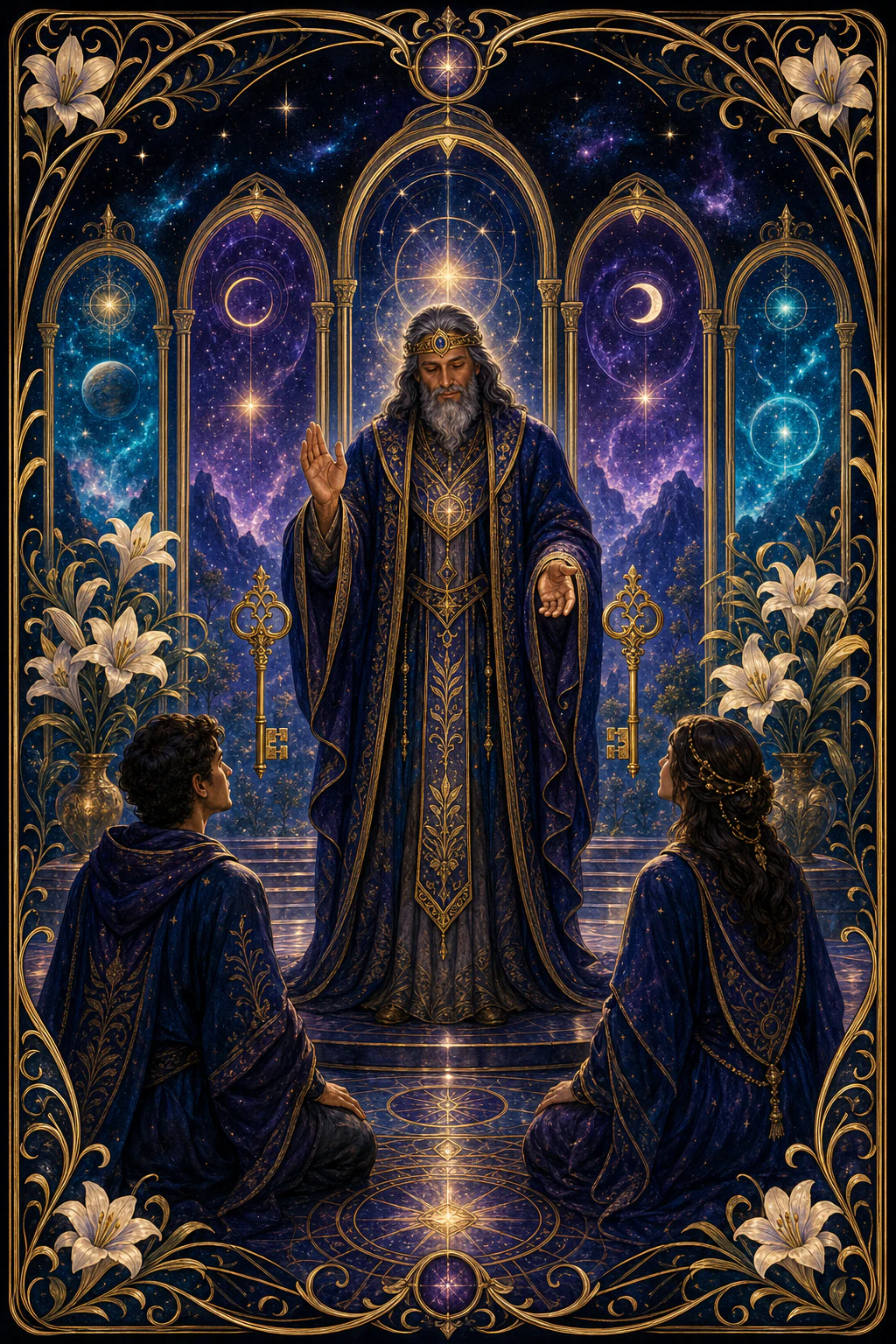
A robed figure in a triple crown sits between two stone pillars, one hand raised in blessing, two tonsured acolytes kneeling below him and a pair of crossed keys at his feet. Everything in the scene has been arranged in advance. The card asks what tradition you belong to, and what belonging has saved you from thinking about.
Upright The Hierophant
Here is the deck's card about inherited systems: religions, schools, professions, families, guilds, the accumulated instructions of everyone who worked something out before you arrived. Upright, it sits with the genuine value of that inheritance, which modern readers are often quick to dismiss. Most of what you know was handed over rather than discovered, and a tradition is largely a device for not repeating other people's mistakes at your own expense. The two kneeling figures in the foreground make the second point. Transmission requires somebody to receive it, and the card takes as much interest in the student as the teacher. Consider what you are currently being taught, in the ordinary sense — the craft you are learning slowly, the practice with rules older than you are, the person whose corrections you have decided to accept. The shadow is not hidden. Institutions preserve and they also conserve, and it can be hard to distinguish a principle from a habit repeated for four hundred years. Doubt is allowed. What the card declines to do is treat the doubt as automatically wiser than the tradition.
Reversed The Hierophant
Inverted, the relationship to authority is generally what has moved. One reading is departure: someone leaving a church, a discipline, a professional orthodoxy or a family's assumptions, and discovering that leaving takes considerably longer than deciding to leave. Old rules go on functioning in the background for years after being formally resigned from, which is worth knowing before you conclude you are free of them. The opposite reading is conformity that stopped being examined — showing up, repeating, belonging, and no longer able to say what the practice is for. That state is comfortable and nearly invisible from within. Inverted, it becomes a good moment to ask what you would tell a genuinely curious outsider who wanted to know why you do it this way. A third possibility concerns building your own version. Some people leave a tradition and spend the next decade quietly reconstructing it with better materials, which the card treats as a legitimate outcome rather than a failure of nerve. Reversal indicates pressure on the arrangement, not a verdict about it.
The Hierophant in love and relationships
Between people, this card raises shared frameworks: the agreed shape a connection takes, whether that shape was inherited from your families, borrowed from friends, or assembled without discussion. Long connections accumulate rules nobody remembers writing — how disagreements are conducted, who apologises first, what gets celebrated. This card gives no counsel on any relationship, nor any hint about how one might go. It asks only whether the framework you are inside was agreed to or absorbed. There is also commitment as public form. Some people find declared arrangements steadying and others find them constricting, and both responses usually trace back to something witnessed early. Consider which you are, and where you learned it.
The Hierophant in work and study
In work and study, this figure stands for qualification, apprenticeship, and the slow business of being taught by someone better than you. It suits anyone deliberately inside a system: an institution, an accreditation, a craft with a formal path. Its respect for that route is real. It also raises the question of orthodoxy. Every field has a house style and a set of things nobody says, and the interesting reflection is which of your professional convictions you genuinely tested and which you absorbed in your first two years and have carried ever since. There is a mentoring reading too. If you are further along, the crossed keys become a question about what you pass on, deliberately or otherwise — and whether anyone is learning from you the parts you would rather not have taught.
Resources and security
On security, this card looks at inherited attitudes rather than amounts. Almost everyone runs on assumptions about money absorbed from a household, a class position or a religious upbringing, and almost nobody revisits them once the circumstances have changed. As reflection only: think back to what you were taught was respectable, wasteful or safe, and whether that instruction was calibrated for a world resembling your own. Nothing here concerns any decision, which is entirely yours and no card's business. But an inherited rule you have never once stated aloud is worth stating, if only to hear how it sounds in your own voice.
Attention and wellbeing
As a habit card, the Hierophant favours the practice done at the same time by many people over long periods: the observance, the weekly meeting, the ritual whose value lies mostly in its repetition. Structure of that kind carries you on days your own motivation is absent, which is the entire design. You might consider what you do regularly in company, and whether that number has quietly fallen to zero over the past few years. This concerns rhythm and company alone. Beyond that the card asserts nothing, and any practice you take up remains a matter for your own judgement.
Yes or no?
Yes
Yes, of the conventional variety. This card leans toward the established route rather than the improvised one. It predicts nothing; read the yes as a question about whether the ordinary path has been fairly considered.
Symbolism in the card
Waite's fifth trump seats a pontiff between two plain grey pillars, wearing the triple tiara and holding a threefold cross-staff in his left hand, the right raised in benediction with two fingers up and two folded — the traditional gesture dividing the seen from the hidden. Two crossed keys lie on the step at his feet, gold and silver, the old emblem of the power to open and to close. Two tonsured attendants kneel before him in robes patterned with roses and lilies, echoing the flowers of the first trump. The card was called the Pope in the Marseille tradition and, like the Popess, proved awkward enough that some printers renamed it Jupiter. Waite chose Hierophant, the Greek title of the priest who displayed the sacred objects at Eleusis, deliberately widening the card from one institution to the general business of doctrine handed down. Note that the pillars are grey rather than black and white, which readers often contrast with the second trump.
The Hierophant as today's card
As the day's card, this one tends to point at the standard method. Do it the way it is normally done, ask the person who already knows, follow the instructions rather than improvising an interesting alternative at the cost of the afternoon. Dull counsel, and frequently correct. The other use is more reflective. If something today involves a rule you did not make, the Hierophant invites you to notice your reaction to it — obedience, resentment, negotiation — and to consider whether that reaction belongs to this rule or to an older one it happens to resemble. Most of us hold a fixed response to authority acquired long before the present instance.
In a three-card spread
In the seat of the past, this figure usually indicates a formation: an institution, a faith, a training, a family's way of doing things that supplied the framework you still partly use. The value lies in separating what you kept from what merely stayed. Presently placed, he marks a working relationship with a system — being taught, being certified, being expected to represent something. Cards nearby often show whether the fit is comfortable. Where the reading points ahead, keep him to a question of belonging rather than an outcome of any kind: if this went on, what would you want to have been formally part of, and what would you rather remain outside?
Keywords
- Tradition
- Conformity
- Morality
- Ethics
Journal prompts
- What were you taught that you have never once examined?
- Which tradition are you inside, and could you explain to a stranger what it is for?
- What are you passing on without meaning to?
Cards read alongside The Hierophant
- The Emperor — Authority, establishment, structure, and a father figure.
- The High Priestess — Intuition, sacred knowledge, divine feminine, and the subconscious.
- Justice — Justice, fairness, truth, cause and effect, law.
- Three of Pentacles — Teamwork, skill, collaboration, and quality craft.
- All 78 tarot card meanings — the full major and minor arcana in one place.
Combinations with The Hierophant
- The Hierophant and The Emperor tarot combination
- The Hierophant and The Lovers tarot combination
- The Hierophant and The Empress tarot combination
- The Hierophant and The Chariot tarot combination
- The Hierophant and The High Priestess tarot combination
- The Hierophant and Strength tarot combination
- All 231 major arcana combinations
The Hierophant by position
- The Hierophant as feelings tarot meaning
- The Hierophant as intentions tarot meaning
- The Hierophant as outcome tarot meaning
- The Hierophant as advice tarot meaning
- The Hierophant as an obstacle tarot meaning
- The Hierophant as action tarot meaning
- The Hierophant as a person tarot meaning
- The Hierophant as how someone sees you tarot meaning
- The Hierophant for a yes or no question tarot meaning
- All card meanings by position
Curious what The Hierophant means for your question? Turn a card on the home page — no account needed.
Draw a card freeOne card, one honest question, most evenings.
Start your free daily readingFree · One card a day · No credit card needed
Go deeper than one card
A personalized deep reading works a full spread around your question — The Hierophant included, if it falls to you. Deep readings run from the $1.99 Single Card Illumination and the $7 Three-Card Path, delivered straight away, to the $19 Five-Card Compass and the $29 Celtic Cross Atlas, composed in depth and delivered within 2–4 hours.
The $29 Celtic Cross Atlas, ten cards read position by position → · All reading options →
Prefer a rhythm to a one-off? Sparkle Pro ($8.99/month or $59/year) draws a three-card past, present and future spread for you every day. There is also a free eight-phase moon ritual guide to pair with today's card.
To sit with this card longer, the tarot journaling guide has prompt sets for daily draws, moon phases, and more — including journal prompts for every major arcana card.
Tarot content is for entertainment and personal reflection, not professional advice.