King of Pentacles Tarot Card Meaning
 Start your free daily reading
Free · One card a day · No credit card needed
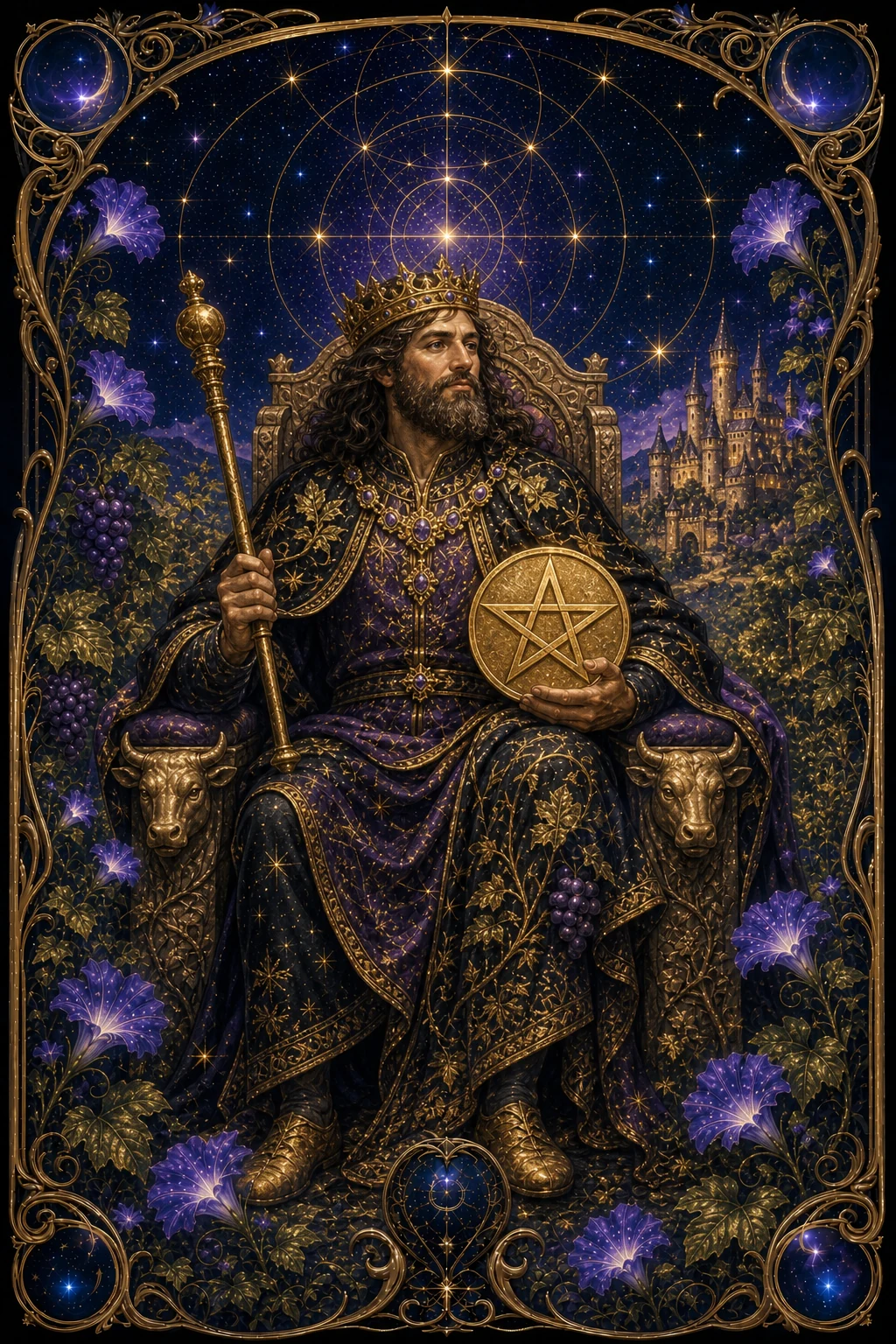
A bearded king sits on a garden throne carved with bulls' heads, grapevines climbing his robe, one hand resting on a golden pentacle as though it were an ordinary object. Behind him stands the castle he built rather than inherited. The card asks what you have made steady, and what the steadying has cost the rest of you.
Upright King of Pentacles
Where the other kings hold their symbol up, this one rests a hand on it. That posture is most of the card. The figure is the deck's picture of competence gone quiet: someone who spent years turning effort into something that now runs without drama, and who has stopped needing anyone to remark on it. Sitting with this card, the question is usually about stewardship rather than accumulation. Anything that lasts — a household, a craft, a business, a thirty-year friendship — is maintained by unremarkable repeated acts that nobody thanks you for. The King is the deck's acknowledgement that such maintenance is a skill, and one that becomes invisible exactly when it is being done well. There is a shadow inside the upright reading, and the older sources have always allowed for it. Comfort settles. A man who has built a garden can spend the remainder of his life inside its walls. There is something in asking which parts of your own steadiness are still chosen and which have simply become the shape of the ground you stand on. The card is warm rather than cautionary, but its warmth includes an honest look at what you have arranged.
Reversed King of Pentacles
Reversed, the same figure reads as someone whose grip has tightened. The hand resting lightly on the pentacle closes over it. Traditional readings speak of stubbornness, of control mistaken for care, of a person so practised at providing that receiving anything has become awkward. There is a gentler version worth considering first. Reversal often describes competence that has been asked to carry too much — the person everyone relies on, quietly running low on the very thing they are relied upon for. If you are the steady one in a family or a team, this is a fair place to ask who is steady for you. The harder reading concerns worth. When a life has been built on what you can produce, it becomes uncomfortably easy to measure yourself by output and to feel the measurement slip whenever the output does. The reversed King is a reflection on the distance between having built something and being the thing you built. Neither reading is a judgement. Both work better as a slow question than as a conclusion reached in one evening.
King of Pentacles in love and relationships
In connections of every kind, this King is the person who shows up. Not the one who says the thing beautifully, but the one who arrives with the right tool, remembers the appointment, and keeps the arrangement running while everyone else is having feelings about it. That is a genuine form of devotion and it is often under-read, particularly by anyone raised on more articulate versions. There is something in asking whether someone in your life has been loving you in this dialect while you waited for a different one. The reverse question is just as fair. Practical care can also be a place to hide. If you find it easier to fix than to say, this is a quiet place to notice that without deciding it is a fault. Provision and intimacy overlap, but they are not the same thing, and this figure occasionally needs reminding.
King of Pentacles in work and study
For work and study, the King of Pentacles belongs to the long middle: the years after competence and before whatever comes next. Mastery, in this card, is not brilliance. It is reliability compounded until it starts to look like authority. If you are early in something, the card points toward patience — the unglamorous truth that most durable skill accumulates in ordinary hours rather than remarkable ones. If you are further along, it points toward legacy in the smallest sense: what you teach, what you leave working, whose job you make easier by having done yours properly. There is also a question here about ambition that has gone quiet. Some people stop wanting more because they have enough, which is a fine place to arrive at. Others stop because wanting became tiring. The card does not distinguish between the two, but you probably can.
Resources and security
Of all seventy-eight cards, this is the one most often reduced to money, which is a shame, because its real subject is enough-ness. The King is drawn with plenty and shows no urgency about it, and the interesting part is the absence of urgency rather than the plenty. As reflection only: consider what condition or arrangement would let you stop calculating, and then consider whether you have moved that line before. Many people have. Noticing where the line currently sits, and who put it there, tends to be a more honest exercise than any sum. Nothing here is guidance about your own decisions, which remain entirely yours.
Attention and wellbeing
This card's relationship to energy is the relationship of anyone who is good at carrying things. Capable people tend to find their limits late, because the early signals are easy to absorb. The reflection is about rhythm rather than effort. The garden in the picture is not maintained by intensity; it is maintained by returning. You might look at where your attention goes across a week and ask which parts of it are tending and which are rescuing. Rest, for this figure, generally needs scheduling like anything else, because it does not announce itself and nothing external requests it. That is a habit question, and habits are the one thing this King is unusually well equipped for.
Yes or no?
Yes
Yes, with a slow tempo attached. The card leans toward whichever option can be maintained rather than whichever is exciting. If your question involves patience, read the yes as being about the long version.
Symbolism in the card
Smith seats the fourth Pentacles court in a garden rather than a hall. His throne is carved with bulls' heads, the traditional emblem of Taurus and, through it, of the fixed earth this suit belongs to. Grapevines and ripe fruit cover his robe and climb the arbour behind him. A sceptre is in his right hand, a large pentacle rests in his left, held without display, and armoured greaves show beneath the vines — an old visual note that the comfort in the picture was won rather than given. Behind the throne stands a castle, usually read as his own construction rather than an inheritance, and the ground at his feet is planted rather than paved. The flowers are practical flowers. The court cards of Pentacles descend from the coin suit of the earliest Italian decks, associated with merchants and with the material world, and this King was long read as the figure of the successful householder. The wealth in the image is agricultural in character: it grows slowly and it requires somebody to stay.
King of Pentacles as today's card
As the day's single card, the King of Pentacles usually reads as an argument for the unremarkable. Finish the thing that has been nearly finished. Do the maintenance task that has moved between four different lists. Cook rather than order. It is not an ambitious card to draw, and that is much of its value. Most lives are held together by the actions nobody would think to write down, and a day spent doing them well is not a wasted day. If you have been waiting for conditions to be right before starting something, this figure offers the least romantic suggestion in the deck: begin in ordinary conditions, at a pace you could still keep in November.
In a three-card spread
In the past position, this King often stands for something you built and have since taken for granted — a stability that felt hard-won at the time and now goes entirely unmentioned. There is value in naming it. In the present, he describes a role you are currently occupying, possibly without having agreed to it: the steady one, the person who handles it. Neighbouring cards usually indicate whether that suits you. In the future position, hold him as a question about tempo rather than outcome. If this situation were approached slowly, tended rather than solved, what would that ask of you in the meantime?
Keywords
- Prosperity
- Security
- Discipline
- Mastery
Journal prompts
- What have you built that you no longer notice?
- Who is steady for you, and when did you last let them be?
- Where does your line sit between enough and more, and who drew it?
Cards read alongside King of Pentacles
- Queen of Pentacles — Practical care, comfort, resourcefulness, and nurture.
- Knight of Pentacles — Reliability, patience, routine, and steady progress.
- Ten of Pentacles — Legacy, family wealth, stability, and lasting success.
- The Emperor — Authority, establishment, structure, and a father figure.
- All 78 tarot card meanings — the full major and minor arcana in one place.
Combinations with King of Pentacles
- Queen of Pentacles and King of Pentacles tarot combination
- Knight of Pentacles and King of Pentacles tarot combination
- Page of Pentacles and King of Pentacles tarot combination
- Ten of Pentacles and King of Pentacles tarot combination
- Nine of Pentacles and King of Pentacles tarot combination
- Eight of Pentacles and King of Pentacles tarot combination
- All 2,772 minor arcana combinations
King of Pentacles by position
- King of Pentacles as feelings tarot meaning
- King of Pentacles as intentions tarot meaning
- King of Pentacles as outcome tarot meaning
- King of Pentacles as advice tarot meaning
- King of Pentacles as an obstacle tarot meaning
- King of Pentacles as action tarot meaning
- King of Pentacles as a person tarot meaning
- King of Pentacles as how someone sees you tarot meaning
- King of Pentacles for a yes or no question tarot meaning
- All card meanings by position
Curious what King of Pentacles means for your question? Turn a card on the home page — no account needed.
Draw a card freeOne card, one honest question, most evenings.
Start your free daily readingFree · One card a day · No credit card needed
Go deeper than one card
A personalized deep reading works a full spread around your question — King of Pentacles included, if it falls to you. Deep readings run from the $1.99 Single Card Illumination and the $7 Three-Card Path, delivered straight away, to the $19 Five-Card Compass and the $29 Celtic Cross Atlas, composed in depth and delivered within 2–4 hours.
The $19 Five-Card Compass, five positions and a keepsake → · All reading options →
Prefer a rhythm to a one-off? Sparkle Pro ($8.99/month or $59/year) draws a three-card past, present and future spread for you every day. There is also a free eight-phase moon ritual guide to pair with today's card.
To sit with this card longer, the tarot journaling guide has prompt sets for daily draws, moon phases, and more.
Tarot content is for entertainment and personal reflection, not professional advice.