Six of Wands Tarot Card Meaning
 Start your free daily reading
Free · One card a day · No credit card needed
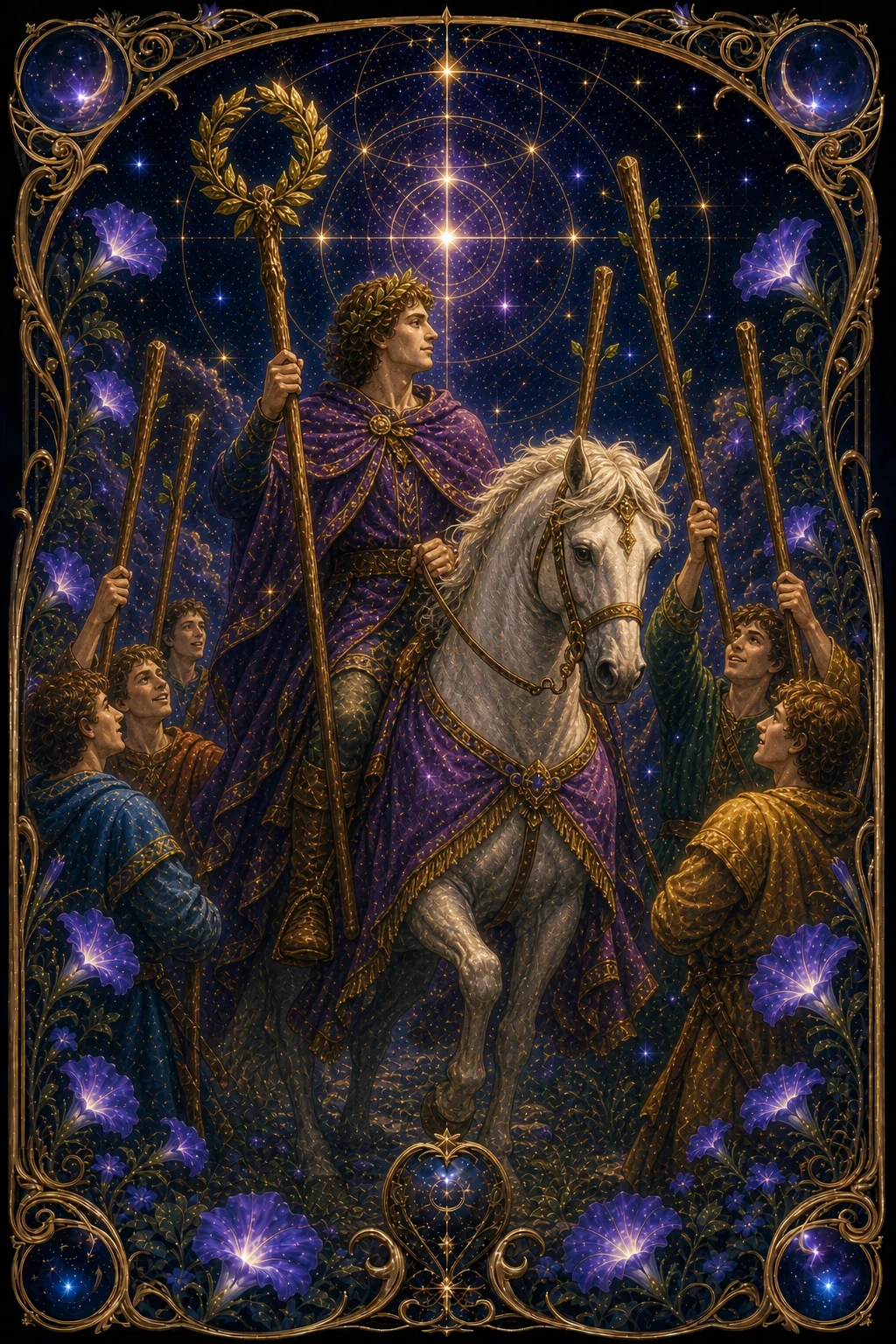
A rider on a white horse moves through a crowd, a laurel wreath on his head and another tied to the staff he carries, while hands and staves rise around him. He is the only one lifted above the others. The card asks how you hold being seen.
Upright Six of Wands
Recognition and achievement are different things, and this card concerns the first. The work happened earlier, somewhere off the card. What the picture shows is the moment other people acknowledge it, which is a separate event and not one anybody controls. That gap deserves sitting with. Plenty of good work is never seen, and plenty of seen work was not the best in the room; both facts are ordinary rather than unjust. Read as reflection, the Six invites an honest look at your appetite for being noticed. In most cultures that is a faintly embarrassing subject, which is why it goes unexamined. Some people need very little and find attention slightly unpleasant; others discover that praise, when it finally arrives, does not fill the space it was meant to. Both are common. The rider's face gives nothing away. Then there is the crowd, which the card includes deliberately. Nobody is carried through a street alone. It is worth naming who has actually been walking alongside whatever you made, and whether you have said anything to them about it.
Reversed Six of Wands
Inverted, the procession grows complicated. The most familiar reading is recognition withheld — effort that produced no acknowledgement, or acknowledgement that landed on somebody standing nearer the front. That is genuinely dispiriting, and it helps to separate the disappointment from any conclusion about the work itself, since the two are only loosely related. A second reading concerns the private cost of a public version. Being visible for something tends to attach you to it, and there are people quietly maintaining a reputation for work they stopped enjoying years ago. If any of that is familiar, this reversal is a reasonable moment to ask what you would do with no audience at all, and whether the answer has changed. A third strand involves the crowd's opinion becoming the measure. When approval is the instrument you use to check your own worth, its absence reads as a verdict rather than as silence. None of this is a judgement, and none of it claims to know your situation. Reversed, the card mostly asks who you are performing for, and whether they are still in the room.
Six of Wands in love and relationships
In connection, this card concerns being appreciated out loud. A great many people are loved steadily and told rarely, and the distance between those two is wider than it looks from inside a busy life. The Six makes a reasonable prompt to say the specific thing: not that you are grateful in general, but the exact act, on the exact day, that you noticed. It raises the reverse question too. Some people find praise difficult to receive and deflect it by reflex, which whoever offered it eventually reads as rejection. If you tend to turn a compliment into a joke, see that kindly. There is a further reading about pride in another person, less discussed than romance and doing more work in most long relationships than anybody credits.
Six of Wands in work and study
For work, the Six sits with visibility. Being good at something and being known for it are separate projects, and organisations reward the second more than they admit. That is neither cynicism nor a recommendation; it is simply the terrain, and knowing which of the two you have been investing in is useful. The card raises a related reflection about credit. Work is nearly always collective, and only one figure here is on a horse. Where you have been the one seen, it costs little to name the people who were not. Where you have not been seen, the question is whether the work is genuinely invisible or whether nobody has been told, since those call for very different responses and are frequently confused.
Resources and security
Status is this card's business where security is concerned — the part of enough-ness that involves other people's eyes. Much of what feels like financial pressure is comparative rather than practical: the wish to be seen as someone doing fine. This is reflection rather than advice — ask what you would still want if it were entirely invisible to everybody you know, and what would quietly drop off the list. There is no decision in it. The exercise separates what you need from what you would like to be seen having, and the separation tends to be quieter than most people anticipate. Standing is expensive to keep up and is almost never itemised anywhere.
Attention and wellbeing
This card's relationship to attention points outward: energy spent maintaining a version of yourself that other people can see. That maintenance is real work and rarely gets counted, which is why some weeks are inexplicably tiring despite containing nothing heavy. Notice where in your life you go unobserved, and how much of it there is. Solitude that nobody is evaluating restores something company cannot. The card offers this as a habit rather than a cure, and it makes no claim about anything beyond how a week is arranged. An hour that nobody watches is not idleness, whatever a calendar appears to believe.
Yes or no?
Yes
Yes, and with some confidence, though the card describes acknowledgement rather than outcome. Take the yes as attaching to the thing already made, not to how anybody receives it.
Symbolism in the card
The rider sits a white horse draped in green cloth, wearing a red cloak and a laurel wreath, a second wreath fixed to the head of the staff in his hand. Five further staves are carried upright by figures on foot around him, so the six of the title includes the crowd. Laurel is Roman rather than medieval, the crown given for victory and for poetry alike, and its use here places the card in the tradition of the triumph — the formal procession granted to a returning general. Those processions are also where the word trump comes from, by way of trionfi, the name of the earliest Italian tarot games. Smith leaves the faces of the crowd largely blank, and the horse is being led at a walk rather than ridden hard. Waite's reading is straightforwardly favourable, yet the picture withholds what a triumph usually displays: any sign of what was won, or from whom.
Six of Wands as today's card
Drawn for the day, the Six often works best pointed outward. Tell somebody their work was good, with a detail attached so it lands as observation rather than politeness. Praise given specifically is remembered for years and takes about a minute. If the card seems to be about you — a review, a result, a piece of attention arriving — its quieter use is to notice how you receive it, and whether you can let it stand for a whole day without immediately qualifying it. Some people cannot, and finding that out is worth more than the compliment was. Laurel is a light thing to wear and a heavy thing to go on polishing.
In a three-card spread
In the past position, the Six frequently marks a moment of recognition, and the thing to ask is whether you kept it or filed it somewhere it does no good. People index criticism far better. In the present, it describes visibility of some kind, and the cards around it usually indicate whether that visibility is welcome. In the forward position, treat it as reflection only, since nothing here forecasts how anybody responds. The serviceable question: if this work were acknowledged, what would you want said about it, and does the work currently match that sentence? Those figures on foot have no faces, which leaves the naming of them to you.
Keywords
- Victory
- Recognition
- Confidence
- Success
Journal prompts
- Whose acknowledgement still counts with you, and is that person still someone you admire?
- What would you keep doing if no one ever mentioned it again?
- When were you last praised, and what did you do with it in the following hour?
Cards read alongside Six of Wands
- Four of Wands — Celebration, harmony, homecoming, and a joyful milestone.
- The Sun — Positivity, fun, warmth, success, vitality.
- The Chariot — Control, willpower, success, action, and determination.
- Nine of Pentacles — Abundance, independence, refinement, and earned comfort.
- All 78 tarot card meanings — the full major and minor arcana in one place.
Combinations with Six of Wands
- Five of Wands and Six of Wands tarot combination
- Six of Wands and Seven of Wands tarot combination
- Four of Wands and Six of Wands tarot combination
- Six of Wands and Eight of Wands tarot combination
- Three of Wands and Six of Wands tarot combination
- Six of Wands and Nine of Wands tarot combination
- All 2,772 minor arcana combinations
Six of Wands by position
- Six of Wands as feelings tarot meaning
- Six of Wands as intentions tarot meaning
- Six of Wands as outcome tarot meaning
- Six of Wands as advice tarot meaning
- Six of Wands as an obstacle tarot meaning
- Six of Wands as action tarot meaning
- Six of Wands as a person tarot meaning
- Six of Wands as how someone sees you tarot meaning
- Six of Wands for a yes or no question tarot meaning
- All card meanings by position
Curious what Six of Wands means for your question? Turn a card on the home page — no account needed.
Draw a card freeOne card, one honest question, most evenings.
Start your free daily readingFree · One card a day · No credit card needed
Go deeper than one card
A personalized deep reading works a full spread around your question — Six of Wands included, if it falls to you. Deep readings run from the $1.99 Single Card Illumination and the $7 Three-Card Path, delivered straight away, to the $19 Five-Card Compass and the $29 Celtic Cross Atlas, composed in depth and delivered within 2–4 hours.
The $7 Three-Card Path, three cards read as one movement → · All reading options →
Prefer a rhythm to a one-off? Sparkle Pro ($8.99/month or $59/year) draws a three-card past, present and future spread for you every day. There is also a free eight-phase moon ritual guide to pair with today's card.
To sit with this card longer, the tarot journaling guide has prompt sets for daily draws, moon phases, and more.
Tarot content is for entertainment and personal reflection, not professional advice.