Nine of Pentacles Tarot Card Meaning
 Start your free daily reading
Free · One card a day · No credit card needed
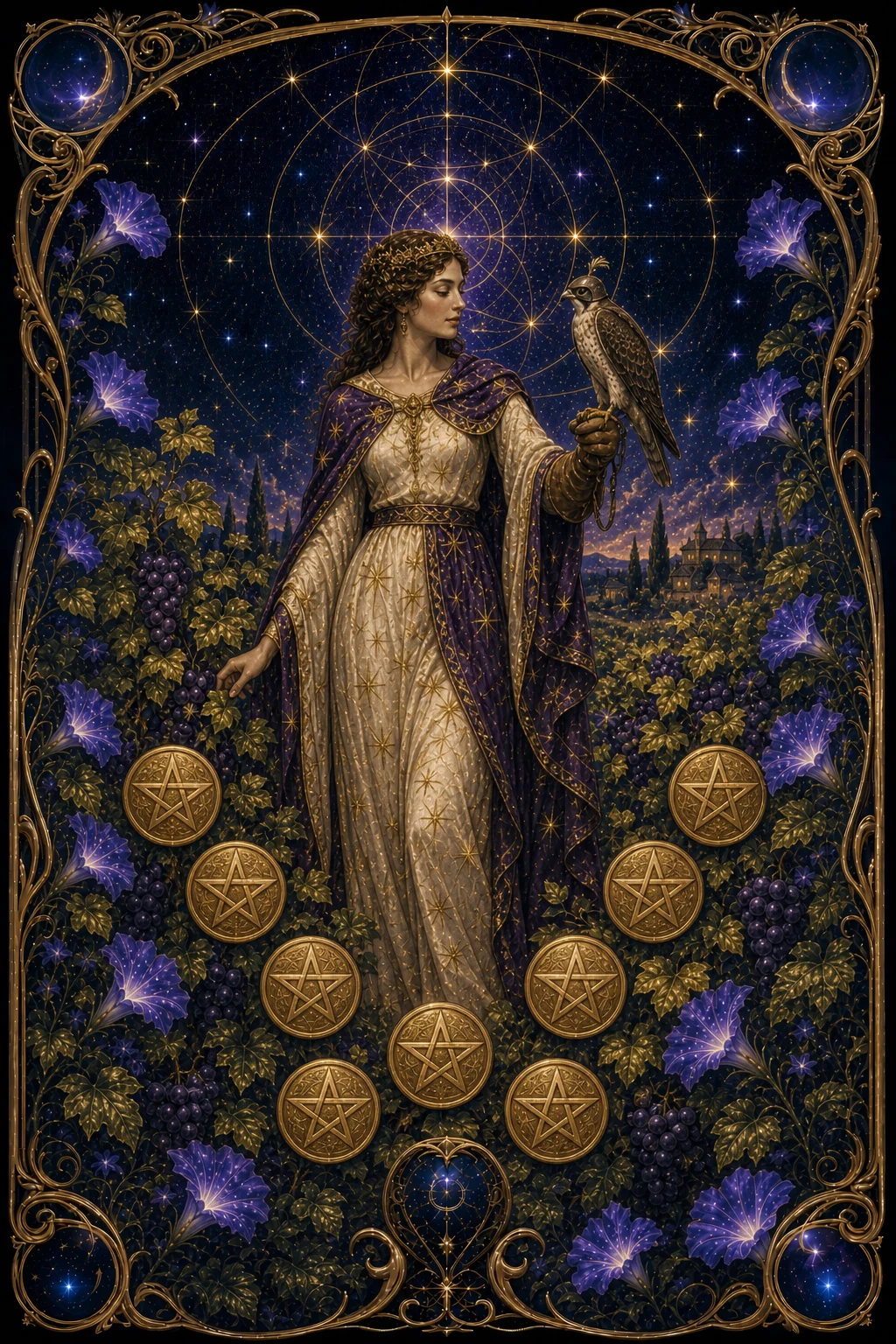
A figure in an embroidered robe stands alone in a walled vineyard, a hooded falcon settled on the gloved hand, nine coins ranged through the vines. A snail is crossing the ground near the hem. The card asks what a life looks like once it has been arranged to suit the person living in it.
Upright Nine of Pentacles
Upright, the card is a portrait rather than an event. Somebody stands in a garden they know the whole of, halfway through an unremarkable afternoon, with nobody else in the frame. What the tradition finds striking is the composure — this is not a celebration, and there is no one to celebrate with. The pleasure in the image is private and slightly unremarkable, which is what makes it convincing. Sitting with the card, the theme is self-sufficiency in its literal sense: a life that has been made to fit, by the person inside it, over time. Some of that fitting is material and a great deal of it is not. It includes the hours you have arranged so they belong to you, the company you have stopped keeping, the standards you now apply only to yourself. The card reads best as a question about solitude rather than success. There is solitude that was chosen and furnished, and solitude that arrived and has since been redecorated to look chosen, and the difference is not always obvious from inside. Neither is a failure. But if you are alone in your garden, it is worth being honest about which kind of afternoon it is.
Reversed Nine of Pentacles
Reversed, the garden walls come forward in the reading. The most common version concerns independence that has hardened past preference into policy — the practised refusal of help, the small daily proofs that nothing is needed from anybody. Self-sufficiency is a real accomplishment and it can also become a story with a lot invested in it, difficult to set down without feeling like a loss of character. There is another reading in the falcon. Hooded, the bird is a trained appetite kept quiet on the wrist; reversed, that arrangement can look less like discipline and more like something not being let out. Worth asking what you have hooded in order to keep the afternoon peaceful, and whether you still remember what it was for. A third possibility is simpler: a life that fits perfectly can stop being interesting, and the boredom that follows is often misdiagnosed as ingratitude. None of these is a claim about anyone's circumstances. Reversed, the card mostly asks whether the arrangement you made is still the one you would make, given that you are no longer the person who made it.
Nine of Pentacles in love and relationships
In matters of connection, this card sits with the person who is complete on their own and knows it. That is a good position and a slightly awkward one. Anyone who has built a life that works has more to lose by rearranging it, and the card notices the particular hesitation of someone weighing genuine company against a schedule they are fond of. Nothing in the picture says the garden should stay empty, and nothing says it should not. The more useful reflection concerns what you are like when nobody is watching you be generous. Solitude is where preferences get set — how you eat, when you sleep, what you tolerate — and those preferences turn out to be the actual material of intimacy later on. If you are already partnered, the card turns toward whatever part of you remains yours inside the arrangement, and whether it has been given any room this year.
Nine of Pentacles in work and study
For work and study, the Nine belongs to the point where you no longer have to explain yourself. Something has been established — a reputation, a method, a way of working that other people have stopped questioning — and the effort that built it has receded far enough to be invisible. The card sits well with anyone who has become the person others assume simply knows how. What it raises is the cost of the walls. An established position is comfortable partly because it is bounded, and the boundaries that keep out interference also keep out the unfamiliar. There is a fair question here about whether you still put yourself in rooms where you are not the competent one. The card takes no position, and it is not an argument for disruption. It only observes that the vineyard is walled, and that walls are something somebody chose, and can be walked through in either direction.
Resources and security
Where security is concerned, the Nine deals in texture rather than amount. What it shows is a life with good fabric in it — the robe embroidered, the vines kept, the ground tended — and none of that reveals a figure. As reflection, the interesting question is which small qualities in your surroundings actually register with you: the chair you like, the mug, the light in one particular room at four o'clock. People often find that the things which make a day feel decent are not the expensive ones. The card makes no claim about anyone's circumstances, and it is not the place to work out a practical question. It suggests only that you notice what you already find pleasant; noticing is the whole of its method.
Attention and wellbeing
As a reflection on rest, the Nine has an unhurried quality that most of us find harder to imitate than to admire. There is a snail in the lower corner of the picture, moving at the only speed available to it, and the card has long been read as an argument for that tempo. You might look at where in your week you genuinely move slowly, and whether those stretches have been quietly colonised by something more useful. Solitude is usually the first thing given away, and generally to whoever asks. Protecting an hour that produces nothing is a habit rather than a mood, and like all habits it has to be put somewhere specific in the week or it does not happen.
Yes or no?
Yes
Yes, though the card frames it as something you can already give yourself rather than something to be granted. If your question involved waiting on somebody else, that framing may be the more interesting half.
Symbolism in the card
Smith's ninth Pentacle places a solitary figure in a walled vineyard heavy with fruit, the coins set among the leaves rather than held. The robe is patterned with what are usually read as Venus symbols, and the left hand wears a falconer's glove on which a small hooded bird sits perfectly still. Falconry was an aristocratic pursuit, and the hood is a working piece of equipment: it keeps the bird calm by removing everything there is to react to. Readers have taken the hooded falcon as disciplined desire, as the mind under management, or as a luxury only a settled life maintains. A house is visible beyond the vines, and a snail crosses the ground at the lower edge — an old emblem of slow, self-carried progress, and one of Smith's habitual small jokes at the bottom of a grand picture. In the earlier Italian coin decks this number was a plain arrangement of nine discs among foliage. The garden, the bird and the solitude are all Smith's additions, and together they turned a count of coins into a portrait of a particular kind of afternoon.
Nine of Pentacles as today's card
Drawn for the day, the Nine tends to suggest spending some part of it in your own company on purpose. Not productively. This card's version of a good hour involves a garden, a bird that is not doing anything, and no witnesses. Practically that might be a walk you take alone, a meal eaten without a screen, or an afternoon in which you decline the thing you would usually agree to. It also works in the other direction. If the day is already solitary and has been for a while, the card can be read as an invitation to look at the quality of that solitude rather than its quantity, and to make one small improvement to it that costs nothing.
In a three-card spread
In the past position, the Nine usually refers to something you made for yourself that you no longer count as an accomplishment, on the grounds that it is simply how you live now. Naming it is the exercise. In the present, it puts you inside an arrangement that suits you, with the accompanying question of whether it still fits the person currently in it. Neighbouring cards tend to indicate what the walls are keeping out. In the future position it forecasts nothing at all; the version that helps is a question. If this situation resolved in a way that left you entirely responsible for your own afternoons, what would you want them to contain?
Keywords
- Abundance
- Independence
- Refinement
- Comfort
Journal prompts
- What part of your life did you arrange yourself, and would you arrange it that way again?
- What have you hooded and kept quiet in order to keep things pleasant?
- When were you last alone without it being a gap between other things?
Cards read alongside Nine of Pentacles
- The Empress — Femininity, beauty, nature, nurturing, and abundance.
- Seven of Pentacles — Patience, long-term investment, assessment, and reward.
- Queen of Pentacles — Practical care, comfort, resourcefulness, and nurture.
- Four of Wands — Celebration, harmony, homecoming, and a joyful milestone.
- All 78 tarot card meanings — the full major and minor arcana in one place.
Combinations with Nine of Pentacles
- Eight of Pentacles and Nine of Pentacles tarot combination
- Nine of Pentacles and Ten of Pentacles tarot combination
- Seven of Pentacles and Nine of Pentacles tarot combination
- Nine of Pentacles and Page of Pentacles tarot combination
- Six of Pentacles and Nine of Pentacles tarot combination
- Nine of Pentacles and Knight of Pentacles tarot combination
- All 2,772 minor arcana combinations
Nine of Pentacles by position
- Nine of Pentacles as feelings tarot meaning
- Nine of Pentacles as intentions tarot meaning
- Nine of Pentacles as outcome tarot meaning
- Nine of Pentacles as advice tarot meaning
- Nine of Pentacles as an obstacle tarot meaning
- Nine of Pentacles as action tarot meaning
- Nine of Pentacles as a person tarot meaning
- Nine of Pentacles as how someone sees you tarot meaning
- Nine of Pentacles for a yes or no question tarot meaning
- All card meanings by position
Curious what Nine of Pentacles means for your question? Turn a card on the home page — no account needed.
Draw a card freeOne card, one honest question, most evenings.
Start your free daily readingFree · One card a day · No credit card needed
Go deeper than one card
A personalized deep reading works a full spread around your question — Nine of Pentacles included, if it falls to you. Deep readings run from the $1.99 Single Card Illumination and the $7 Three-Card Path, delivered straight away, to the $19 Five-Card Compass and the $29 Celtic Cross Atlas, composed in depth and delivered within 2–4 hours.
The $7 Three-Card Path, three cards read as one movement → · All reading options →
Prefer a rhythm to a one-off? Sparkle Pro ($8.99/month or $59/year) draws a three-card past, present and future spread for you every day. There is also a free eight-phase moon ritual guide to pair with today's card.
To sit with this card longer, the tarot journaling guide has prompt sets for daily draws, moon phases, and more.
Tarot content is for entertainment and personal reflection, not professional advice.