The Chariot Tarot Card Meaning
 Start your free daily reading
Free · One card a day · No credit card needed
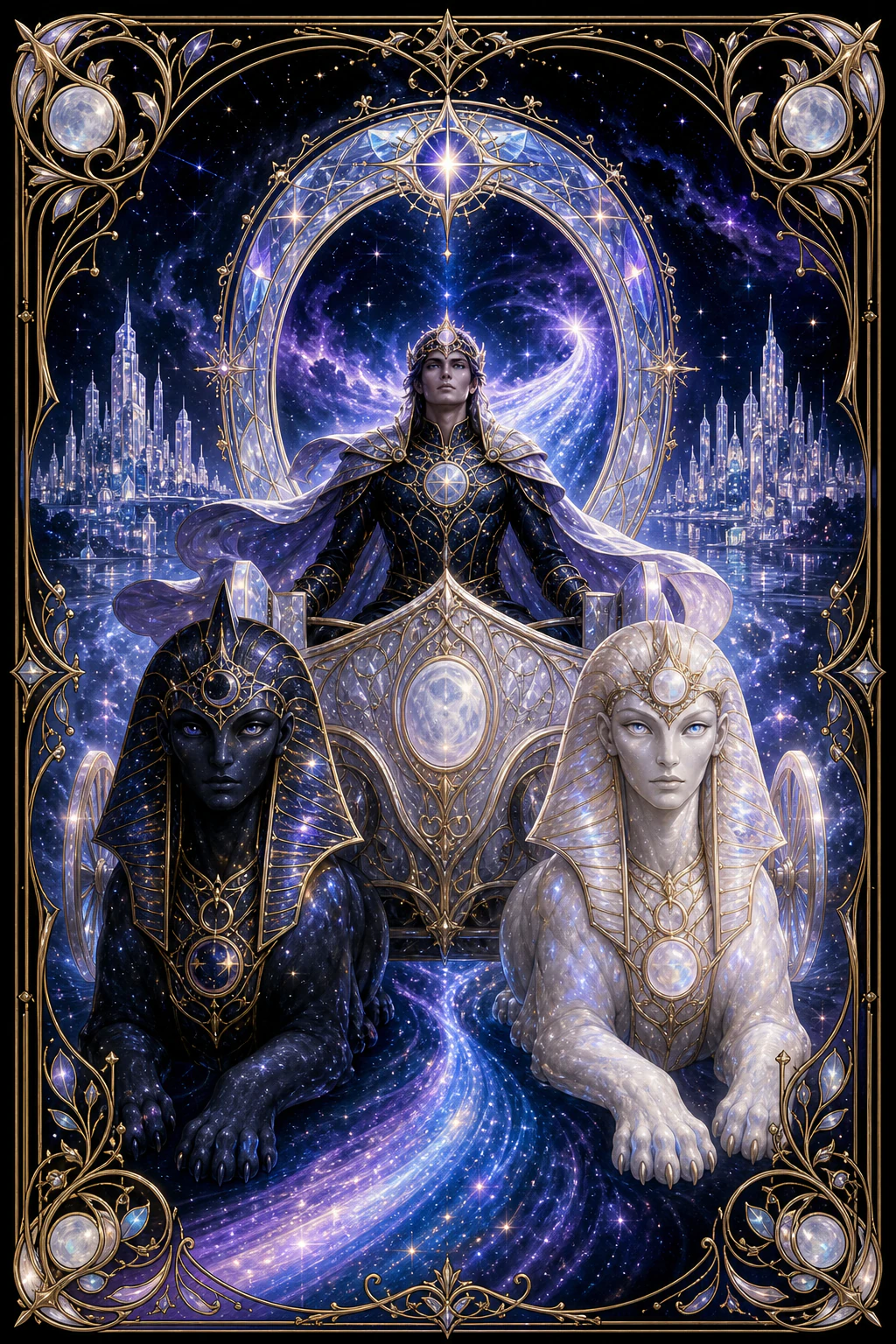
A crowned figure stands in a stone chariot beneath a canopy of stars, drawn by one black sphinx and one white one. There are no reins in his hands. The card asks what carries you forward when the usual means of steering are unavailable.
Upright The Chariot
Movement is the surface subject and control is the argument underneath. The driver holds a wand rather than reins, and the two creatures at the front face slightly different ways, which the tradition reads as opposing forces held to a single direction by will alone. Upright, the card sits with progress that comes from concentration rather than favourable conditions: the deadline met by simply continuing, the distance covered because you kept getting up. A plain reflection follows about direction versus speed. Considerable effort can be spent moving quickly along a route chosen absently, and the stone vehicle here is heavy enough to make that expensive. Consider what you are currently driving hard at, and when you last checked whether you still want it. The other reading concerns composure under pressure. The figure is armoured, crowned and completely still from the waist up, which is the picture's account of what holding a course looks like from outside: unremarkable, effortful, and entirely invisible to anyone watching. That invisibility deserves naming if you have been managing something difficult without comment.
Reversed The Chariot
Reversed, the two sphinxes tend to pull apart. The familiar reading is loss of direction — effort continuing at full intensity while the aim quietly dissolves, which is more common than stopping and considerably harder to notice. Motion makes an excellent disguise for confusion. If your weeks are full and your sense of where they are heading is thin, that is what the inverted card describes, without offering any remedy for it. There is an aggression reading too. Force applied where patience was wanted; a matter pushed because pushing is what you are practised at. The card is not moralising about drive, which it plainly admires. It observes only that a heavy vehicle at speed is poor at small adjustments. The third and gentlest reading is exhaustion. Nobody holds a course indefinitely by will, and the reversed card belongs beside anyone who has been steering so long that stopping now seems more frightening than carrying on. What would it cost to halt for a week? The answer is worth having even if the halt never happens.
The Chariot in love and relationships
In connection, this card concerns effort and direction rather than feeling. Some relationships are carried for long stretches by one person's determination, and determination is real devotion, and it also has a limit. Consider what in your life is being held together by sheer will, and whether the will is currently shared. Nothing in the image advises anybody about a relationship, and no outcome is being suggested. A second reflection concerns pace. People move toward closeness at different speeds, and the driver in the picture has one gear. If you tend to arrive at intentions faster than those around you, that is neither virtue nor fault, but it is worth knowing about yourself before it becomes an argument about something else.
The Chariot in work and study
For work, the Chariot belongs to the push: the project with a date on it, the qualification completed at the end of long days, the season whose plan is simply to keep going. Its counsel, such as it is, amounts to narrow focus for a defined period. The card is much less comfortable as a permanent setting. Sustained forward drive with no arrival built into it is how people end up competent, respected, and unable to say what any of it was for. The two sphinxes raise a question here as well. Most working lives contain two pulls — money and interest, ambition and home, the thing you are good at and the thing you would rather be doing. Nothing here resolves them. It suggests they can be harnessed to the same vehicle for a while, provided somebody is deciding where it goes.
Resources and security
Where security is concerned, the subject is momentum. Financial habits accumulate a direction of their own, and after a few years the arrangement tends to be steering rather than being steered. As reflection only, with no bearing on anything you decide: consider what your current arrangements are heading toward if continued unchanged, and whether that destination was chosen or merely arrived at. The whole point of the image is that the vehicle moves whether or not the driver is paying attention. Noticing the direction costs nothing, and it commits you to no change at all.
Attention and wellbeing
As a reflection on energy, this card concerns sustained output and its unglamorous requirement, which is that intense stretches be finite. Attention behaves rather like the sphinxes: it can be aimed for a while, and it starts to wander when the aim is held too long without a stop. You might look at whether your current pace has an end date, and if it has none, what could serve as one. Marking a finish line, even an arbitrary one, changes how the intervening weeks feel. That is a habit observation only, and nothing here concerns health of any kind.
Yes or no?
Yes
Yes, provided the direction has been chosen rather than inherited from momentum. This card favours committed movement. It forecasts nothing, so let the yes stand as an enquiry into whether the destination is one you want.
Symbolism in the card
The seventh trump shows an armoured figure standing in a square stone chariot, a canopy of six-pointed stars above, a crescent moon shaped as a face on each shoulder, and a crown bearing an eight-pointed star. On the front of the vehicle sits a winged solar disc above a lingam and yoni emblem, a Hindu symbol Waite borrowed for the union of opposites. Drawing the chariot are two sphinxes, one black and one white, taken from the frontispiece of Éliphas Lévi's writings; a city wall stands behind and a river runs past it. The driver holds a wand and no reins whatsoever, which is the detail the whole card is built on. In older Italian and Marseille packs the vehicle is drawn by two horses and the rider is a straightforward triumphal victor, part of the Renaissance procession the trumps descend from. The sphinxes, the stars and the absent reins are all later refinements toward a card about inner rather than military command.
The Chariot as today's card
Taken as the day's only card, the Chariot tends to argue for one direction and a closed door. Choose whatever matters most today and let the other items be visibly unattended rather than half-attended. It suits a day requiring nerve — the conversation you would rather delegate, the piece of work that only proceeds if you sit down with it for three hours. If today is not that sort of day, read the card the other way round: notice what you are being carried along by, and whether you ever agreed to it. A vehicle already in motion is comfortable enough that people ride for years without asking.
In a three-card spread
Drawn for what came before, it usually indicates a period of hard forward effort, and the interesting question is what that cost as well as what it achieved, since the cost is generally the part left unrecorded. Held in the present, it names a situation calling for a chosen direction and the composure to keep it while other things go temporarily unattended. The cards flanking it usually show what is pulling sideways. Placed where a reading looks onward, treat it as an enquiry into aim rather than an outcome, because outcomes are not what any of this is for: if you kept on exactly as you are, where would that put you, and is it where you intended?
Keywords
- Willpower
- Determination
- Success
- Focus
Journal prompts
- What are you driving hard at, and when did you last check that you want it?
- Which two pulls in your life are harnessed to the same vehicle right now?
- If your current pace has no end date, what could serve as one?
Cards read alongside The Chariot
- Strength — Strength, courage, persuasion, influence, compassion.
- The Magician — Manifestation, resourcefulness, power, and inspired action.
- Seven of Wands — Challenge, perseverance, defense, and standing your ground.
- Knight of Wands — Passion, adventure, bold action, and impulsive energy.
- All 78 tarot card meanings — the full major and minor arcana in one place.
Combinations with The Chariot
- The Chariot and The Lovers tarot combination
- The Chariot and Strength tarot combination
- The Chariot and The Hierophant tarot combination
- The Chariot and The Hermit tarot combination
- The Chariot and The Emperor tarot combination
- The Chariot and Wheel of Fortune tarot combination
- All 231 major arcana combinations
The Chariot by position
- The Chariot as feelings tarot meaning
- The Chariot as intentions tarot meaning
- The Chariot as outcome tarot meaning
- The Chariot as advice tarot meaning
- The Chariot as an obstacle tarot meaning
- The Chariot as action tarot meaning
- The Chariot as a person tarot meaning
- The Chariot as how someone sees you tarot meaning
- The Chariot for a yes or no question tarot meaning
- All card meanings by position
Curious what The Chariot means for your question? Turn a card on the home page — no account needed.
Draw a card freeOne card, one honest question, most evenings.
Start your free daily readingFree · One card a day · No credit card needed
Go deeper than one card
A personalized deep reading works a full spread around your question — The Chariot included, if it falls to you. Deep readings run from the $1.99 Single Card Illumination and the $7 Three-Card Path, delivered straight away, to the $19 Five-Card Compass and the $29 Celtic Cross Atlas, composed in depth and delivered within 2–4 hours.
The $29 Celtic Cross Atlas, ten cards read position by position → · All reading options →
Prefer a rhythm to a one-off? Sparkle Pro ($8.99/month or $59/year) draws a three-card past, present and future spread for you every day. There is also a free eight-phase moon ritual guide to pair with today's card.
To sit with this card longer, the tarot journaling guide has prompt sets for daily draws, moon phases, and more — including journal prompts for every major arcana card.
Tarot content is for entertainment and personal reflection, not professional advice.