Nine of Swords Tarot Card Meaning
 Start your free daily reading
Free · One card a day · No credit card needed
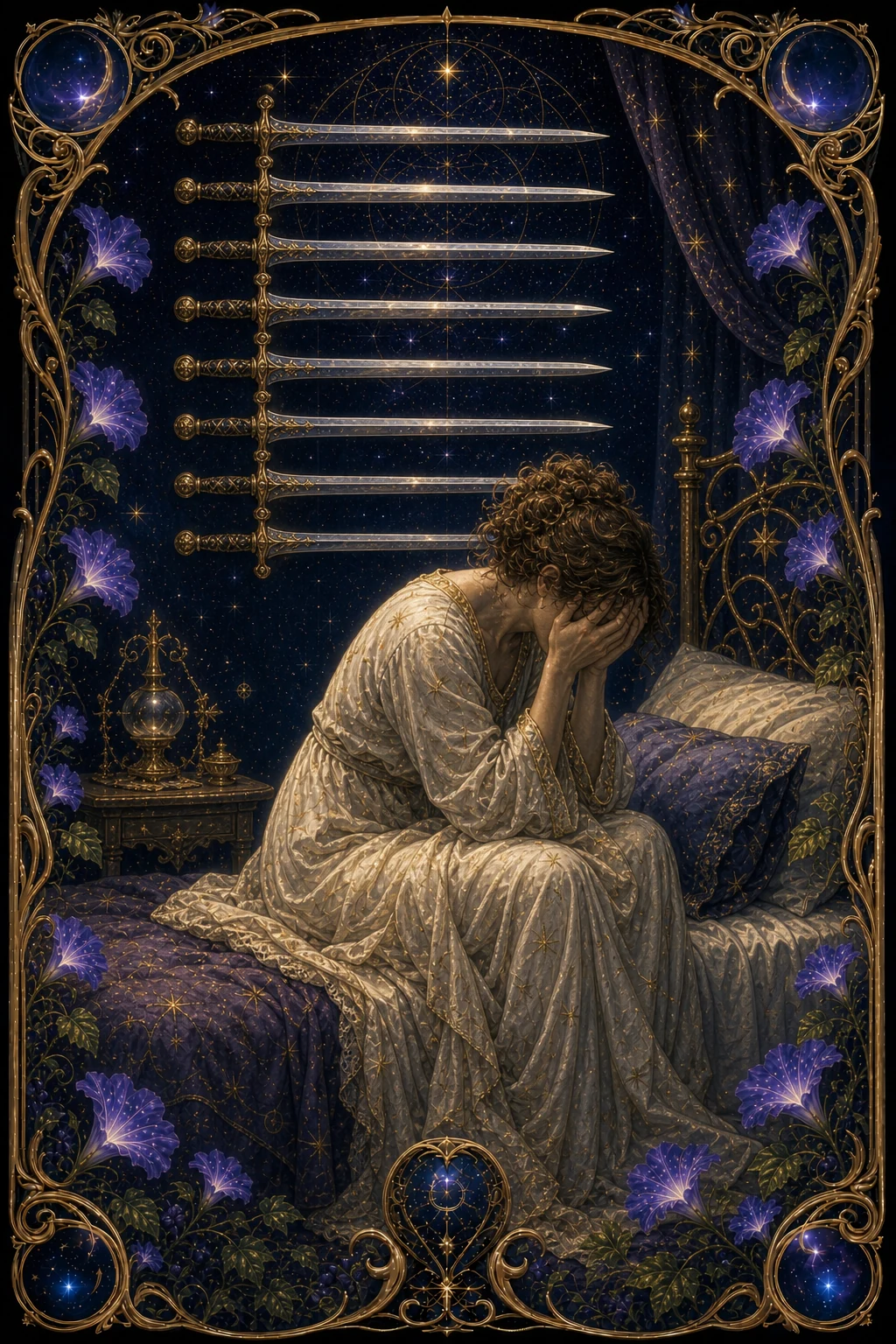
A figure sits up in bed with the face covered by both hands, in a room where nine swords hang level on the wall behind. Nothing in the picture has happened. What this card describes is an hour, not an event.
Upright Nine of Swords
Everyone who has been awake at three in the morning knows that thinking is different there. Proportion goes first. A remark from a colleague, a bill, something you said in 2014 — at that hour they all arrive the same size, and the mind, having nothing else to do, begins to rehearse. Rehearsal is the specific action of this card. Conversations get run and re-run with better lines. Outcomes get staged in detail. None of it is happening, and all of it feels like preparation. The detail that carries the whole picture is that the swords are on the wall. They hang in a neat row above the bed, and not one of them is in anyone's hand. The trouble in the image is entirely overhead: a shape the room makes, not a wound in it. Daylight is the traditional test and it is a fair one, since much of what seems enormous at three turns out to be merely tiresome at nine. This is a card about an hour and its distortions, and nothing more clinical than that. If your nights are consistently like this, that is not a matter for a deck of cards. It belongs with a doctor or someone qualified to help, who can do what a card cannot.
Reversed Nine of Swords
Reversal is usually read here as the beginning of daylight rather than as a cure for the dark. Two versions turn up, and they are worth keeping apart. In the first, the night thought gets said aloud to somebody at breakfast and immediately loses about a third of its size, which is an ordinary and slightly humiliating experience most people recognise. Things that survive being spoken tend to be the real ones; things assembled at three in the morning tend not to. In the second version, the shape stays inside and hardens into a habit of mind — a reflex of assuming the worst reading of every quiet email, carried privately into daylight where it does not belong. That version is less about the night than about what the night taught. The older sources are unusually humane about this card, and they point consistently outward: to company, to speech, to being somewhere with other people in it. Reversed, the card mostly asks whether you have told anyone. That is a question rather than an instruction, and there is no obligation to answer it today. Where the pattern is persistent, the sensible destination is a professional, not a reading.
Nine of Swords in love and relationships
In relationships, this card belongs to the conversation held with someone who is asleep beside you, or not in the room at all. It is the argument conducted entirely in your own head, in which you play both parts and the other person is given lines they would never say. That is a very common thing to do and it is not a character flaw; it is what a mind does when it has a gap and no information. The difficulty is that the imagined version can be answered, and the real person then arrives to find the matter apparently settled. If you are carrying a private grievance the other party has never been told about, the Nine simply registers the imbalance. Nothing requires you to raise it. The card only observes that one of you has been at this for weeks and the other has not been invited.
Nine of Swords in work and study
For work, this card sits with the Sunday evening and the wakeful stretch before a difficult day. Working life produces a particular kind of night thought: the unanswered message that becomes a verdict, the meeting invitation with no agenda, the sense that everyone else received a briefing you missed. Most of it is manufactured from an absence of information rather than the presence of bad news. Something plain often becomes visible when the same fear is put into one sentence, in the actual words, and read again in the morning. Sentences that seemed structural at night frequently turn out to be a question you could simply ask somebody. That is not a technique for anything; it is closer to bookkeeping. The card's own contribution is the observation that a mind given a blank will fill it in the least generous way available.
Resources and security
Money keeps unusual hours. What this card touches is the difference between a financial situation and the feeling of one, which do not always move together — people with plenty lie awake, people with very little sleep soundly, and neither fact says anything about the sums involved. As a reflection rather than advice, notice whether the figure that troubles you at night is a number you have looked at recently or an impression built up from not looking. Precision is unromantic and tends to be smaller than dread. None of this concerns your particular situation, which is yours to handle with properly qualified help if you want it.
Attention and wellbeing
Where this card touches wellbeing at all, it is mostly an observation about timing: judgement is not equally reliable at every hour, and treating a three o'clock verdict as final is a category error. Whatever got decided then is worth re-reading at a reasonable hour. Beyond that, the Nine has no business making suggestions about your body or your sleep, and it would be presumptuous to try. What it can honestly hold is the ordinary business of habit — light, hours, company, the point in an evening after which nothing useful gets decided. If the nights are a persistent pattern rather than a rough week, that is a conversation for someone medically qualified, who has tools a card does not.
Yes or no?
No
No, in as much as the card argues against settling anything in the small hours. It is not a forecast. If you asked while wakeful, the useful move is to ask again in daylight.
Symbolism in the card
The scene is an interior, and interiors are rare here. The figure sits on the edge of a bed with both hands over the face, in a plain white nightgown, against a black ground that reads as a wall and as nothing at all. Nine swords hang horizontally behind, stacked in a receding row, none of them touching the sleeper. The quilt is the detail readers return to: it is patterned in alternating squares of roses and zodiacal signs, an unusually decorative object for so bleak a card, and it implies a bed belonging to somebody with a life. Carved into the side of the bedframe is a relief of two figures duelling, one already fallen. It is a picture of a conflict, inside a picture of somebody imagining one. Older decks show none of this — the Marseille pip gives nine blades in a lattice and no room, no bed and no night. The insomniac interior is a modern reading, and its power comes largely from the choice to draw an event that is not occurring.
Nine of Swords as today's card
Drawn in the morning, this card usually refers backwards rather than forwards. It suits the day after a poor night, when the residue is still present and everything is being read through it. The useful thing to notice is that the residue is not information. Decisions made through it tend to be worse than the ones made at four in the afternoon, and there is rarely any need to make them before then. If the night was fine and the card turns up anyway, it makes a reasonable prompt to ask who in your life is currently having the other kind of night, and whether a message from you would cost much.
In a three-card spread
Where it falls on the past, the Nine tends to describe a stretch of worry rather than an event, which is worth naming precisely, since periods like that often get remembered as a crisis that never actually arrived. In the present, the card describes the weather in the room and not the state of the situation; the neighbouring cards usually carry the facts. In the future position, refuse the forecast entirely, because a deck cannot know your nights and it would be unkind of it to guess. The honest form is a question about anticipation: what are you rehearsing, and what would change if the rehearsal were replaced by asking someone directly?
Keywords
- Anxiety
- Worry
- Fear
- Stress
Journal prompts
- What did you decide at three in the morning that you have never re-read in daylight?
- Which conversation have you rehearsed most often, and does the other person know it is happening?
- Written as one plain sentence, what does the worry actually say?
Cards read alongside Nine of Swords
- Four of Swords — Rest, recovery, contemplation, and quiet renewal.
- The Moon — Illusion, fear, anxiety, subconscious, intuition.
- Three of Swords — Heartbreak, sorrow, painful truth, and emotional release.
- Ten of Swords — A painful ending, exhaustion, surrender, and a new dawn.
- All 78 tarot card meanings — the full major and minor arcana in one place.
Combinations with Nine of Swords
- Eight of Swords and Nine of Swords tarot combination
- Nine of Swords and Ten of Swords tarot combination
- Seven of Swords and Nine of Swords tarot combination
- Nine of Swords and Page of Swords tarot combination
- Six of Swords and Nine of Swords tarot combination
- Nine of Swords and Knight of Swords tarot combination
- All 2,772 minor arcana combinations
Nine of Swords by position
- Nine of Swords as feelings tarot meaning
- Nine of Swords as intentions tarot meaning
- Nine of Swords as outcome tarot meaning
- Nine of Swords as advice tarot meaning
- Nine of Swords as an obstacle tarot meaning
- Nine of Swords as action tarot meaning
- Nine of Swords as a person tarot meaning
- Nine of Swords as how someone sees you tarot meaning
- Nine of Swords for a yes or no question tarot meaning
- All card meanings by position
Curious what Nine of Swords means for your question? Turn a card on the home page — no account needed.
Draw a card freeOne card, one honest question, most evenings.
Start your free daily readingFree · One card a day · No credit card needed
Go deeper than one card
A personalized deep reading works a full spread around your question — Nine of Swords included, if it falls to you. Deep readings run from the $1.99 Single Card Illumination and the $7 Three-Card Path, delivered straight away, to the $19 Five-Card Compass and the $29 Celtic Cross Atlas, composed in depth and delivered within 2–4 hours.
The $7 Three-Card Path, three cards read as one movement → · All reading options →
Prefer a rhythm to a one-off? Sparkle Pro ($8.99/month or $59/year) draws a three-card past, present and future spread for you every day. There is also a free eight-phase moon ritual guide to pair with today's card.
To sit with this card longer, the tarot journaling guide has prompt sets for daily draws, moon phases, and more.
Tarot content is for entertainment and personal reflection, not professional advice.