Three of Swords Tarot Card Meaning
 Start your free daily reading
Free · One card a day · No credit card needed
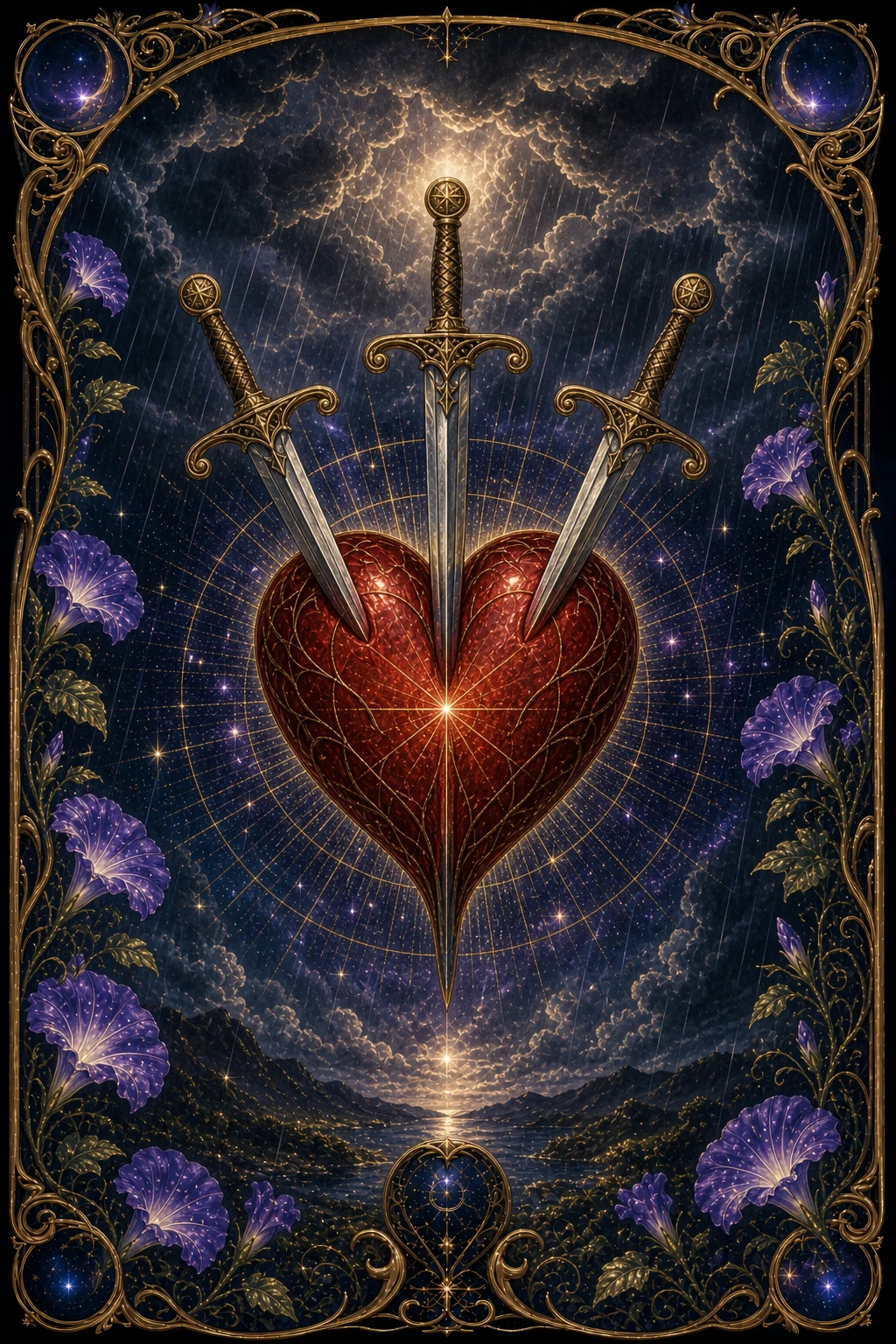
Three blades pass through a red heart against a grey sky, and rain falls across the whole card. There are no figures, no story, no before or after — only the shape of sorrow, drawn plainly. What it asks is how you tend to carry the things that have already hurt.
Upright Three of Swords
There is no gentle way to introduce this image, so the tradition mostly does not try. It is the deck's picture of grief, and it is worth saying at the outset that a card cannot know your circumstances, cannot forecast anything, and is not commenting on anyone in your life. What it offers is a place to look at sorrow you may already be carrying, which is a different thing entirely. The design is unusually abstract for this deck. No person appears, which means the heart is not anybody's in particular, and readers have long taken it as an image of the experience rather than of an event. Grief of this kind is often bound up with knowing something. The old readings pair heartbreak with painful truth for a reason: much of what hurts most is not the loss itself but the accuracy that arrives with it, the sudden legibility of a situation you had been reading generously. Rain, in this card, is doing something useful. Sorrow that is felt tends to move; sorrow held out of sight tends to stay exactly as it was. If something in your life is genuinely heavy, or has been heavy for a long time, that belongs in the company of people who love you and, where it is wanted, qualified support. A picture on a table is not equipped for it.
Reversed Three of Swords
Inverted, the swords are usually described as sliding free — though most readers are careful not to make that sound like a happy ending, because the reversed card is more often about the long middle of things than about their conclusion. Several readings live here. One is the slow work after: pain that no longer arrives fresh each morning, and the odd disorientation of noticing that. People sometimes feel disloyal when a sorrow starts to lighten, as though the weight were the last thing keeping something present. It is not, and the card is a reasonable place to sit with that particular guilt. Another reading concerns pain kept in circulation. A story retold in the same words for years, a grievance polished until it shines — the reversal can describe hurt that has become part of how a person introduces themselves. That observation is offered without judgement; some hurts earn their permanence. The third is refusal, the ache pressed down and worked around, which tends to surface sideways as irritability or distance. Nothing here describes any condition. Where sorrow is severe, persistent or frightening, it deserves the attention of people you trust and of qualified support, which no reading substitutes for.
Three of Swords in love and relationships
Where affection is concerned, this card does not say that anything is wrong between you and anyone. It is not capable of saying so, and it would not be worth much if it were. What it touches is the honest fact that caring about people includes being hurt by them occasionally, usually without malice on either side, and that most long connections carry a few unattended bruises. Some of those are worth raising and some are worth setting down. It is worth considering which of yours are which. Then there is the question of what you have not forgiven yourself for — the thing you said in a difficult year, the person you were less kind to than you meant to be. That sorrow is real too, and it tends to get less air than the other kind. Handle it as gently as you would handle it for somebody else.
Three of Swords in work and study
In working life, the card sits with disappointments that were also clarifications. The role that did not come. The project quietly closed. The moment you understood exactly how you were regarded, which was not how you had been assuming. These land harder than people admit, partly because working disappointment is supposed to be absorbed professionally and quickly. It rarely is. The reflection here is not about resilience, a word that has been asked to do too much. It is about permission to have found something genuinely disappointing before moving to what it taught you. If you are carrying an old professional hurt, notice whether it has quietly become a rule — an entire category of thing you no longer try, decided in one bad season by a version of you who was having a hard week.
Resources and security
On matters of security, this card touches the emotional residue rather than the arithmetic. Money troubles leave marks that outlast them, and people who came through a lean period often carry the reflexes long after the circumstances have changed. That is not irrational; it is a nervous system doing its filing. As reflection only, you might consider whether any of your current habits around money are answers to a situation that has since ended. Noticing is enough. None of this is guidance about money; decisions of that kind sit with you, and with an adviser who is qualified to help.
Attention and wellbeing
On the matter of daily energy, what is worth separating is feeling something from staging it. Sorrow needs room — an hour, a walk, a conversation with somebody who does not try to fix it — and it also does badly on a diet of nothing but itself. Both are true and the balance is personal. Sleep, food and daylight matter more in heavy weeks than they seem to, in the dull practical way that is easy to dismiss and hard to replace. If low feeling is persistent or severe, that is a matter for people close to you and for qualified support, and it is not something a card is equipped to address.
Yes or no?
No
No, though not as a prediction of anything. The card leans away from the option that requires you to keep overlooking something. Treat that as an observation about honesty, not about outcomes.
Symbolism in the card
This is one of the few numbered cards in the deck with no human figure at all. Smith draws a single red heart, pierced by three straight swords arranged in a fan, set against a slate sky with rain falling in short strokes across the entire surface. The image is older than the deck: pierced hearts appear throughout medieval and Renaissance devotional art, most famously in depictions of the sorrows of the Virgin, where the sword through the heart illustrates a prophecy in Luke about grief foreseen. Smith would have known the tradition well. Three, in the numbered sequence, is generally the number of something taking form — the plan realised, the third thing made by two — and in this suit that formation is the moment an understanding becomes undeniable. The rain is the detail readers argue about least and value most. It is weather, it will pass, and while it is falling it is falling on everything equally. The card is bleak and it is not violent; nothing is happening in it. The wound has already been drawn.
Three of Swords as today's card
Meeting this card in the morning is unwelcome, and the first thing worth saying is that it has no information about your day. Taken as reflection, it suggests one small kindness turned inward: fewer obligations, a slower start, a message to the person you always feel better for talking to. It also works turned outward. Somebody near you is having a difficult stretch you have half-noticed and not asked about. The card is a decent reminder to ask. If the image simply lands badly, put the deck down — that is a perfectly good reading, and there is no obligation to sit with an image that is not helping today.
In a three-card spread
Drawn into the past, this card usually refers to something you have already been through and possibly still date your life around. The useful question is what it taught you that remains true, and what it taught you that was only true then. In the present, it describes weather rather than a verdict: something is being felt, and the neighbouring cards often show what is helping. Placed third, hold it strictly as reflection and not as forecast. Nothing here indicates that any sorrow lies ahead. The honest form of the question is what you would want to have in place — people, habits, room — if a hard stretch ever came, since that is worth knowing in fair weather.
Keywords
- Heartbreak
- Sorrow
- Truth
- Release
Journal prompts
- What have you been through that still sets the rules for what you attempt?
- Whose forgiveness are you waiting on, and is any of it your own?
- Who would you tell if a week became genuinely heavy, and when did you last tell them anything?
Cards read alongside Three of Swords
- The Star — Hope, faith, purpose, renewal, spirituality.
- Five of Cups — Loss, regret, grief, and noticing what still remains.
- Six of Swords — Transition, moving forward, release, and calmer waters.
- Temperance — Balance, moderation, patience, purpose.
- All 78 tarot card meanings — the full major and minor arcana in one place.
Combinations with Three of Swords
- Two of Swords and Three of Swords tarot combination
- Three of Swords and Four of Swords tarot combination
- Ace of Swords and Three of Swords tarot combination
- Three of Swords and Five of Swords tarot combination
- King of Cups and Three of Swords tarot combination
- Three of Swords and Six of Swords tarot combination
- All 2,772 minor arcana combinations
Three of Swords by position
- Three of Swords as feelings tarot meaning
- Three of Swords as intentions tarot meaning
- Three of Swords as outcome tarot meaning
- Three of Swords as advice tarot meaning
- Three of Swords as an obstacle tarot meaning
- Three of Swords as action tarot meaning
- Three of Swords as a person tarot meaning
- Three of Swords as how someone sees you tarot meaning
- Three of Swords for a yes or no question tarot meaning
- All card meanings by position
Curious what Three of Swords means for your question? Turn a card on the home page — no account needed.
Draw a card freeOne card, one honest question, most evenings.
Start your free daily readingFree · One card a day · No credit card needed
Go deeper than one card
A personalized deep reading works a full spread around your question — Three of Swords included, if it falls to you. Deep readings run from the $1.99 Single Card Illumination and the $7 Three-Card Path, delivered straight away, to the $19 Five-Card Compass and the $29 Celtic Cross Atlas, composed in depth and delivered within 2–4 hours.
The $7 Three-Card Path, three cards read as one movement → · All reading options →
Prefer a rhythm to a one-off? Sparkle Pro ($8.99/month or $59/year) draws a three-card past, present and future spread for you every day. There is also a free eight-phase moon ritual guide to pair with today's card.
To sit with this card longer, the tarot journaling guide has prompt sets for daily draws, moon phases, and more.
Tarot content is for entertainment and personal reflection, not professional advice.