Four of Swords Tarot Card Meaning
 Start your free daily reading
Free · One card a day · No credit card needed
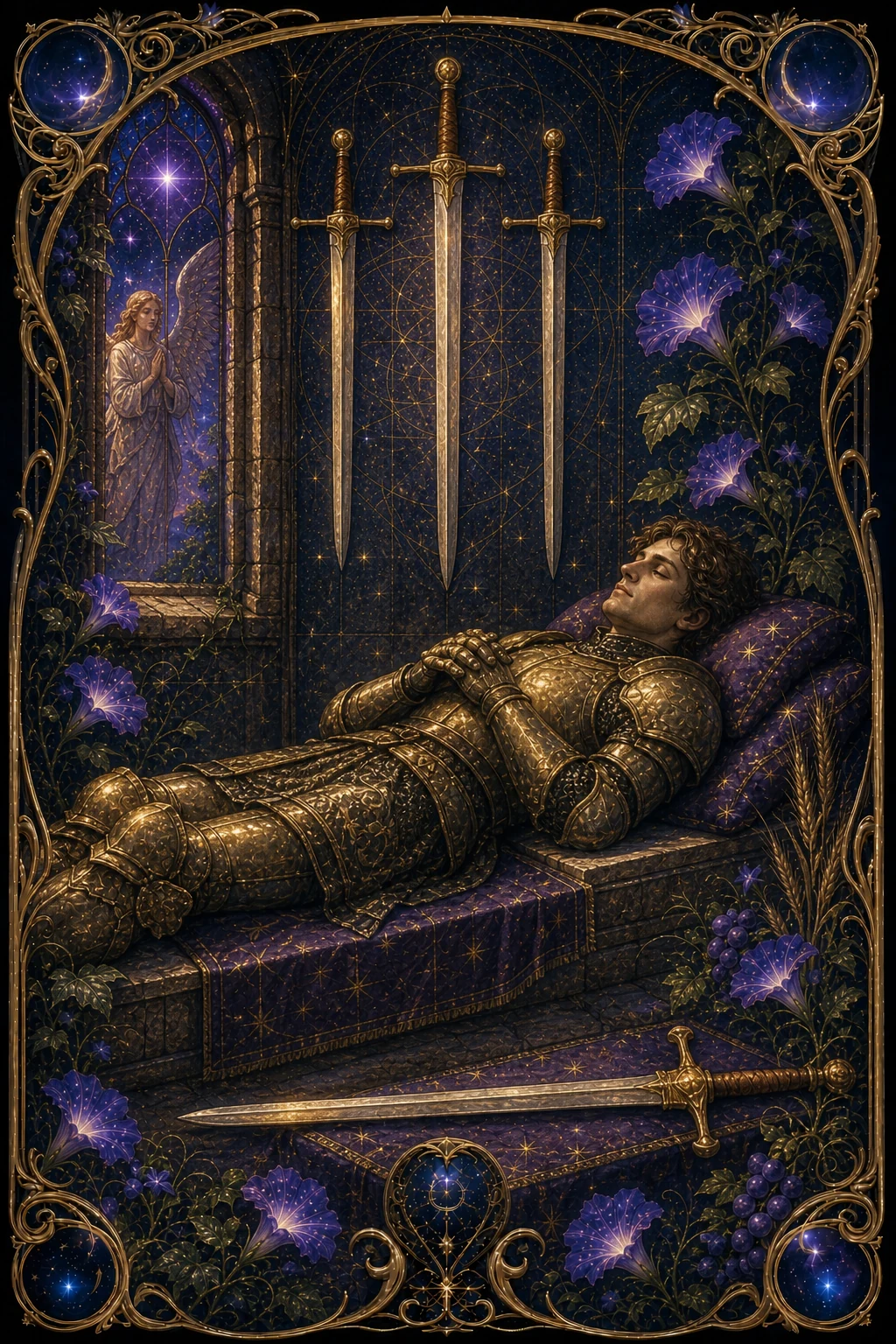
A carved figure lies full-length on a stone tomb inside a chapel, hands folded, three swords hung on the wall above and a fourth laid along the side beneath. A stained-glass window lets in one panel of coloured light. What it asks is what it would take for you to be still, and what you would set down first.
Upright Four of Swords
Upright, this is the deck's argument for the deliberate pause. The suit is otherwise full of motion — cutting, arguing, deciding, travelling — and here everything stops on purpose. Four is the number of structure in the sequence, and what is being structured in this card is stillness itself: not a collapse, not an accident of the calendar, but a break built the way you would build anything else. That distinction is most of the meaning. Anyone can stop when there is nothing left. Choosing to stop while there is still momentum is a much rarer skill, and it is the one this card describes. Note that three swords hang above the figure and only one is laid down beside them. The pause is not the end of the argument; the thinking is still on the wall, exactly where it was left, available again afterwards. The question this card tends to raise is one of permission. What would you need to be true before you allowed yourself a genuine break — not the evening spent half-working, but a real one? Many people find they have set the bar at a point they never actually reach, which is a way of never granting the thing at all.
Reversed Four of Swords
Reversed, readers usually take the figure to be sitting up, and the card turns toward the question of returning. Sometimes that is straightforward: the pause has done its work, the restlessness is genuine, and the ordinary appetite for doing things has come back on its own. Sometimes it is less straightforward, and the card describes a stop that has quietly extended past its usefulness. There is a real difference between resting and hiding, and it is not always obvious from inside. Rest tends to restore appetite; hiding tends to shrink it. If a break in your life has been going on long enough that returning has started to feel unimaginable rather than merely unappealing, that is worth noticing kindly rather than sternly. The reversal also speaks to the opposite failure — the pause refused, the fourth sword never set down, activity used as a way of not being alone in a quiet room. Both are common and neither is a character flaw. Nothing here predicts anything about your time or your plans. It asks one question: is the current arrangement of your stillness serving you, or has it simply become the arrangement?
Four of Swords in love and relationships
Between people, this card favours the unforced interval. Not distance and not withdrawal, but the recognition that closeness of every kind occasionally needs a quiet weekend rather than another conversation. Relationships are frequently over-processed. Some tensions genuinely resolve by being talked through, and others resolve by two people going about their week alongside each other and letting the temperature come down on its own. Knowing which is in front of you is most of the art. There is also a solitary reading. If you have been actively looking for connection and the looking has become a second job, this card sits comfortably with the idea of setting it aside for a season without declaring anything about it. The chapel in the picture is quiet and it is not empty. Company and stillness are not opposites, whatever the image first suggests.
Four of Swords in work and study
For work and study, the Four is the least fashionable card in the deck and quietly one of the most practical. It sits with the deliberate stop mid-project: the draft left alone for a week, the decision deferred until Monday on purpose, the holiday taken while things are going well rather than after they have stopped going well. Almost everyone who works with ideas knows that the answer tends to arrive during the interval and not during the effort, and almost nobody schedules the interval. There is a harder version. Some working lives are arranged so that stopping is genuinely expensive, and the card does not pretend otherwise. If that is your situation, the reflection scales down without losing its point: what is the smallest real pause available to you, and have you taken even that? A lunch away from the screen counts. It is not much and it is not nothing.
Resources and security
On security, the theme here is the deliberate non-decision. Not every open question needs resolving this month, and there is a kind of financial fidgeting that costs more in attention than it ever returns — the arrangements reviewed weekly, the same figures checked before bed. As reflection only, consider which of your money habits are actual maintenance and which are a way of feeling occupied with something you cannot presently change. Leaving a settled thing alone is a legitimate choice. This is not advice about your circumstances, and anything consequential is a matter for you and a suitably qualified professional.
Attention and wellbeing
This card's subject is rest as a habit rather than as a reward. Habits are scheduled, protected and slightly boring, which is what makes them work; anything that depends on feeling like it eventually stops happening. You might look at where the genuinely undemanded hours sit in your week, if any do, and whether they are in the diary or merely hoped for. Stillness also has a texture worth attending to — a walk with no destination and a scroll through a feed both count as stopping, and most people can tell which one they get up from feeling better. Notice which is which for you, without making it a project.
Yes or no?
No
No, in the sense of not yet rather than not ever. This card leans toward leaving a thing alone a while longer. If the question involves urgency, consider where the urgency actually originates.
Symbolism in the card
Smith's drawing is architectural and deliberately still. A knight lies carved on a stone tomb in what appears to be a chapel, hands pressed together in the attitude of medieval funerary sculpture, which is exactly what the figure resembles: an effigy rather than a person, the kind found in English parish churches and drawn from life by artists all over Victorian Britain. Three swords hang point-down on the wall above him. A fourth lies along the tomb's flank beneath. In the upper corner a stained-glass window shows a small scene, usually read as a supplicant kneeling before a seated figure, with the word pax sometimes reported in the glass. Four in the numbered sequence carries the sense of the settled and the structural — four walls, four corners, the square that does not move. The effigy pose is the card's central pun and its central instruction: complete stillness, held on purpose, in a building made for quiet. The colours are muted throughout except for that one window, which is the only warmth in the frame and the only thing in it that moves, in the sense that light moves.
Four of Swords as today's card
As the day's card, this one gives permission rather than instruction. Take the break you were planning to skip. Leave the thing unfinished overnight and notice whether it looks the same in the morning, which it usually does not. Decline one optional item. It is worth being specific, since a vague intention to take it easier tends to evaporate by eleven o'clock — name the twenty minutes and defend them like an appointment. If the day genuinely has no give in it, the card can point at the following one instead. Even the intention to rest at a stated future hour changes how the present hours feel, which is a small trick and a reliable one.
In a three-card spread
In the opening position, this Four often marks an interval you took, or one you were denied and have not fully made up. Both shape what came next. In the middle, it describes a present need for pause, and the cards on either side tend to show what makes stopping difficult — an obligation, a person, an idea about yourself. Set at the end, resist turning it into a promise of quiet ahead. The better use is a question about design: if this situation continued at its current pace, where would rest actually fit, and what would have to be true for you to take it without arranging an excuse first?
Keywords
- Rest
- Recovery
- Contemplation
- Renewal
Journal prompts
- What condition have you set for allowing yourself a real break, and do you ever meet it?
- When you stop, what returns first — and what does that tell you about what you have been spending?
- Which unfinished thing would look different after a week of not being touched?
Cards read alongside Four of Swords
- The Hermit — Soul-searching, introspection, being alone, inner guidance.
- The Hanged Man — Pause, surrender, letting go, new perspectives.
- Six of Swords — Transition, moving forward, release, and calmer waters.
- Nine of Cups — Contentment, satisfaction, gratitude, and wishes fulfilled.
- All 78 tarot card meanings — the full major and minor arcana in one place.
Combinations with Four of Swords
- Three of Swords and Four of Swords tarot combination
- Four of Swords and Five of Swords tarot combination
- Two of Swords and Four of Swords tarot combination
- Four of Swords and Six of Swords tarot combination
- Ace of Swords and Four of Swords tarot combination
- Four of Swords and Seven of Swords tarot combination
- All 2,772 minor arcana combinations
Four of Swords by position
- Four of Swords as feelings tarot meaning
- Four of Swords as intentions tarot meaning
- Four of Swords as outcome tarot meaning
- Four of Swords as advice tarot meaning
- Four of Swords as an obstacle tarot meaning
- Four of Swords as action tarot meaning
- Four of Swords as a person tarot meaning
- Four of Swords as how someone sees you tarot meaning
- Four of Swords for a yes or no question tarot meaning
- All card meanings by position
Curious what Four of Swords means for your question? Turn a card on the home page — no account needed.
Draw a card freeOne card, one honest question, most evenings.
Start your free daily readingFree · One card a day · No credit card needed
Go deeper than one card
A personalized deep reading works a full spread around your question — Four of Swords included, if it falls to you. Deep readings run from the $1.99 Single Card Illumination and the $7 Three-Card Path, delivered straight away, to the $19 Five-Card Compass and the $29 Celtic Cross Atlas, composed in depth and delivered within 2–4 hours.
The $7 Three-Card Path, three cards read as one movement → · All reading options →
Prefer a rhythm to a one-off? Sparkle Pro ($8.99/month or $59/year) draws a three-card past, present and future spread for you every day. There is also a free eight-phase moon ritual guide to pair with today's card.
To sit with this card longer, the tarot journaling guide has prompt sets for daily draws, moon phases, and more.
Tarot content is for entertainment and personal reflection, not professional advice.