The Moon Tarot Card Meaning
 Start your free daily reading
Free · One card a day · No credit card needed
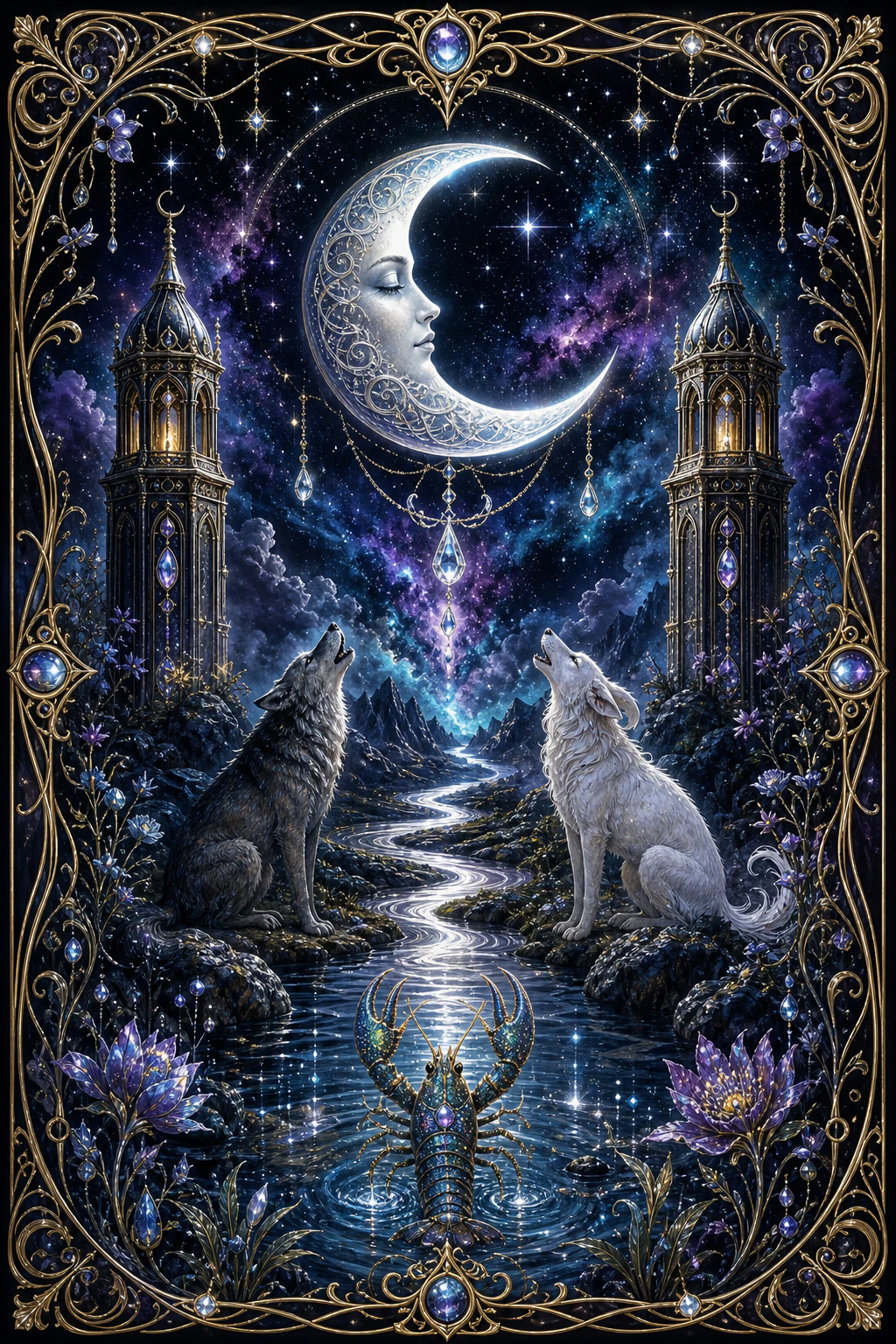
A path runs from a pool at the bottom of the card, between two grey towers, and away toward hills that the light does not reach. A dog and a wolf howl at the moon; a crayfish is halfway out of the water. Everything in the picture is visible and almost nothing in it is clear.
Upright The Moon
Upright, the card concerns the gap between what you have seen and what you have concluded. Half-light does that. A shape at the end of a lane at midnight is genuinely ambiguous, and the mind, which dislikes ambiguity considerably more than it dislikes being wrong, supplies a shape within about a second. Most of what feels like intuition is this process running well; most of what feels like certainty in an unclear situation is the same process running fast. This card does not take a position on which is happening to you. It only marks that inference is occurring and invites you to separate it from observation, which is harder than it sounds and takes a pen. The two animals are the standard illustration of the point — the same creature, one domesticated and one not, both making the same sound at the same object. Traditional readings speak of illusion and dreams, and there is a softer and truer version available: this is a card about incomplete information, and incomplete information is the ordinary condition of nearly every interesting situation. What it asks for is patience rather than vigilance. Some things resolve by being waited on rather than solved.
Reversed The Moon
Reversed, readers usually describe fog lifting, and it can be as plain as that: a misunderstanding corrected, a suspicion checked against a fact and found to be neither confirmed nor especially load-bearing. The relief in that is real, and often disproportionate to the size of the misunderstanding, because carrying an unresolved interpretation costs more than the interpretation is worth. The other direction is a doubling down. Reversal sometimes describes the point where a story has been told to yourself often enough that fresh evidence gets filed under the story rather than tested against it. The tell is usually that new information never changes the conclusion, only the explanation for it. This is an entirely ordinary human process, not a defect, and noticing it is the whole intervention. The card is not about your mind being unreliable and should not be read that way; it is about a situation being underlit. Where uncertainty has become genuinely heavy — sleep gone, the same loop running for weeks — that is a matter for people you trust and for proper support, not for a picture of a dog and a wolf.
The Moon in love and relationships
Between people, this card sits on everything unspoken and therefore interpreted. A delayed reply, a tone that was different on Thursday, an answer that was technically responsive. Interpretation flourishes in exactly these gaps, and worth remembering that an interpretation reveals a good deal about your own history and comparatively little about the other person. The remedy the card gestures at is unromantic: ask. Most of the elaborate architecture built in the small hours would not survive one direct question, and the reluctance to ask it usually turns out to be about not wanting to look like someone who needs to. If you are the one being interpreted, the reflection reverses neatly. Ambiguity you leave in place is a decision, however passive it feels, and other people are furnishing it in your absence. None of this predicts anything about a particular relationship.
The Moon in work and study
At work, this is the card of the situation you cannot see the whole of — a reorganisation half-announced, a manager's mood, a project whose actual purpose has never been stated in a meeting. Institutions produce a great deal of half-light, sometimes deliberately and more often through simple inattention. The temptation is to make the gap coherent by inventing the missing middle, then acting on the invention. A steadier approach is to write down what is known, what has been said, and what you have supplied yourself, in three separate columns, and to notice how short the first column usually is. The card is also useful for anything creative that has not yet declared itself. Work that is still forming genuinely cannot be evaluated, and asking it to prove itself early is a reliable way to lose it. Some things are only navigable at the pace of the path in the picture, which winds.
Resources and security
Where security is concerned, the subject is the difference between a fact and a forecast. Numbers feel solid; the story built on top of them rarely is, and the story is what most people are actually reacting to at two in the morning. As reflection only, you might separate what you currently know about your situation from what you have projected forward, and observe which of the two has been generating the feeling. The moon governs tides, and the traditional association here is with cycles rather than trends — the recognition that a low point in a rhythm looks identical to a decline while you are standing in it. Nothing above touches your actual finances, and a genuine decision about them is not a card's business.
Attention and wellbeing
This card's territory is night and the peculiar authority that thoughts acquire in it. Everything is more certain at three in the morning, and almost none of it survives daylight, which is a fact about attention rather than about you. If your nights have become a place where problems get worked on, the practical reflection is about the shape of the evening leading into them rather than the thoughts themselves. Light, screens, the last conversation of the day: these are habit questions and they belong to you. None of that is health guidance and it cannot stand in for any. If sleep has been difficult for a sustained stretch, the useful move is a qualified person rather than a picture.
Yes or no?
It depends
It depends, chiefly because the information available to you is probably incomplete. Rather than forcing an answer, consider what one piece of missing detail would change most, and whether it can be found.
Symbolism in the card
Numbered eighteen, the card shows a moon drawn with a face in profile inside a full disc, casting straight and curved rays, with fifteen yod shapes — the smallest letter of the Hebrew alphabet — falling from the sky. Below, a dog and a wolf face each other across a pale track, howling, and a crayfish rises from a pool in the foreground with its claws breaking the surface. Two grey towers stand at the middle distance, and the path passes between them toward high ground. Smith's arrangement follows the Marseille pattern closely, where the same crustacean, dogs and towers all appear; earlier Italian versions had shown astronomers measuring instead, and the shift toward this dreamlike scene happened somewhere in the eighteenth century. The crayfish, which climbs out and traditionally sinks back, is generally read as material surfacing and receding rather than arriving once. The towers are the detail most often skipped, and they carry the composition: identical, unlabelled, and marking the gate through which the path is obliged to pass.
The Moon as today's card
Drawn for the day ahead, this card makes a modest and slightly annoying suggestion, which is to postpone one conclusion. Not a decision, necessarily — a conclusion, of the kind reached about a person's motive or a message's tone. Hold it open until evening and see whether it still looks the same. Days under this image often involve waiting for information, and the card's contribution is mostly permission to wait without treating the delay as a problem to be solved by guessing harder. It is also a fair prompt to write down a dream if one is still hanging about at breakfast, on the grounds that the material is cheap to record and occasionally interesting.
In a three-card spread
Landing in the first slot, the Moon often marks a stretch you have never fully established the facts of, which may be why it keeps coming up. Deciding it is unresolvable is sometimes the more accurate move. In the central position, it describes present conditions as underlit rather than adverse, and the cards on either side usually indicate whether the darkness is external or supplied. Where it falls last, nothing about it forecasts an event. Treat it as a caution about method rather than result. Should this situation stay unlit longer than is comfortable, what would you like to have refrained from concluding in the meantime?
Keywords
- Illusion
- Fear
- Subconscious
- Intuition
Journal prompts
- Which recent conclusion of yours rests on something you were told, and which on something you saw?
- What question have you not asked because asking would reveal that you care?
- Where in your life are you currently mistaking a low point in a rhythm for a direction?
Cards read alongside The Moon
- The High Priestess — Intuition, sacred knowledge, divine feminine, and the subconscious.
- The Star — Hope, faith, purpose, renewal, spirituality.
- Seven of Cups — Choices, imagination, illusion, and wishful thinking.
- Two of Swords — A difficult choice, stalemate, avoidance, and inner balance.
- All 78 tarot card meanings — the full major and minor arcana in one place.
Combinations with The Moon
- The Moon and The Star tarot combination
- The Moon and The Sun tarot combination
- The Moon and The Tower tarot combination
- The Moon and Judgement tarot combination
- The Moon and The Devil tarot combination
- The Moon and The World tarot combination
- All 231 major arcana combinations
The Moon by position
- The Moon as feelings tarot meaning
- The Moon as intentions tarot meaning
- The Moon as outcome tarot meaning
- The Moon as advice tarot meaning
- The Moon as an obstacle tarot meaning
- The Moon as action tarot meaning
- The Moon as a person tarot meaning
- The Moon as how someone sees you tarot meaning
- The Moon for a yes or no question tarot meaning
- All card meanings by position
Curious what The Moon means for your question? Turn a card on the home page — no account needed.
Draw a card freeOne card, one honest question, most evenings.
Start your free daily readingFree · One card a day · No credit card needed
Go deeper than one card
A personalized deep reading works a full spread around your question — The Moon included, if it falls to you. Deep readings run from the $1.99 Single Card Illumination and the $7 Three-Card Path, delivered straight away, to the $19 Five-Card Compass and the $29 Celtic Cross Atlas, composed in depth and delivered within 2–4 hours.
The $29 Celtic Cross Atlas, ten cards read position by position → · All reading options →
Prefer a rhythm to a one-off? Sparkle Pro ($8.99/month or $59/year) draws a three-card past, present and future spread for you every day. There is also a free eight-phase moon ritual guide to pair with today's card.
To sit with this card longer, the tarot journaling guide has prompt sets for daily draws, moon phases, and more — including journal prompts for every major arcana card.
Tarot content is for entertainment and personal reflection, not professional advice.