Knight of Swords Tarot Card Meaning
 Start your free daily reading
Free · One card a day · No credit card needed
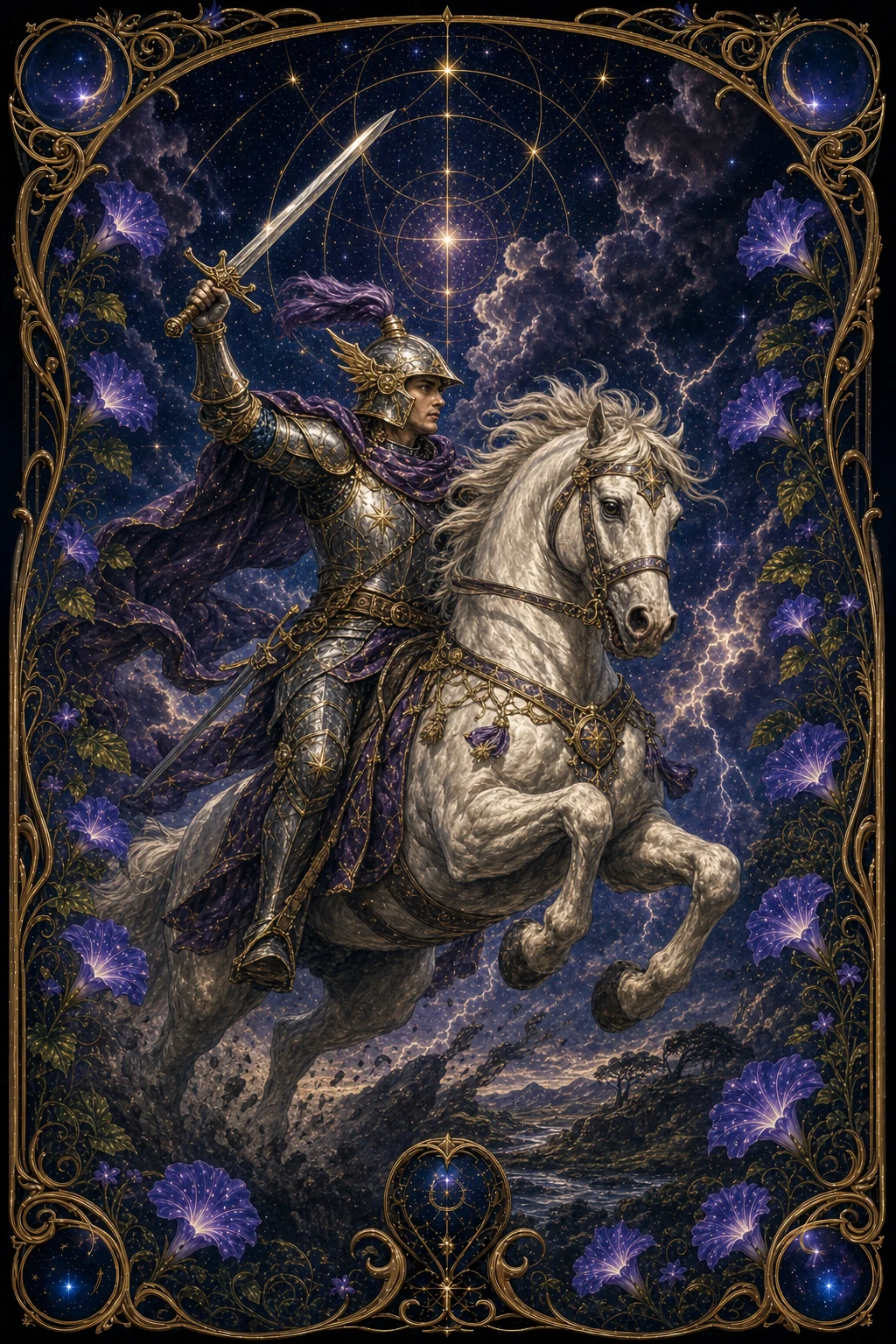
A knight in full armour drives a white horse forward at a gallop, sword raised, cloak and mane streaming, riding straight into a sky of torn cloud. Nothing in the picture is being aimed at. Velocity is the subject here, and what velocity does to accuracy.
Upright Knight of Swords
Speed is the whole matter. The horse is at full stretch, the visor is up, the sword is already high: this is a figure who decided some distance back and has not revisited it since. There is something genuinely admirable in that, and modern readings can be sniffy about it. Most things that get done are done by somebody who stopped consulting and moved, while the deliberators are frequently still deliberating when the horse is out of sight. What the card holds alongside that is the cost. Momentum makes correction expensive, and the faster the ride, the dearer it becomes to admit that the direction was wrong two fields ago. The Knight also stands for conviction expressed as argument. In the suit of the mind, charging means saying the thing — pressing the point, winning the exchange, arriving at the meeting with the case already made. Whether that reads as courage or as noise usually depends on what was at stake and who else was in the room. The reflection underneath is mostly about tempo: what have you been moving on so quickly that you have not had to feel it?
Reversed Knight of Swords
Turned over, the ride goes wrong in one of two ways. In the first, the horse is still going and the rider has lost the thread — force without direction, energy spent on the nearest available target because it is nearer than the real one. Arguments about the dishwasher are rarely about the dishwasher. This version tends to leave a mess that takes longer to repair than the original problem would have taken to address. The second version is the stall. All that charge, and nowhere permitted to put it: the plan blocked, the decision deferred by somebody else, the case prepared for a meeting that keeps being moved. Force with no outlet does not evaporate. It goes inward and becomes a low irritability that surprises the people nearby. The traditional counsel is not to slow down, which never works as an instruction, but to check the direction, which is smaller and more achievable. Reversed, this is a reasonable place to ask what you are hurrying toward, and whether the hurry belongs to the thing or was already present before it arrived.
Knight of Swords in love and relationships
Among relationships, this Knight is the fast approach and the fast exit, and tradition has always been slightly wary of both. Intensity arrives early with this card: strong statements, quick certainty, a great deal said in the first fortnight. That can be exhilarating and it is not automatically shallow, though it does tend to outrun the evidence. The other face is conflict style. Some people, when hurt, become quick and precise and go straight for the sentence that lands, and afterwards find that winning the exchange cost more than the disagreement was worth. If you recognise that in yourself, the card invites you to register it without concluding anything about your character. Speed in an argument is often what arrives instead of feeling, and the horse is generally more comfortable than standing still.
Knight of Swords in work and study
At work, the Knight of Swords belongs to the sprint. Deadlines, launches, the week in which everything is decided quickly and the momentum carries a team through work that would otherwise take a month — this figure does that well, and organisations tend to be grateful for it. The unglamorous note concerns what a sprint leaves behind. Speed makes shortcuts, and shortcuts come back later with interest, usually addressed to whoever inherits the work. There is also a question about how you handle disagreement. The suit is edged, and this Knight is at his most recognisable in the meeting where somebody is technically correct and the room has closed around them. Being right and being effective are separate skills, and the card is a decent place to ask which one you have been practising lately.
Resources and security
Where security is concerned, the Knight touches decisions made at speed. There is a particular kind of choice that gets made because deciding is more comfortable than sitting in the not-knowing, and the reasons are then written up afterwards as though they had come first. As reflection rather than guidance: consider whether any recent commitment of yours was made partly to end the discomfort of deliberating, and how the same choice would look if it were reached slowly and arrived at the same place. Some would. The card offers nothing useful about what to do with money, and real decisions belong to you and to qualified advisers.
Attention and wellbeing
Read as a note about energy, the Knight is the picture of running hot. That state has a genuine usefulness and a genuine bill, and the bill is not usually presented on the day. What the card can honestly hold is rhythm — the observation that a body kept at speed loses its ability to tell you it is at speed, and that the signals get quieter rather than louder. You might look for the small tells you have learned to ride past: the meal skipped without noticing, the evening that turned into more work. Slowing down is not the point and rarely takes as an instruction. Noticing the pace is more modest and more available.
Yes or no?
Yes
Yes, delivered at speed and with a caution attached. This card leans toward action rather than accuracy, so it is worth checking that the question being answered is still the one that matters.
Symbolism in the card
The second Swords court rides at full gallop, which no other knight in the deck is given: the horse's forelegs are entirely off the ground, and its mane and tail blow forward as though the wind came from behind and around at once. The rider wears plate armour with a red-plumed helm, cloak flying, the sword lifted high in his right fist, angled forward rather than held ready. Small birds scatter across the sky. The clouds are drawn as torn, driven shapes and the trees below bend hard in the same direction — the same wind that ruffles the Page's field, stronger by several grades. The horse's harness is decorated with birds and butterflies, motifs the whole suit shares. Knights in the older Italian decks were cavalry, the middle rank of a household between servant and lord, and the tarot inherited them as figures of errand and motion. This one has long been read as the tradition's picture of intellect committed to action before the argument is quite finished.
Knight of Swords as today's card
Pulled for the day, this Knight generally suits the morning when a decision has been sitting about too long and the deciding has become the problem. It argues for moving. Send the message, book the thing, say the sentence you have been drafting since Tuesday. Its other daily use is a caution about tone. On a fast day the messages get shorter, and the shortness reads differently at the other end than it did while writing. Rereading before sending is the least romantic thing this figure could possibly recommend, which is probably why it deserves mentioning. Speed is a fine instrument as long as somebody is steering.
In a three-card spread
In the past position, the Knight often marks a period of high momentum, and the useful question is what it produced and what it flattened, because both generally happened. In the present, he describes the pace of a situation rather than its merits; its companions usually indicate whether the speed belongs to you or is being set by somebody else, which is a distinction worth drawing carefully. Placed in the future, hold him strictly as a question about tempo. If this matter were approached quickly, what would that gain, what would it cost, and which of those two have you been more willing to count?
Keywords
- Ambition
- Action
- Intensity
- Drive
Journal prompts
- What are you moving on quickly enough that you have not had to sit with it?
- When did being right last cost more than it was worth?
- Which decision has waited so long that the waiting is now the problem?
Cards read alongside Knight of Swords
- Eight of Wands — Momentum, swift action, movement, and rapid communication.
- Knight of Wands — Passion, adventure, bold action, and impulsive energy.
- Two of Swords — A difficult choice, stalemate, avoidance, and inner balance.
- The Chariot — Control, willpower, success, action, and determination.
- All 78 tarot card meanings — the full major and minor arcana in one place.
Combinations with Knight of Swords
- Page of Swords and Knight of Swords tarot combination
- Knight of Swords and Queen of Swords tarot combination
- Ten of Swords and Knight of Swords tarot combination
- Knight of Swords and King of Swords tarot combination
- Nine of Swords and Knight of Swords tarot combination
- Knight of Swords and Ace of Pentacles tarot combination
- All 2,772 minor arcana combinations
Knight of Swords by position
- Knight of Swords as feelings tarot meaning
- Knight of Swords as intentions tarot meaning
- Knight of Swords as outcome tarot meaning
- Knight of Swords as advice tarot meaning
- Knight of Swords as an obstacle tarot meaning
- Knight of Swords as action tarot meaning
- Knight of Swords as a person tarot meaning
- Knight of Swords as how someone sees you tarot meaning
- Knight of Swords for a yes or no question tarot meaning
- All card meanings by position
Curious what Knight of Swords means for your question? Turn a card on the home page — no account needed.
Draw a card freeOne card, one honest question, most evenings.
Start your free daily readingFree · One card a day · No credit card needed
Go deeper than one card
A personalized deep reading works a full spread around your question — Knight of Swords included, if it falls to you. Deep readings run from the $1.99 Single Card Illumination and the $7 Three-Card Path, delivered straight away, to the $19 Five-Card Compass and the $29 Celtic Cross Atlas, composed in depth and delivered within 2–4 hours.
The $19 Five-Card Compass, five positions and a keepsake → · All reading options →
Prefer a rhythm to a one-off? Sparkle Pro ($8.99/month or $59/year) draws a three-card past, present and future spread for you every day. There is also a free eight-phase moon ritual guide to pair with today's card.
To sit with this card longer, the tarot journaling guide has prompt sets for daily draws, moon phases, and more.
Tarot content is for entertainment and personal reflection, not professional advice.