Two of Swords Tarot Card Meaning
 Start your free daily reading
Free · One card a day · No credit card needed
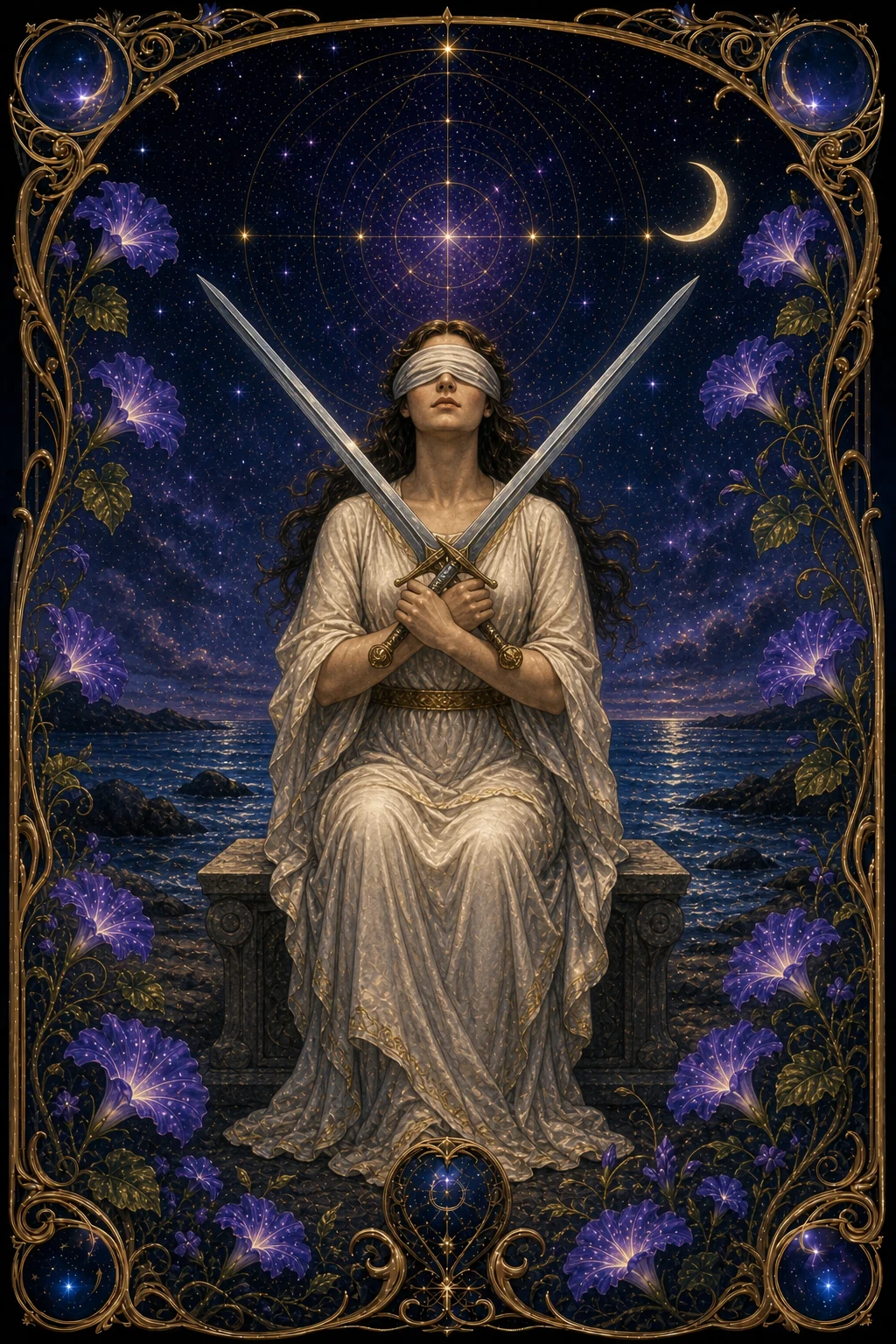
A seated figure in grey holds two crossed swords against her chest, blindfolded, with a moonlit sea and scattered rocks behind her. She is balanced, and she is not looking at anything. The card asks what you are keeping in that position, and how much it weighs.
Upright Two of Swords
Upright, this is the deck's portrait of a held breath. The blades are equal, the arms are crossed, and the whole arrangement is stable in the way that a stalemate is stable — nothing moves, and holding it still takes constant work. Traditional readings call it a difficult choice, though the card is less about the difficulty than about the posture people adopt while not making one. The blindfold is the honest part. Some things genuinely cannot be seen yet, and waiting in the dark is a reasonable response to insufficient information. But a blindfold is also something worn, and there is a difference between not having the facts and having arranged not to. Only you can say which you have on. What tends to surface when sitting with this card is the cost side of the ledger. A decision deferred is not free; it draws quietly on attention for as long as it stays open, and people are often startled by how much energy an unmade decision was using once it is finally made. The card does not push. It notices that you have been carrying two heavy things, evenly, for a while, and asks whether the balance was chosen or simply arrived at.
Reversed Two of Swords
Reversed, the arms come apart. Most readers take this as the blindfold loosening — information arriving, or a refusal finally worn out, or the plain exhaustion that eventually ends a stalemate on its own terms rather than yours. That last version deserves saying honestly: a choice avoided for long enough often gets made by circumstance, and the result is rarely worse than feared, but it does belong to somebody else. There is another reading in which reversal describes overwhelm rather than release. The swords fall and everything that was being held apart runs together — every consideration at once, none of them ranked, which feels like clarity arriving and behaves like noise. If that is the shape of things, the useful move is smaller than deciding. It is separating what you actually know from what you have been assuming, on paper, in two columns. The reversed card also touches something quieter: the moment you admit you already know your answer and have been waiting for permission or for better evidence to justify it. Nothing here predicts how anything resolves. It asks what would change if you allowed yourself to have a preference.
Two of Swords in love and relationships
In connection, this card sits with the conversation that both people can feel and neither has opened. Not conflict — the two of you may be perfectly warm — but a suspended question about direction, or commitment, or something one person needs and has decided is unreasonable to want. The blindfold matters here. It is remarkably easy to avoid knowing how someone feels by never quite creating the conditions in which they could tell you. If a stalemate in your life has lasted a long time, it may be worth asking what the balance is protecting, because balances of this kind usually protect somebody. Sometimes it is you, and sometimes it is a version of the relationship that neither of you would choose again from scratch. The card offers no verdict on anyone's situation. It only notes that not-looking is a position, not an absence of one.
Two of Swords in work and study
At work, the Two arrives around choices where both options are defensible and the defence is the problem. Two good roles. Two directions for a project. Staying or going, argued to a draw so many times that the arguing has become the routine. This card is less interested in which is right than in what you are gaining from the suspension — and there is usually a gain, or it would not have lasted. Perhaps neither option can disappoint you while both remain hypothetical. Perhaps declaring for one means telling somebody something. A practical reflection: if a colleague brought you this exact choice with these exact facts, what would you say to them, and how quickly? Most people answer that faster than they answer for themselves, which is worth a moment's attention on its own.
Resources and security
Regarding security, the Two touches the specific discomfort of the unopened envelope. Money is one of the few areas where not looking has a genuine short-term benefit: the situation stays exactly as uncertain as you left it, and uncertainty is more comfortable than a number when you fear the number. As reflection rather than guidance, consider whether anything in your arrangements is currently being held in balance by inattention, and what the balance costs in background worry. Learning where things stand is not the same as fixing them, and it is often the cheaper half. What follows is yours to weigh, and anything substantial should be taken to a qualified adviser.
Attention and wellbeing
The energy question in this card is the low, constant draw of anything left unresolved. Open questions run in the background whether or not you are consciously working on them, and they show up as tiredness that seems out of proportion to the day. You might list what is currently unfinished in your head — not to finish it, just to see the length of the list. Some items can be closed in ten minutes. Some are not yours. A few are genuinely waiting on something outside you, and naming those as waiting rather than pending tends to release a surprising amount of the pressure they were generating.
Yes or no?
It depends
It depends, and the card is fairly unapologetic about it. This is the image of a question held open rather than settled. If you need an answer today, consider whether you are missing information or missing permission.
Symbolism in the card
Smith seats a woman on a plain stone bench at the water's edge, dressed in a pale grey robe, blindfolded with white cloth. She holds two long swords crossed over her heart, arms folded, the points raised well above her head — a pose that looks composed and is in fact quite hard to sustain. Behind her a dark sea is broken by rocks and a small island, and a crescent moon sits in the upper right of an otherwise empty sky. The water is traditionally read as feeling, which she has turned her back on entirely, and the moon as the light you get when there is no sun: enough to navigate by, not enough to see with. The crossed blades echo older allegorical images of Justice with her scales, and the blindfold carries the same double meaning it does there — impartiality in one reading, wilful blindness in another. It is a still card in a suit full of motion. Everything in it is waiting, and the waiting has been drawn as an achievement of balance rather than a failure of nerve.
Two of Swords as today's card
Drawn on an ordinary morning, this card tends to point at whatever you have been stepping around. The practical version is modest: pick the smallest open question in your life and close it today, on the grounds that the muscle matters more than the item. Reply to the message. Choose the restaurant. Say the preference you have been calling flexible. If instead the day genuinely calls for waiting, the card is equally happy — but say to yourself that you are waiting, and for what, and roughly until when. Undeclared waiting is where most of the fatigue lives. Declared waiting is nearly restful by comparison.
In a three-card spread
Appearing first, the Two often points to a fork you did not treat as one at the time, a period of holding still that shaped things quietly. It can be worth reconstructing what you actually knew then, since hindsight tends to award you information you did not have. In the centre, it describes the current arrangement: something suspended, deliberately or otherwise, with the surrounding cards suggesting what feeds the suspension. As the final card, avoid reading it as a stalemate ahead. Better to hold it as an enquiry — if nothing were decided here, what would that cost, and who besides you would carry the cost?
Keywords
- Choice
- Stalemate
- Avoidance
- Balance
Journal prompts
- What are you holding evenly at the moment, and what would drop if you let one side down?
- Where are you waiting for information, and where are you waiting for permission?
- What would you advise a friend in your exact position, and why is it easier to say for them?
Cards read alongside Two of Swords
- Ace of Swords — Clarity, breakthrough, truth, and a new intellectual path.
- The High Priestess — Intuition, sacred knowledge, divine feminine, and the subconscious.
- Seven of Cups — Choices, imagination, illusion, and wishful thinking.
- The Moon — Illusion, fear, anxiety, subconscious, intuition.
- All 78 tarot card meanings — the full major and minor arcana in one place.
Combinations with Two of Swords
- Ace of Swords and Two of Swords tarot combination
- Two of Swords and Three of Swords tarot combination
- King of Cups and Two of Swords tarot combination
- Two of Swords and Four of Swords tarot combination
- Queen of Cups and Two of Swords tarot combination
- Two of Swords and Five of Swords tarot combination
- All 2,772 minor arcana combinations
Two of Swords by position
- Two of Swords as feelings tarot meaning
- Two of Swords as intentions tarot meaning
- Two of Swords as outcome tarot meaning
- Two of Swords as advice tarot meaning
- Two of Swords as an obstacle tarot meaning
- Two of Swords as action tarot meaning
- Two of Swords as a person tarot meaning
- Two of Swords as how someone sees you tarot meaning
- Two of Swords for a yes or no question tarot meaning
- All card meanings by position
Curious what Two of Swords means for your question? Turn a card on the home page — no account needed.
Draw a card freeOne card, one honest question, most evenings.
Start your free daily readingFree · One card a day · No credit card needed
Go deeper than one card
A personalized deep reading works a full spread around your question — Two of Swords included, if it falls to you. Deep readings run from the $1.99 Single Card Illumination and the $7 Three-Card Path, delivered straight away, to the $19 Five-Card Compass and the $29 Celtic Cross Atlas, composed in depth and delivered within 2–4 hours.
The $7 Three-Card Path, three cards read as one movement → · All reading options →
Prefer a rhythm to a one-off? Sparkle Pro ($8.99/month or $59/year) draws a three-card past, present and future spread for you every day. There is also a free eight-phase moon ritual guide to pair with today's card.
To sit with this card longer, the tarot journaling guide has prompt sets for daily draws, moon phases, and more.
Tarot content is for entertainment and personal reflection, not professional advice.