Eight of Wands Tarot Card Meaning
 Start your free daily reading
Free · One card a day · No credit card needed
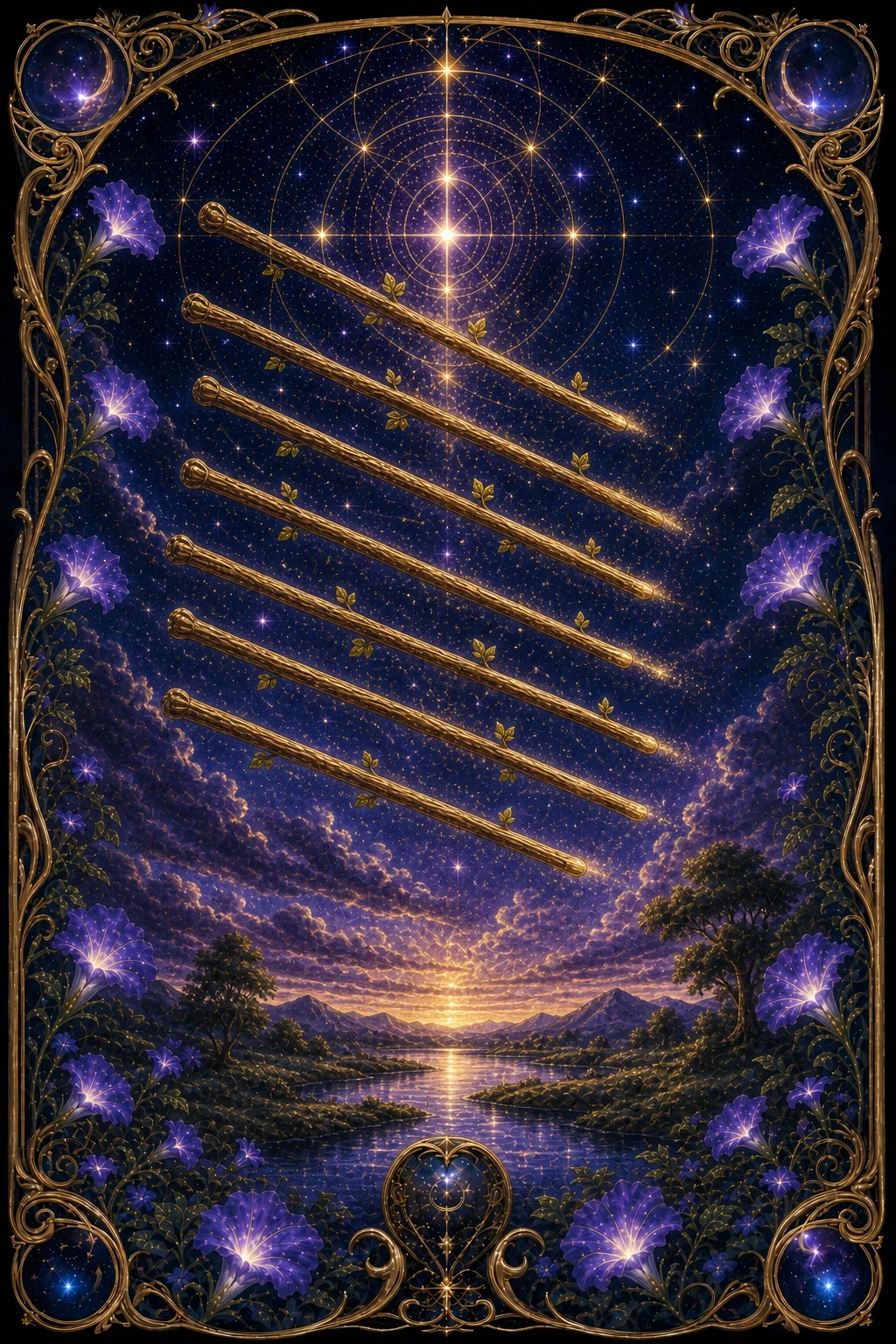
Eight budding staves cross a clear sky above green country and a thin river, all of them level, none of them held. There is no person anywhere in the frame. The card asks what in your life is already in flight, having left your hands some time ago.
Upright Eight of Wands
The unusual thing about this card is the empty foreground. Every other numbered card in the suit gives you somebody to identify with — a figure holding, defending, carrying. Here the staves travel on their own, and the reflection follows from that: some part of what you set going is now beyond the reach of your management. Traditionally the card is read as speed, messages, and the sudden unblocking of something that had been stuck for a season. Sit with it a moment longer and the more useful theme is release. Words leave the mouth and become other people's property. Applications go out. A decision made in April behaves in September in ways April could not have anticipated. None of this is prediction; it is simply what happens to anything launched. The staves are drawn in the descending half of their arc, which readers argue about endlessly. Some see arrival, some see the loss of altitude that follows enthusiasm. Both readings ask the same thing of you: whether you would still choose the direction now, having lost the ability to choose the speed. Upright, this card sits comfortably with anyone who prefers doing to deliberating, and it gently notes what that preference costs in second thoughts.
Reversed Eight of Wands
Turned, the flight stalls or scatters. The classic readings speak of delay, of crossed wires, of the message that arrived in the wrong tone and had to be explained twice. Anyone who has waited three weeks for a reply that took four minutes to write knows the specific texture of this. It is worth separating the kinds of stall. There is the external kind, where the thing genuinely sits in somebody else's inbox and nothing you do moves it. There is the internal kind, where the draft is finished and unsent and you have been calling that waiting. The reversed card is a fair place to work out which one you are living in, since only one of them is yours to change and pretending otherwise is tiring. A second reading concerns velocity without aim. Eight things moving is not the same as progress, and the reversal often describes a life that has become very busy in the direction of nothing in particular. If you have been mistaking the sensation of speed for the fact of it, this is a quiet correction rather than an accusation. Nothing here forecasts a delay or promises its end. It only asks what you would do with the pause if you decided to call it one.
Eight of Wands in love and relationships
For connection, this card belongs to the sentence already sent. Something has been said, or written, or implied clearly enough that both people heard it, and the interval afterwards is the whole of the experience. That interval is where most of us behave worst: rereading, editing in retrospect, drafting the follow-up that would soften it. The card offers no reassurance about how a thing lands, and it would be dishonest to pretend a shuffled deck knows. What it does raise is your own conduct in the gap. Some people fill it with more messages. Others go quiet and call it dignity. Neither is a virtue, exactly. If a relationship of any kind is in a fast stretch — a great deal of contact, a great deal of momentum, very little settling — there is a fair question about whether the pace is shared or whether one of you is being carried along by the other.
Eight of Wands in work and study
In work and study, the Eight suits the week when everything you sent out comes back at once. It also suits its opposite: the long overdue thing finally moving because somebody else finally acted. Either way, the card describes conditions rather than merit. A useful reflection is about what you release and how. Most working days are a sequence of small dispatches — the note, the estimate, the file handed on — and each of them keeps arriving somewhere long after you have forgotten sending it. It is worth asking whether your dispatches are as careful as your deliberations, because for a great many people they are not. There is also a temptation the card names precisely. When several things are in the air, it can feel like the moment to add a ninth. The picture already looks crowded, and it declines to say whether that is thrilling or unmanageable.
Resources and security
On the subject of security, this card touches speed rather than sums. Money moves faster than attention does, and things arranged quickly tend to be reviewed slowly, if at all. As a reflection: consider what in your arrangements you set up in one afternoon and have not looked at since — the recurring thing, the automatic thing, the amount that leaves without asking. Not because anything is wrong with it, but because standing arrangements have a way of outliving the reasons that made them. None of this is advice about your circumstances, which belong to you and to anyone properly qualified you choose to consult.
Attention and wellbeing
Read as a note on attention, the Eight belongs to the days that arrive already in motion. Notifications, replies, the small constant business of being reachable — all of it is drawn here as things flying at you with nobody visible to intercept them. The reflection is simple and not easy: notice how much of the pace is arriving and how much you are generating. Attention has a speed of its own, and it takes a surprisingly long while to slow down once it has been running fast all morning. You might observe how long the descent takes on an ordinary evening, without asking yourself to make it any shorter.
Yes or no?
Yes
Yes, and quickly, in the sense that this card leans toward things already in motion rather than things awaiting a decision. Read it as a nudge to look at what you have set going rather than a promise about where it lands.
Symbolism in the card
Pamela Colman Smith drew this one almost as a landscape. Eight budding staves fly in parallel across a pale sky over low green hills, a river below and a small house on the far bank, and unlike every other card of the suit there is no human figure at all. The wands are sprouting leaves, the same detail carried through the whole suit from the Ace, which keeps them alive rather than merely thrown. Their angle is a matter of long dispute among readers: they are usually described as landing, though nothing in the image says where. Waite's own commentary is unusually terse here, calling them the wands in movement and little else, and much of the modern language of speed and news accumulated afterwards. The older Italian pip cards showed eight batons arranged in a pattern with no scene around them, so the countryside, the water and the distant house are Smith's additions. They give the flight somewhere to have come from and somewhere to be going, which is most of why the card feels like a journey rather than a diagram.
Eight of Wands as today's card
As the single card of a morning, this one usually reads as a note about tempo. It suits a day with a lot of small dispatches in it and makes a reasonable prompt to send the ones you have been holding. It also suits the opposite use: pick the single thing you have been meaning to put in motion and put it in motion before the day fills. If the day turns out to be slow and nothing arrives, the card has not failed. A deck cannot know your calendar. It leaves you with the same question either way — what is already out there with your name on it, and how are you behaving while you wait?
In a three-card spread
In the past position, the Eight tends to mark the point where something left your control, often a message or a decision whose consequences arrived on their own schedule. Naming that moment precisely is worth more than describing what followed. In the present, it reads as a crowded interval: several things in flight, few of them recallable. Nearby cards tend to say whether it feels like momentum or like weather. In the future position, keep it as a question rather than a timeline. If this situation kept moving at its current speed, what would you want to have said clearly before it did, and to whom?
Keywords
- Momentum
- Action
- Movement
- News
Journal prompts
- What is already in flight that you cannot call back, and how do you feel about the version of you who sent it?
- Which stall in your life is genuinely somebody else's, and which one is a draft you have not sent?
- When the pace picks up, what is the first thing you stop doing carefully?
Cards read alongside Eight of Wands
- Ace of Wands — Inspiration, creative potential, and a powerful new spark.
- Three of Wands — Expansion, foresight, enterprise, and opportunities ahead.
- Knight of Wands — Passion, adventure, bold action, and impulsive energy.
- The Chariot — Control, willpower, success, action, and determination.
- All 78 tarot card meanings — the full major and minor arcana in one place.
Combinations with Eight of Wands
- Seven of Wands and Eight of Wands tarot combination
- Eight of Wands and Nine of Wands tarot combination
- Six of Wands and Eight of Wands tarot combination
- Eight of Wands and Ten of Wands tarot combination
- Five of Wands and Eight of Wands tarot combination
- Eight of Wands and Page of Wands tarot combination
- All 2,772 minor arcana combinations
Eight of Wands by position
- Eight of Wands as feelings tarot meaning
- Eight of Wands as intentions tarot meaning
- Eight of Wands as outcome tarot meaning
- Eight of Wands as advice tarot meaning
- Eight of Wands as an obstacle tarot meaning
- Eight of Wands as action tarot meaning
- Eight of Wands as a person tarot meaning
- Eight of Wands as how someone sees you tarot meaning
- Eight of Wands for a yes or no question tarot meaning
- All card meanings by position
Curious what Eight of Wands means for your question? Turn a card on the home page — no account needed.
Draw a card freeOne card, one honest question, most evenings.
Start your free daily readingFree · One card a day · No credit card needed
Go deeper than one card
A personalized deep reading works a full spread around your question — Eight of Wands included, if it falls to you. Deep readings run from the $1.99 Single Card Illumination and the $7 Three-Card Path, delivered straight away, to the $19 Five-Card Compass and the $29 Celtic Cross Atlas, composed in depth and delivered within 2–4 hours.
The $7 Three-Card Path, three cards read as one movement → · All reading options →
Prefer a rhythm to a one-off? Sparkle Pro ($8.99/month or $59/year) draws a three-card past, present and future spread for you every day. There is also a free eight-phase moon ritual guide to pair with today's card.
To sit with this card longer, the tarot journaling guide has prompt sets for daily draws, moon phases, and more.
Tarot content is for entertainment and personal reflection, not professional advice.