Knight of Wands Tarot Card Meaning
 Start your free daily reading
Free · One card a day · No credit card needed
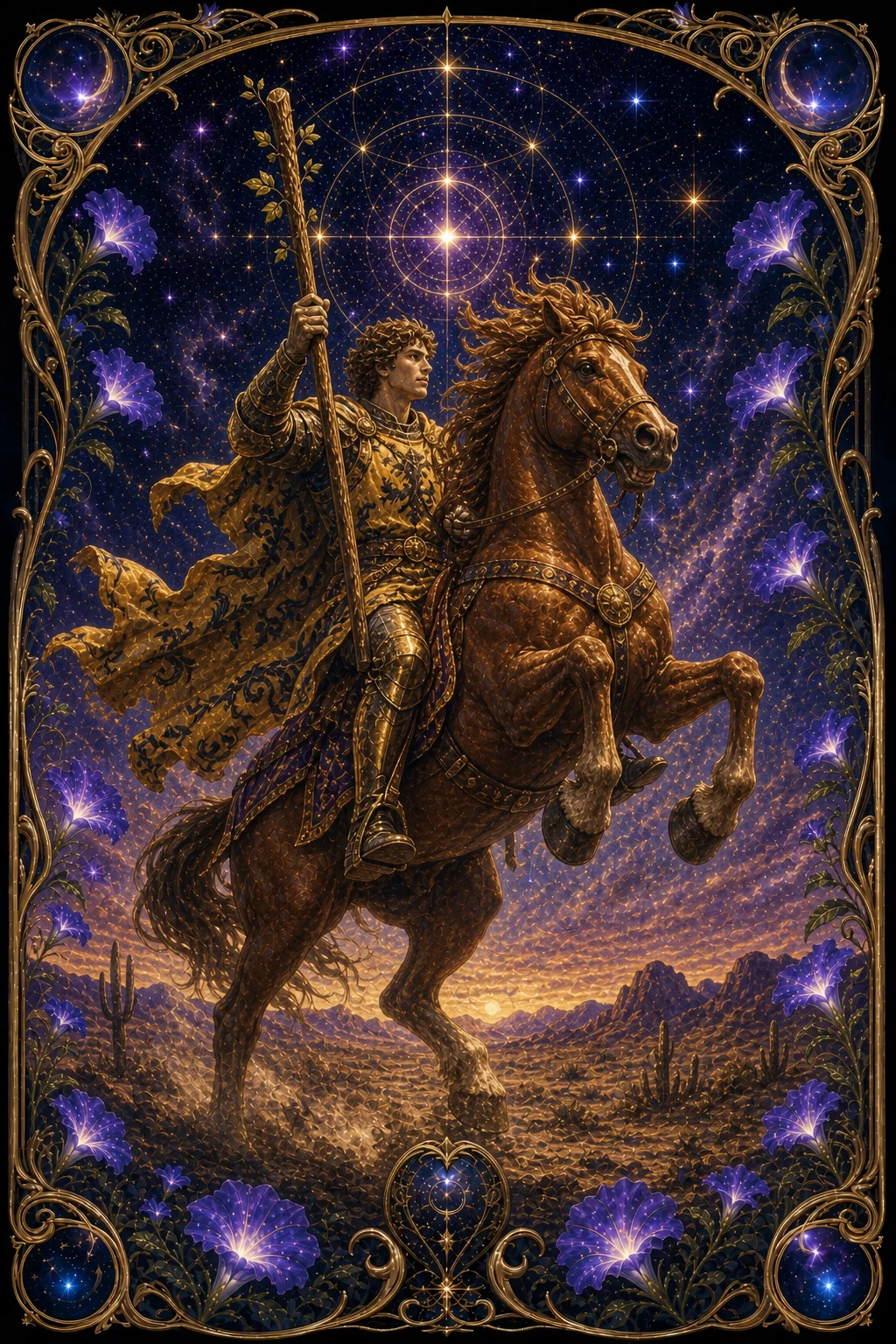
A knight in a plumed helmet sits a rearing horse, armour bright, staff angled forward like a lance he has forgotten is not one. The desert behind holds the same three pyramids the Page ignored. The card asks what you do with a feeling when the feeling arrives, and how quickly.
Upright Knight of Wands
Here is the deck's most kinetic figure. The horse is up on its hind legs and the rider is going with it, which is either superb horsemanship or none at all, and the picture refuses to settle the matter. What is clear is that a decision has been made with the body rather than the head. Knights carry their suit's energy outward, and fire moving outward looks like this: conviction converted into speed before anyone has finished the sentence. There is genuine value in it. Some things only ever get done by people who did not wait for the full picture, and the deliberate among us underestimate how much of the world was built by the impatient. The card also carries a well-documented cost. Arrival is not this figure's strength. Beginnings are thrilling, middles are dull, and there is always another horizon available to anyone whose horse is already moving. Sitting with the card, the useful question is not whether you are impulsive. It is what impulse tends to be doing for you. For a great many people, sudden motion is an extremely effective way of not having a slower and more uncomfortable thought.
Reversed Knight of Wands
Reversed, the heat has nowhere to go. The classical readings speak of recklessness, of a temper that arrives fast and departs faster than the people it landed on, of energy that scatters into half a dozen exits. Held more kindly, the reversal often describes frustration: the same charge with the gallop removed. Anyone who has spent a season wanting badly to move and finding no direction available knows that this is not calm. It is engine noise. There is a second reading about charm, and it is the less flattering one. This figure is easy to like at speed and harder to rely on at rest, and reversal sometimes points at the distance between those two facts — the promise made warmly and meant sincerely at the time. If you have been on either side of that, it is worth being precise about which. The card is not a character judgement. Fire is not a moral quality; it is a temperature, and everyone has met their own version of running hot. The question posed by the reversal is what happens to yours when there is nowhere acceptable to put it.
Knight of Wands in love and relationships
In matters of connection, this figure is the pursuit rather than the partnership. Attention arrives at full brightness, which is lovely to be on the receiving end of and difficult to interpret, since intensity and interest are not the same measurement. The card raises a fair question for whoever is being swept along: what has actually been offered, as opposed to what has been implied by enthusiasm? And a fair question for the sweeper: whether the ardour is for this person specifically or for the state of being ardent, which is a considerably more available commodity. None of this is cynicism. Passion is not a lesser form of love and it does not become one by burning quickly. It is only that the card is honest about the difference between the beginning of something and the whole of it, and the beginning is where this figure is most at home.
Knight of Wands in work and study
At work, the Knight of Wands is the person who volunteers before the brief is finished. That is an asset in stalled rooms and a liability in careful ones, and most careers contain both. The reflection here concerns follow-through, though not in the scolding sense. Some people are genuinely better at the first thirty per cent, and the mature version of that is not reform but arrangement: knowing what you are for, and building around the parts you reliably do not do. Pretending otherwise for a decade is more expensive than admitting it in a meeting. There is also something to notice about how you handle boredom. If your working life has a pattern of intense starts and quiet exits, the pattern is information rather than failure, and it usually has a shape you could describe if you looked at three examples in a row.
Resources and security
Where money and safety are concerned, the Knight is drawn mid-gallop and has never once counted anything. Its reflection is about tempo: the difference between a decision made at speed and the same decision made on Thursday with the same information. Most people know which of the two they favour and few have checked recently. Purely as reflection, you might look back at something you committed to quickly and ask whether the speed helped, hindered, or simply felt better than waiting. That is a question about your own habits rather than about any particular choice, and nothing in the card speaks to your circumstances.
Attention and wellbeing
The Knight runs hot and does not notice the running. Enthusiasm masks tiredness efficiently, which is why the flat afternoon following a fast fortnight arrives as a surprise every single time. There is nothing to fix in that, and the card is no authority on anyone's body. It only observes a rhythm: bright output, then a trough, then the search for the next bright thing before the trough has been fully experienced. You might notice, without judgement, what you tend to reach for at the bottom of that curve, and whether it has ever actually worked.
Yes or no?
Yes
Yes, with the tempo marked. The card leans toward acting rather than waiting, though it says nothing about whether the action lasts. If your question is about starting, read a yes. If it is about staying, ask again.
Symbolism in the card
Smith's Knight rides a horse rearing hard enough that the cloak is thrown back, yellow and red plumes streaming from the helm like flame. The tunic and the horse's blanket carry salamanders, the fire creature repeated across the whole Wands court, and here they are drawn closed — tail to mouth — where the Page's were open, which readers take as the difference between potential and its full expression. Three pyramids stand behind, the same landscape the Page occupies, quietly linking the two ranks as one person at different velocities. The wand is held upright rather than couched, so despite every visual cue this is not a charge at anybody; the figure is carrying a growing thing at speed. Armour appears at the arms and legs, but the pose is unguarded. In the older Italian decks the knight of batons was simply a mounted figure with a staff, and the rearing horse, the flames and the desert are Smith's contribution to a card the tradition had left comparatively still.
Knight of Wands as today's card
For the day ahead, this card usually reads as a nudge toward the thing you would do if you stopped preparing. Send it, ask them, book it, begin. There is no promise attached and the card cannot see your afternoon. A second and less obvious use: if you are already moving quickly, the Knight makes a decent mirror. Note the moment today when you accelerate, and see what was happening immediately before it. Speed frequently starts as a response to something rather than a choice about something, and the gap between those two is visible only if you are watching. Either use is a day's work for this card.
In a three-card spread
In the past position, this Knight often marks a bolt — a departure, a leap, a season entered at pace. The valuable part is usually not the leap itself but what you were leaving, which tends to be clearer now than it was then. In the present, the figure describes momentum you are currently inside, and the neighbouring cards tend to indicate whether anything is steering it. In the future position, resist the reading of adventure ahead. Try it as a question instead: if you moved on this at your fastest, what would you gain, and what would you not have looked at first?
Keywords
- Passion
- Adventure
- Action
- Impulse
Journal prompts
- What did your last burst of speed help you avoid thinking about?
- Which beginning in your life deserved a middle, and what became of it?
- When someone arrives at you with great warmth, what do you tend to assume it means?
Cards read alongside Knight of Wands
- Page of Wands — Exploration, enthusiasm, discovery, and a creative message.
- Eight of Wands — Momentum, swift action, movement, and rapid communication.
- Knight of Swords — Ambition, decisive action, intensity, and charging ahead.
- The Chariot — Control, willpower, success, action, and determination.
- All 78 tarot card meanings — the full major and minor arcana in one place.
Combinations with Knight of Wands
- Page of Wands and Knight of Wands tarot combination
- Knight of Wands and Queen of Wands tarot combination
- Ten of Wands and Knight of Wands tarot combination
- Knight of Wands and King of Wands tarot combination
- Nine of Wands and Knight of Wands tarot combination
- Knight of Wands and Ace of Cups tarot combination
- All 2,772 minor arcana combinations
Knight of Wands by position
- Knight of Wands as feelings tarot meaning
- Knight of Wands as intentions tarot meaning
- Knight of Wands as outcome tarot meaning
- Knight of Wands as advice tarot meaning
- Knight of Wands as an obstacle tarot meaning
- Knight of Wands as action tarot meaning
- Knight of Wands as a person tarot meaning
- Knight of Wands as how someone sees you tarot meaning
- Knight of Wands for a yes or no question tarot meaning
- All card meanings by position
Curious what Knight of Wands means for your question? Turn a card on the home page — no account needed.
Draw a card freeOne card, one honest question, most evenings.
Start your free daily readingFree · One card a day · No credit card needed
Go deeper than one card
A personalized deep reading works a full spread around your question — Knight of Wands included, if it falls to you. Deep readings run from the $1.99 Single Card Illumination and the $7 Three-Card Path, delivered straight away, to the $19 Five-Card Compass and the $29 Celtic Cross Atlas, composed in depth and delivered within 2–4 hours.
The $19 Five-Card Compass, five positions and a keepsake → · All reading options →
Prefer a rhythm to a one-off? Sparkle Pro ($8.99/month or $59/year) draws a three-card past, present and future spread for you every day. There is also a free eight-phase moon ritual guide to pair with today's card.
To sit with this card longer, the tarot journaling guide has prompt sets for daily draws, moon phases, and more.
Tarot content is for entertainment and personal reflection, not professional advice.