Knight of Pentacles Tarot Card Meaning
 Start your free daily reading
Free · One card a day · No credit card needed
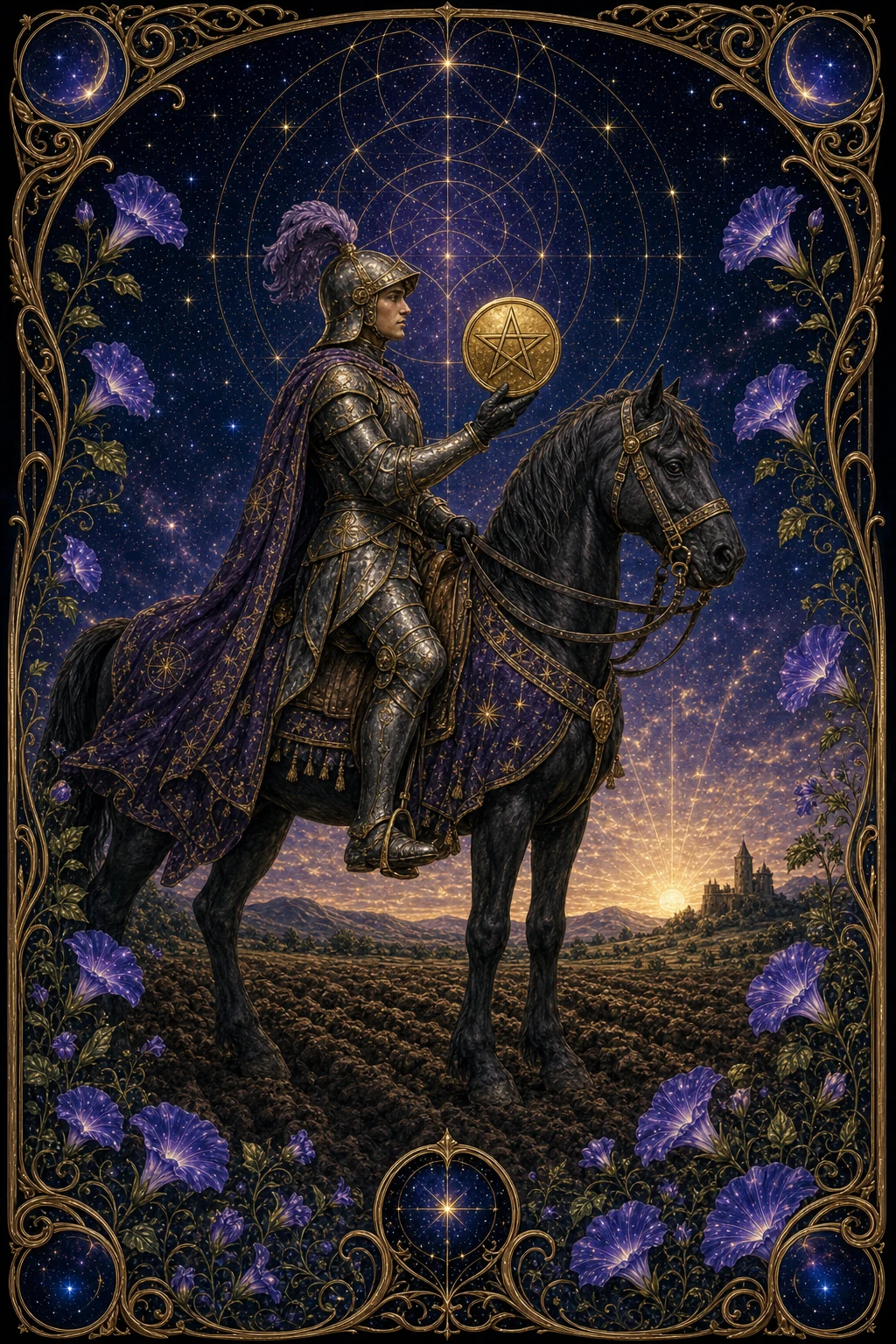
A knight in dark armour has halted at the edge of a ploughed field, a coin held out in front of him on an open palm, his heavy black horse standing perfectly still. Of the four knights, this is the only one whose mount has all four feet on the ground. It asks what you are prepared to keep doing after it stops being interesting.
Upright Knight of Pentacles
Upright, the card's whole argument is in the stillness. The other three knights are in motion, and this one has stopped at the edge of a field that has already been turned over, holding his coin like a man checking a measurement. Readers have called him dull for a century, usually affectionately. Dullness, in this context, means a person whose behaviour on Thursday can be predicted from their behaviour on Monday, and there is a great deal to be said for it. The theme is reliability as a chosen method rather than a personality defect. Anything requiring many identical days — a field, a fitness, a manuscript, a slow repair of trust — can only be reached by somebody willing to be boring on purpose. The Knight stands for a willingness that is rare and seldom praised. The shadow is real and the tradition names it plainly. A horse this heavy takes a long time to turn. There is a version of steadiness that is really inertia wearing armour, still going in a direction chosen years ago by someone with different information. It is worth asking, without hurry, which of your steady commitments you would choose again this morning.
Reversed Knight of Pentacles
Reversed, the stillness stops being deliberate. The most familiar reading is stalling: a routine maintained past the point where it produced anything, kept up because stopping would require an explanation and a decision. Routine is unusually good at disguising itself as progress, since it feels identical from the inside on both the good days and the useless ones. If something in your life has been continuing on schedule for a long while without anyone asking what it is for, this is a reasonable moment to do so. The opposite reversal is worth holding too. Sometimes the card describes impatience in a person built for the long form — the steady one suddenly wanting the field ploughed by Friday, and doing worse work at speed than they would have done at their own pace. Neither reading is a fault. There is also the horse to consider. Reversed, this figure can be someone carrying more weight than the picture admits, moving slowly not from temperament but from load. If that is nearer the mark, the useful question is what is actually strapped to you, and how much of it was ever yours to carry.
Knight of Pentacles in love and relationships
In connection, this Knight is constancy without decoration. He is the same in the fourth month as in the first, which is either the most reassuring thing available or quietly maddening, depending on what you grew up around. People raised in unpredictable houses often find steadiness difficult to trust, and mistake an absence of drama for an absence of feeling. The card is a decent place to notice which of those you do. The other side is the pace. This figure moves at one speed, and if something between you needs a change of tempo — a conversation brought forward, a decision that will not wait for the natural moment — the horse will not oblige unless asked directly. If you recognise yourself in him, the reflection is about whether your reliability has become a way of never being the one who initiates.
Knight of Pentacles in work and study
For work and study, this Knight is the one who finishes. Not quickly, not with flourish, but in a way that means nobody has to check. That reputation takes years to build and about a fortnight to spend, which is partly why the people who have it guard it so carefully. The reflection concerns method rather than ambition. If you look at what you have actually completed in the last few years, most of it was probably delivered by the ordinary, slightly tedious version of you rather than the inspired one. It is worth knowing what conditions that version needs. There is also a harder question about the field. He is looking at ground already ploughed, which suggests reviewing work rather than starting it, and some working lives accumulate a great deal of checking. Whether that is diligence or a way of avoiding the next furrow is not something the card will decide for you.
Resources and security
Whatever this card has to say about security is a matter of tempo and nothing else. The Knight is not counting, acquiring or defending; he is holding one coin steady at the pace of an animal that walks. Taken as reflection and nothing more, that raises the question of what in your life you have been building slowly enough to actually trust, and whether you have the patience for anything that does not report progress weekly. Most durable things are dull to watch. There is no recommendation here about anyone's arrangements — those sit with you and with people properly qualified to discuss them. The card notices only that slowness and reliability tend to travel together, and that we are generally worse at tolerating the first than we think.
Attention and wellbeing
As a reflection on habit, this Knight is the deck's argument for the unremarkable routine. Not an ambitious one — the version that survives a bad week. Whatever you do for yourself only when conditions are good is not yet a habit; it is a preference with good weather. The card suggests looking at what you would still manage on your worst Tuesday and treating that as the actual baseline, then leaving it alone. There is a second observation in the horse's stillness. Rest, for this figure, is not collapse at the end of a sprint but a pace kept throughout, and people built this way often find that stopping entirely is harder for them than continuing. That is worth noticing rather than solving.
Yes or no?
Yes
Yes, at the card's own speed, which is slower than the question probably wants. Nothing here suggests urgency. If the timing matters more than the answer, that is where this figure is actually pointing.
Symbolism in the card
Smith gives this Knight the only motionless mount in the deck. A figure in full dark armour sits on a heavy black horse, both entirely at rest, the visor raised and a large coin held out on an open palm. Sprigs of oak leaves appear on the helm and at the horse's brow, an old emblem of endurance, and the animal itself is drawn as a plough horse rather than a charger — broad, hairy-hoofed, bred for pulling rather than for speed. The ground behind is a ploughed field in neat furrows running to a treeline, the work evidently already done. Compared with the Knights of Wands, Cups and Swords, all of whom are in some stage of a gallop, the stillness reads as deliberate characterisation rather than an accident of drawing. Knights in the older Italian decks were simply mounted courtiers ranked between page and king. It is Smith who turned this one into a portrait of patience, and who set him at the edge of a finished field rather than on a road to anywhere.
Knight of Pentacles as today's card
As the day's card, this Knight is unglamorous and easy to follow. Do the thing you would do anyway, at the usual time, without improving the system first. The card has a mild allergy to reorganisation as a substitute for work. It also suits a day where the honest task is endurance rather than achievement — a long shift, a slow appointment, a stretch of something that simply has to be got through. There is no cleverness available in that situation and this figure does not offer any. If the day has felt static, the card is worth reading as permission rather than criticism. Some days are for keeping the pace, and a kept pace is not nothing.
In a three-card spread
In the past position, this Knight usually indicates a long stretch of steady effort that looked uneventful at the time and turns out to be where most of the ground was covered. People routinely omit these years from their own accounts. In the present, he describes being mid-furrow: committed, unexciting, some distance from either end. The cards on either side tend to say whether that is patience or a rut. Set in the future, he is not an outcome but a rate. If this situation asked the same modest effort of you every week for a year, with no visible signal in between, would you still want it?
Keywords
- Reliability
- Patience
- Routine
- Progress
Journal prompts
- What are you doing at exactly the same pace you were a year ago, and is that patience or habit?
- What would you still manage on your worst Tuesday?
- Which of your long commitments would you choose again this morning?
Cards read alongside Knight of Pentacles
- Seven of Pentacles — Patience, long-term investment, assessment, and reward.
- Eight of Pentacles — Diligence, mastery, repetition, and devoted craft.
- Four of Swords — Rest, recovery, contemplation, and quiet renewal.
- The Hermit — Soul-searching, introspection, being alone, inner guidance.
- All 78 tarot card meanings — the full major and minor arcana in one place.
Combinations with Knight of Pentacles
- Page of Pentacles and Knight of Pentacles tarot combination
- Knight of Pentacles and Queen of Pentacles tarot combination
- Ten of Pentacles and Knight of Pentacles tarot combination
- Knight of Pentacles and King of Pentacles tarot combination
- Nine of Pentacles and Knight of Pentacles tarot combination
- Eight of Pentacles and Knight of Pentacles tarot combination
- All 2,772 minor arcana combinations
Knight of Pentacles by position
- Knight of Pentacles as feelings tarot meaning
- Knight of Pentacles as intentions tarot meaning
- Knight of Pentacles as outcome tarot meaning
- Knight of Pentacles as advice tarot meaning
- Knight of Pentacles as an obstacle tarot meaning
- Knight of Pentacles as action tarot meaning
- Knight of Pentacles as a person tarot meaning
- Knight of Pentacles as how someone sees you tarot meaning
- Knight of Pentacles for a yes or no question tarot meaning
- All card meanings by position
Curious what Knight of Pentacles means for your question? Turn a card on the home page — no account needed.
Draw a card freeOne card, one honest question, most evenings.
Start your free daily readingFree · One card a day · No credit card needed
Go deeper than one card
A personalized deep reading works a full spread around your question — Knight of Pentacles included, if it falls to you. Deep readings run from the $1.99 Single Card Illumination and the $7 Three-Card Path, delivered straight away, to the $19 Five-Card Compass and the $29 Celtic Cross Atlas, composed in depth and delivered within 2–4 hours.
The $19 Five-Card Compass, five positions and a keepsake → · All reading options →
Prefer a rhythm to a one-off? Sparkle Pro ($8.99/month or $59/year) draws a three-card past, present and future spread for you every day. There is also a free eight-phase moon ritual guide to pair with today's card.
To sit with this card longer, the tarot journaling guide has prompt sets for daily draws, moon phases, and more.
Tarot content is for entertainment and personal reflection, not professional advice.