The Emperor Tarot Card Meaning
 Start your free daily reading
Free · One card a day · No credit card needed
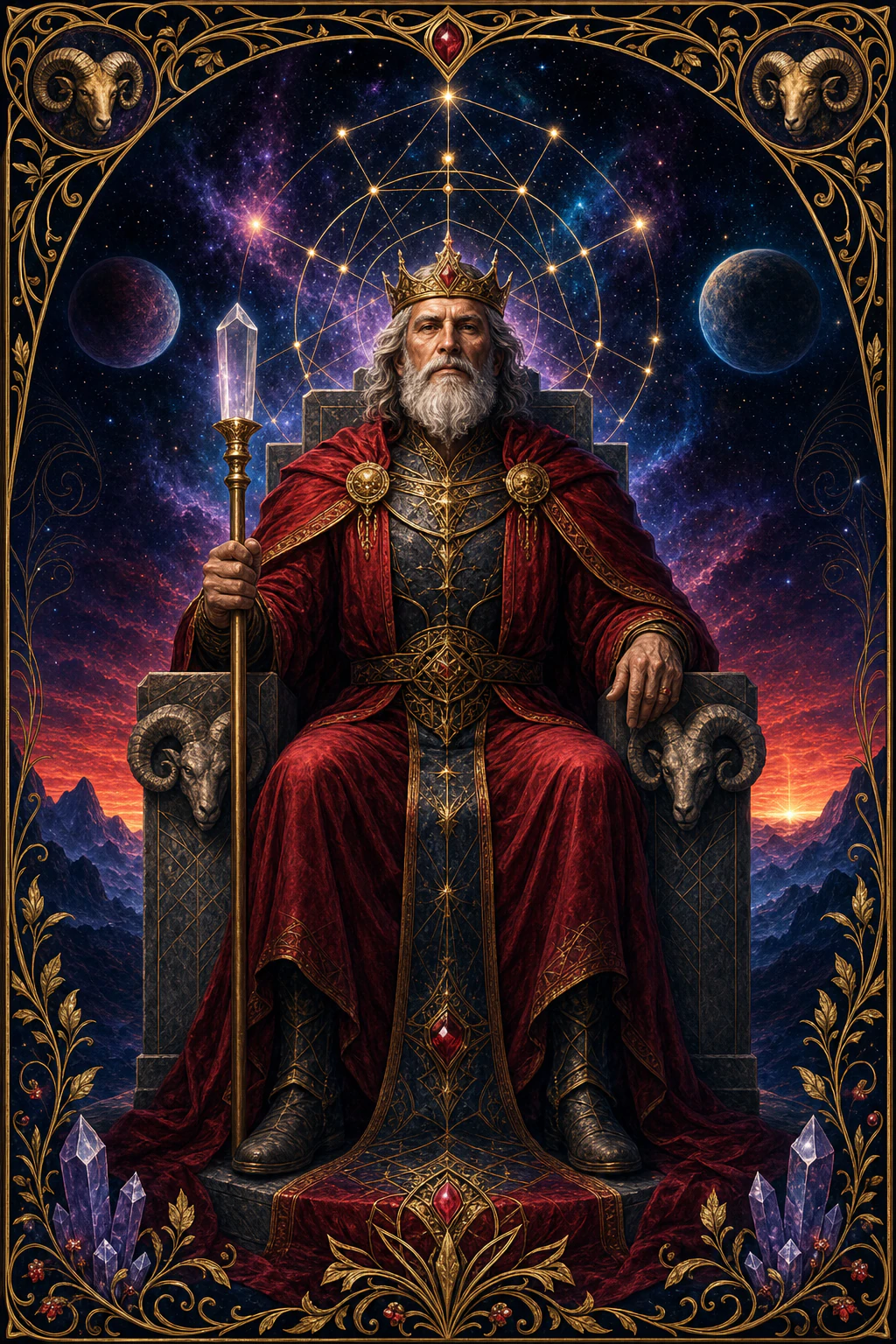
An armoured man sits on a stone throne carved with four rams' heads, holding an ankh-topped sceptre, bare red mountains behind him and a thin river at their foot. Nothing in the picture is soft. The card asks what structure you live inside, and who put it there.
Upright The Emperor
Order is the subject, and the image is unfashionably unembarrassed about it. The throne is stone, the ground is rock, the mountains behind carry no vegetation at all; this is a landscape organised for endurance rather than growth. Upright, the Emperor sits with boundaries, rules, and those parts of a life held steady on purpose. Most people carry an ambivalence there. Structure is what makes anything possible and also what makes everything feel arranged in advance, and the card is content to hold both at once. The reflection is usually about authorship. Every life runs on rules — hours kept, standards maintained, things not done regardless of how convenient they would be — and a fair number of them were installed by somebody else and never reviewed. Consider which of yours you would set again today, knowing what you now know. There is a plainer version as well. If something has been drifting, this figure argues for a decided shape: an hour, a limit, a sentence said once and then kept to. Not because discipline is virtuous, but because unmade decisions cost more than made ones.
Reversed The Emperor
Reversed, the structure fails in one of two directions and the card does not indicate which. Rigidity is the familiar one: rules kept past their usefulness, authority exercised because it happens to be available, a position defended long after the reason for holding it stopped applying. If you notice yourself being right at some length, this is a serviceable moment to check what the rightness is protecting. The opposite failure is more common and less discussed. Without form, energy dissipates; days blur, commitments soften, and the absence of a frame gets experienced as freedom for roughly a fortnight before it starts to feel like drift. The inverted Emperor keeps company with anyone who has been meaning to decide something for months. Then there is inherited authority. Many people run their working lives on a voice acquired from a parent, a teacher, an early manager — standards absorbed too young to be argued with. Reversed, this is a reasonable place to ask whose voice you hear when you push yourself, and whether you would hire that voice today.
The Emperor in love and relationships
In relationships, this figure raises reliability and its limits. Being the person who holds the frame — who makes the plans, keeps the arrangements, decides what happens when nobody else will — is a genuine form of care and an easy one to become trapped inside. Consider whether that role was chosen or simply left vacant long enough that you filled it. The other reflection concerns what is being protected. Armour shows beneath the robes in the picture, and armour is worn for good reasons by people who have had reasons. No advice about anybody's connection is available here, and nothing on the card implies an outcome. Only the question of whether a defence built during a harder period is still being worn indoors, from habit rather than need.
The Emperor in work and study
For working life, the Emperor stands for institutional reality: hierarchies, deadlines, the person who signs things. That world often gets described as an obstacle to real work, but this card takes the less romantic view that structure is what allows sustained effort to accumulate at all. If your work has been chaotic, the reflection points toward one boundary rather than a whole system — a time nothing is answered, a task that gets the first hour, a request declined in the same words each time. There is a second question about authority. Some people want it and dislike admitting so; others hold it and never wanted it. Both are ordinary. What the card asks is which parts of your work you would still want to be responsible for if the title were removed, since that answer tends to be steadier than titles are.
Resources and security
Security, in this figure's terms, is a matter of arrangement rather than amount. A structure you understand tends to feel steadier than a larger one you do not, which is why identical circumstances can be experienced as safe by one person and precarious by another. As reflection only: consider where your sense of solidity actually comes from — what you have, what you know how to do, or who would answer the phone — and how recently you checked. Nothing here is guidance about any decision of yours, all of which remain yours. The Emperor merely holds that a defended position ought to be one you have inspected.
Attention and wellbeing
As a reflection on habit, this card favours the frame over the effort. Attention behaves better inside limits: a defined start, a defined stop, and a rule about the middle that does not require deciding twice. If your days have been running on willpower, the argument here is that willpower is an expensive fuel and structure a cheaper one. You might pick a single boundary and hold it for a week — a time the screens go off, a walk at the same hour, the meal eaten away from the desk. This is a matter of habit alone, and nothing in the card speaks to health of any sort.
Yes or no?
Yes
Yes, with conditions attached rather than enthusiasm. This card favours whatever can be given a clear shape and defended. If your question has no defined edges, the answer matters less than the exercise of defining them.
Symbolism in the card
The fourth trump seats a bearded figure on a cubic stone throne whose arms and back terminate in four carved rams' heads — the emblem of Aries, and through it the martial, initiating cardinal fire the card is traditionally assigned. He holds an ankh-headed sceptre in one hand and a globe in the other, with armour showing at his legs and shoulders beneath a red robe. Behind him rise bare orange mountains with a narrow river at their base, the only water in an otherwise mineral country. The number four governs the reading: four rams, the four corners of a settled world, the square stability following the third card's growth. Older packs show him in profile with his legs crossed in the figure of a four, sceptre on his shoulder, an image descending from medieval seals of temporal power. Waite keeps the sovereignty and adds the wilderness, which changes the tone considerably: this authority is drawn as something maintained in difficult country rather than enjoyed in a palace.
The Emperor as today's card
Drawn for the day, this card usually means the least interesting advice available, which is to say: decide one thing and hold it. Choose the hour, keep it, and do not renegotiate at eleven o'clock. It also suits a day with an awkward conversation in it, the sort where the difficulty lies in stating a limit plainly and then declining to argue about it. If the day ahead is entirely unstructured, the Emperor is a fair prompt to give it a spine before it gives itself one. Three fixed points in a free day tend to produce more satisfaction than eight, a fact most people relearn annually.
In a three-card spread
Set behind you, this figure commonly stands for a rule, an institution or a person whose authority shaped how you now organise yourself, often without your having agreed to the arrangement. Identifying it is more useful than judging it. Occupying the present, he marks a live question of boundaries: something requiring a decision, a limit, or a plain sentence spoken once. Cards to either side tend to show the cost of continuing to postpone. In the forward-looking seat, hold him strictly to a question of form rather than a prediction, because none is being made: if this situation were given a firm shape, what would you have to stop leaving open?
Keywords
- Authority
- Leadership
- Stability
- Control
Journal prompts
- Which of your rules would you set again today, and which came with the furniture?
- Whose voice do you hear when you push yourself, and would you hire it now?
- What are you still defending that no longer needs a defence?
Cards read alongside The Emperor
- The Empress — Femininity, beauty, nature, nurturing, and abundance.
- The Hierophant — Spiritual wisdom, religious beliefs, conformity, and tradition.
- Justice — Justice, fairness, truth, cause and effect, law.
- King of Pentacles — Prosperity, security, discipline, and material mastery.
- All 78 tarot card meanings — the full major and minor arcana in one place.
Combinations with The Emperor
- The Emperor and The Empress tarot combination
- The Emperor and The Hierophant tarot combination
- The Emperor and The High Priestess tarot combination
- The Emperor and The Lovers tarot combination
- The Emperor and The Magician tarot combination
- The Emperor and The Chariot tarot combination
- All 231 major arcana combinations
The Emperor by position
- The Emperor as feelings tarot meaning
- The Emperor as intentions tarot meaning
- The Emperor as outcome tarot meaning
- The Emperor as advice tarot meaning
- The Emperor as an obstacle tarot meaning
- The Emperor as action tarot meaning
- The Emperor as a person tarot meaning
- The Emperor as how someone sees you tarot meaning
- The Emperor for a yes or no question tarot meaning
- All card meanings by position
Curious what The Emperor means for your question? Turn a card on the home page — no account needed.
Draw a card freeOne card, one honest question, most evenings.
Start your free daily readingFree · One card a day · No credit card needed
Go deeper than one card
A personalized deep reading works a full spread around your question — The Emperor included, if it falls to you. Deep readings run from the $1.99 Single Card Illumination and the $7 Three-Card Path, delivered straight away, to the $19 Five-Card Compass and the $29 Celtic Cross Atlas, composed in depth and delivered within 2–4 hours.
The $29 Celtic Cross Atlas, ten cards read position by position → · All reading options →
Prefer a rhythm to a one-off? Sparkle Pro ($8.99/month or $59/year) draws a three-card past, present and future spread for you every day. There is also a free eight-phase moon ritual guide to pair with today's card.
To sit with this card longer, the tarot journaling guide has prompt sets for daily draws, moon phases, and more — including journal prompts for every major arcana card.
Tarot content is for entertainment and personal reflection, not professional advice.