Three of Cups Tarot Card Meaning
 Start your free daily reading
Free · One card a day · No credit card needed
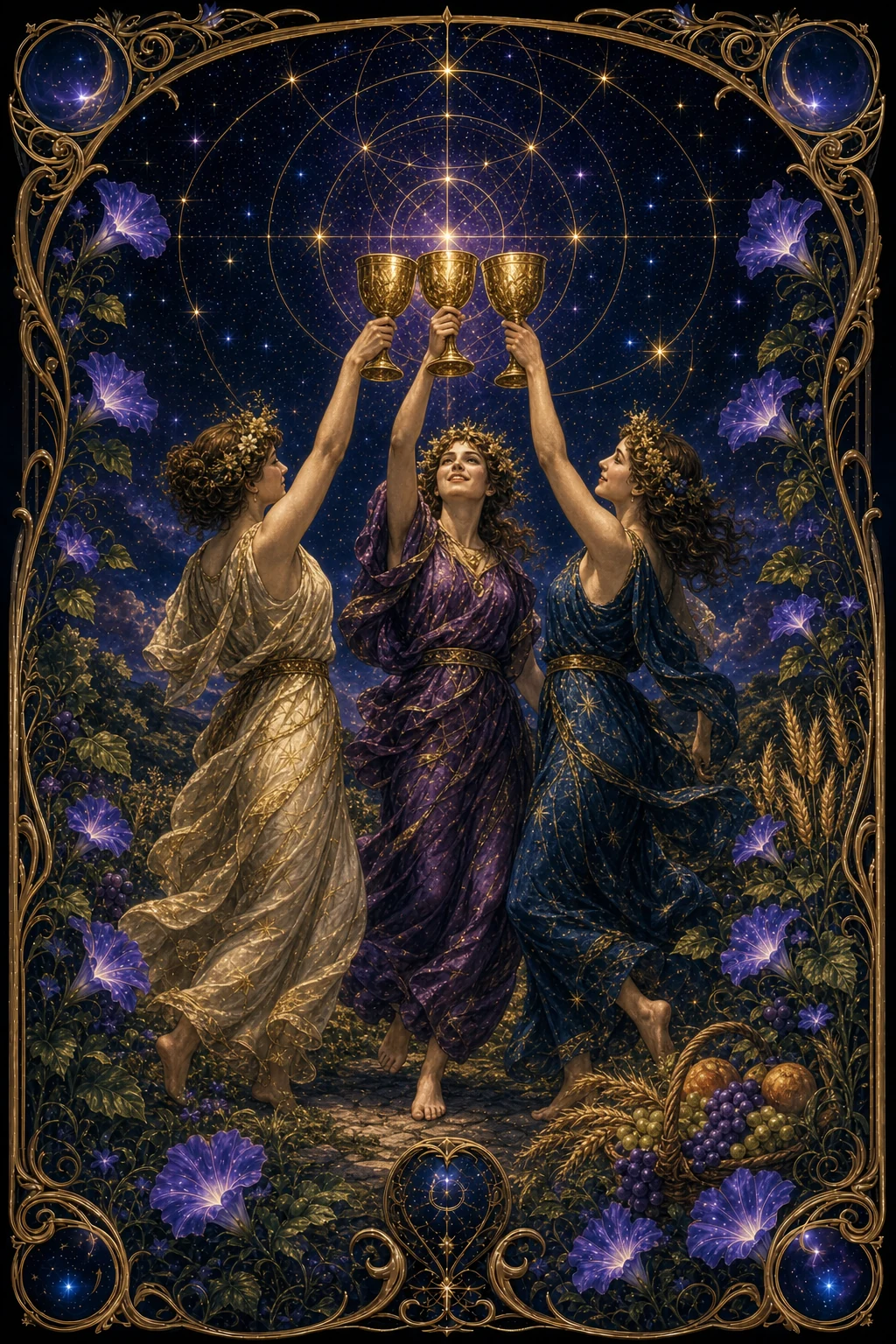
Three women stand in a cut field, raising their cups until the rims almost touch, fruit and a gourd at their feet. Nobody is looking out of the picture. The Three asks what your life contains that is only good in company.
Upright Three of Cups
The word usually attached to this card is celebration, which is accurate and slightly thin. What Smith drew is not a party but a completed thing being marked: the fruit is already gathered, the work sits behind them, and the raising of cups is the punctuation. Marking is a skill, and busy people quietly lose it. Finishing a long piece of work and moving directly to the next has become so normal that it barely registers as a choice, and this card is a fair place to notice the accumulated backlog of things never properly acknowledged. A second theme runs underneath, less discussed: the specific relief of being among people who do not need the situation explained. Threes bring a suit to its first flowering, and in this suit the flowering is plural. Feeling checked against other people's feeling turns out to be how most of us discover what we think. Consider which of your circles currently provides that, and whether it still meets, or whether it survives mainly as a group chat and a shared past. No obligation attaches to any of this. The card puts a picture of easy company on the table and lets you measure the current distance to it.
Reversed Three of Cups
Turned over, the circle closes or crowds. Several readings sit here and they pull in opposite directions. The first is exhaustion with company — an over-full calendar, a run of obligations dressed as pleasures, the particular tiredness of being the entertaining one for a fourth evening running. Solitude in that case is not withdrawal but arithmetic. The second is the outside of the circle. Anyone can find themselves standing slightly apart from a group they were once central to, and the reversal describes that ache without assigning blame, since groups drift for reasons that are usually nobody's doing: geography, hours, a change nobody discussed. Separating the friendships that ended from the ones that merely lapsed repays the effort, because the second kind can often be picked up with a single unremarkable message. A third reading concerns performance. Celebration can be staged, and there are gatherings whose real function is to be seen to have gathered. If part of your social life has begun to feel like documentation, this is a good place to look at that plainly. None of these is a diagnosis; the card offers three doors and lets you notice which one you opened first.
Three of Cups in love and relationships
Where affection is concerned, this card widens the frame past couples, which is most of its usefulness. The people who see you regularly, know your circumstances and would notice your absence are a form of love that receives almost none of the attention paid to romance, and the Three restores them to the picture. A pair is not a life. The reflection here is about surrounding structure: who, apart from any one person, actually holds the shape of your week. There is a further note about how easily a new closeness can quietly eat the older ones. It happens without ill intent and is generally invisible from inside. Read as an inventory rather than an instruction, the card suggests listing the three people you would tell first about good news, then noticing how recently each of them heard from you.
Three of Cups in work and study
In work and study, the Three belongs to the colleagues rather than the job. Much of what makes a difficult role tolerable is horizontal: the person at the next desk, the group chat that translates management's memo, the cohort who went through the same training and know exactly what was wrong with it. That layer is rarely acknowledged in any formal account of a working life and is usually the thing people miss most after leaving. The card also nudges at shared credit. Achievements are almost never singular, and the habit of naming who else was involved is both accurate and unaccountably rare. Where a piece of work has gone well recently, the picture's suggestion is unglamorous: say so out loud, to the people it was done with, before the next thing starts.
Resources and security
Read as a card about security, this one points away from individual holdings and toward the pooled kind. Lifts given, tools lent, a spare room, somebody's cousin who understands boilers — most households run partly on an informal economy that appears in no account anywhere. The Three is a decent prompt to see yours. Who could you call at short notice, and, less comfortably, who calls you? Networks of this sort are maintained by small unreturned favours rather than by fairness, and they thin out quietly when nobody uses them. Nothing here concerns your finances or constitutes advice about them; the card looks at a different kind of holding entirely.
Attention and wellbeing
Where energy is concerned, the Three sits with pleasure that is shared rather than solitary, and with the awkward fact that most people schedule the second kind and merely hope for the first. Company takes arranging. It requires a date, a message, a mild imposition on somebody, and the effort falls disproportionately on whoever is willing to go first. The card does not say this should be you. It notes only that the raised cups in the picture required somebody to suggest the afternoon. If your last few months have been dense with obligations and thin on the sort of evening you would remember, that gap is worth seeing, and feeling guilty about it fixes nothing.
Yes or no?
Yes
Yes, with the qualification that this card's yes is a plural one. If your question involves doing something alone that would be better done with others, the answer is pointing at the others.
Symbolism in the card
Three young women dance in a ring on cropped ground, each lifting a cup, their arms raised so the vessels meet near the centre of the card. One wears white with a wreath of leaves, one red with grapes and vine in her hair, one a pale floral gown; a gourd and a spread of fruit lie at their feet, and the field behind them has already been cut. The composition borrows openly from Renaissance paintings of the Three Graces, the classical trio associated with charm, beauty and the giving of gifts, whose conventional pose is exactly this ring of raised arms. The harvest setting places the image in autumn and ties the suit's water to the season's produce, an association the older decks do not make: Marseille shows three plain cups arranged in a triangle among flowers, with nobody dancing. Waite's brief text calls it the conclusion of a matter in plenty and merriment, one of the few places where his own gloss runs warmer than the picture strictly requires.
Three of Cups as today's card
Drawn alone, this card usually reads as a small argument against efficiency. It suits a day with a lunch in it, or an evening given to somebody rather than to the list. If the day genuinely has no room, take the card at its smaller scale: one message sent for no reason other than warmth costs a minute and lands with more weight than a minute deserves. There is also the acknowledgement reading. Something in your recent months probably merited marking and never got it. Marking it late is still marking it, and can be done privately, with no dancing involved whatsoever.
In a three-card spread
Behind you, the Three often points to a period of easy belonging, and the risk with it is a nostalgia that flatters the past by editing it. Remembering accurately is the more useful exercise. In the present position it describes support already available, whether or not you have been drawing on it; people frequently hold this card and report feeling alone, which is itself worth examining. Ahead, treat it as an open question rather than a promise, because the deck knows nothing. A serviceable form: if this situation improved, who would you want in the room, and what would they need to hear first?
Keywords
- Friendship
- Celebration
- Community
- Joy
Journal prompts
- What have you finished lately without ever marking it?
- Which friendship lapsed rather than ended, and what has stopped you sending the message?
- Who would you tell first, and how long has it been since they heard anything?
Cards read alongside Three of Cups
- Four of Wands — Celebration, harmony, homecoming, and a joyful milestone.
- The Sun — Positivity, fun, warmth, success, vitality.
- Nine of Cups — Contentment, satisfaction, gratitude, and wishes fulfilled.
- Six of Cups — Nostalgia, innocence, generosity, and happy memories.
- All 78 tarot card meanings — the full major and minor arcana in one place.
Combinations with Three of Cups
- Two of Cups and Three of Cups tarot combination
- Three of Cups and Four of Cups tarot combination
- Ace of Cups and Three of Cups tarot combination
- Three of Cups and Five of Cups tarot combination
- King of Wands and Three of Cups tarot combination
- Three of Cups and Six of Cups tarot combination
- All 2,772 minor arcana combinations
Three of Cups by position
- Three of Cups as feelings tarot meaning
- Three of Cups as intentions tarot meaning
- Three of Cups as outcome tarot meaning
- Three of Cups as advice tarot meaning
- Three of Cups as an obstacle tarot meaning
- Three of Cups as action tarot meaning
- Three of Cups as a person tarot meaning
- Three of Cups as how someone sees you tarot meaning
- Three of Cups for a yes or no question tarot meaning
- All card meanings by position
Curious what Three of Cups means for your question? Turn a card on the home page — no account needed.
Draw a card freeOne card, one honest question, most evenings.
Start your free daily readingFree · One card a day · No credit card needed
Go deeper than one card
A personalized deep reading works a full spread around your question — Three of Cups included, if it falls to you. Deep readings run from the $1.99 Single Card Illumination and the $7 Three-Card Path, delivered straight away, to the $19 Five-Card Compass and the $29 Celtic Cross Atlas, composed in depth and delivered within 2–4 hours.
The $7 Three-Card Path, three cards read as one movement → · All reading options →
Prefer a rhythm to a one-off? Sparkle Pro ($8.99/month or $59/year) draws a three-card past, present and future spread for you every day. There is also a free eight-phase moon ritual guide to pair with today's card.
To sit with this card longer, the tarot journaling guide has prompt sets for daily draws, moon phases, and more.
Tarot content is for entertainment and personal reflection, not professional advice.