Five of Pentacles Tarot Card Meaning
 Start your free daily reading
Free · One card a day · No credit card needed
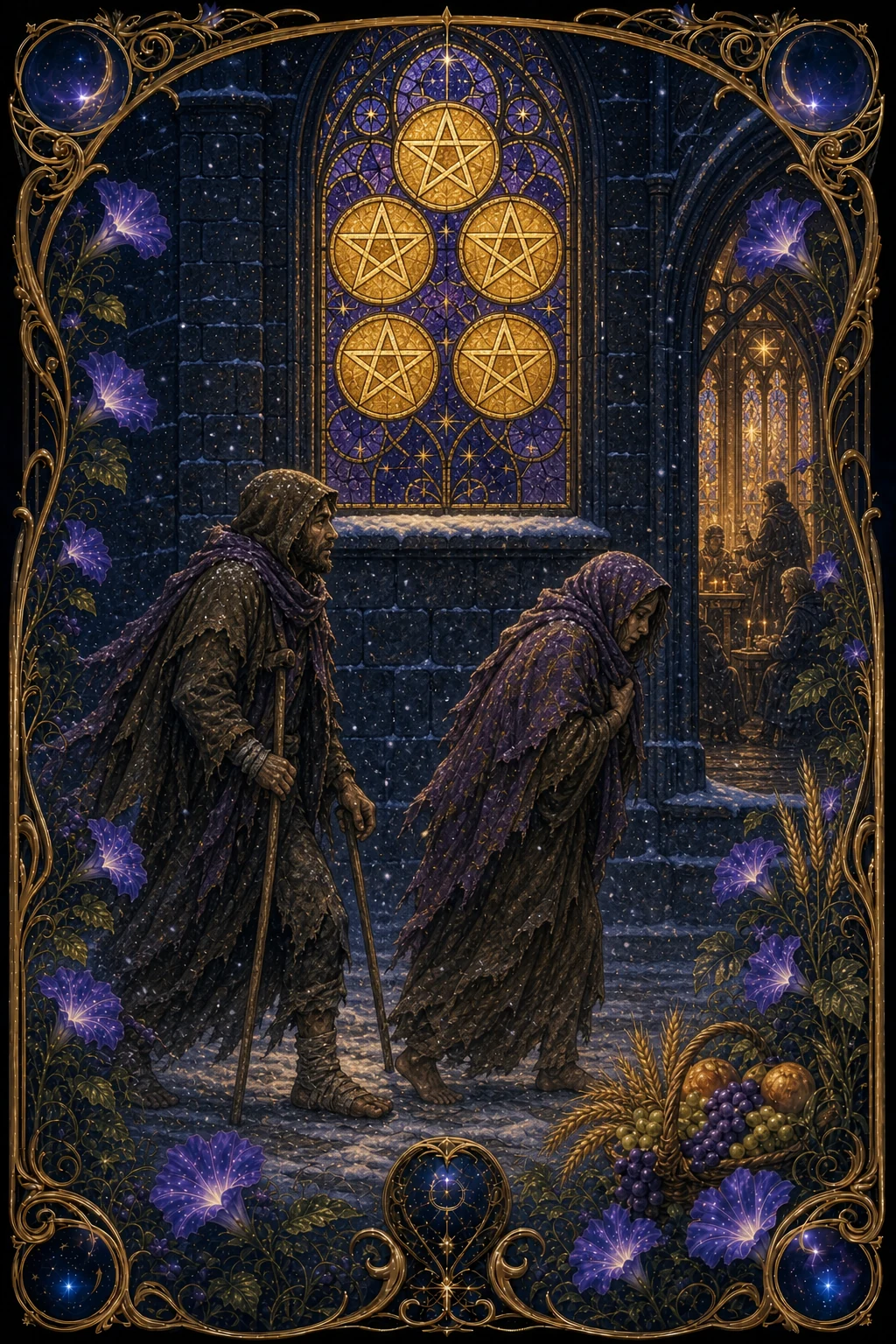
Two figures move through snow past a church wall, one on crutches, one barefoot with a shawl over her head, while above them a stained-glass window burns yellow and blue with five coins set in the glass. Neither of them looks up. The card asks what makes it so hard to knock on a lit door.
Upright Five of Pentacles
The whole design turns on a single fact: the shelter is right there, and it is being walked past. That is not a comment on anyone's judgement. There are many honest reasons a person does not stop — not knowing the door is open, having been turned away before, being too cold to think about anything except the next hundred yards, or simply not wanting to be the one who asked. The card is at its most useful when read as exclusion rather than as poverty. Its subject is the experience of being outside something: a group, a room, a conversation, a version of life other people appear to have been given the address for. That experience is common and rarely admitted, since admitting it is itself a form of exposure. Nothing here predicts anybody's circumstances, and no card knows anything about your situation. What the picture offers is company. Two figures, not one, which means even in this image the isolation is not total. If something in your life currently feels like the cold side of a wall, it is worth naming what specifically you would want if you did stop — because the vague version cannot be asked for, and the specific one usually can.
Reversed Five of Pentacles
Reversed, most readers describe a turn: the figures come indoors, or the long stretch outside begins to end. That reading is worth holding lightly, since recovery is rarely as clean as a card flip, and a great many turns are only visible afterwards. A gentler version of the same idea is simply that something has been said aloud. Circumstances need not change at all for isolation to change character; the difference between an unshared difficulty and a shared one is enormous and does not appear in any figure. The second common reading points the other way, toward the hardening of a difficult season into an identity — the point at which being the person outside becomes the story, and help arriving is met with suspicion because it does not fit the shape any more. That is a description offered without judgement, and it is a very human thing to do. No prediction is made in either direction. If any of this touches something real and current for you, please treat that as considerably more important than the card: practical difficulty deserves practical support, from people who know you and from the services and advisers that exist for it, and a deck of pictures is no substitute for either.
Five of Pentacles in love and relationships
In connection, this card concerns the particular loneliness that happens near other people rather than away from them. Being in the room and not in the conversation. Being in a long relationship in which something has quietly gone cold and neither party can find the sentence that starts. What the picture gets right is that the two figures are together and are not looking at each other; proximity and contact are different things, and the difference is easy to miss for years. There is a second reflection about asking. Many people will offer help endlessly and accept none, and often the private reason is that receiving feels like a debt or an admission. If that pattern is familiar, the card offers a place to consider what it would take to let one person do one thing for you. Where a connection is leaving you isolated or unsafe, that is a matter for people you trust and for proper support services; no deck is equipped for it.
Five of Pentacles in work and study
At work, the Five sits with exclusion rather than failure — being outside the room where decisions happen, in a role that has become peripheral, or in a stretch between things that is nobody's fault and still feels like one. It also touches the experience of not knowing the unwritten rules, which is a real and under-discussed disadvantage that has very little to do with ability. The reflection worth taking from it concerns asking. Many working difficulties are eased considerably by one direct question to one specific person, and the reason the question does not get asked is almost never that it would be refused. It is that asking makes the difficulty official. That is a reasonable fear and it is usually more expensive than the asking would be. Nothing here recommends any particular course of action, and any decision about your own work is yours alone to make.
Resources and security
This card carries the suit's hardest theme, and the responsible way to hold it is as feeling rather than forecast. It concerns the experience of scarcity — the narrowing of attention, the way worry crowds out everything else, the peculiar shame that attaches to it in cultures that treat difficulty as a verdict. That shame is worth naming, because it is not deserved and it does an enormous amount of quiet harm. Nothing in this card predicts anyone's circumstances, in either direction, and nothing here is guidance about money or any decision connected to it. If real hardship is present for you, the appropriate response lives entirely outside tarot: people you trust, and the free advice services that exist precisely for this.
Attention and wellbeing
Cold and exhaustion narrow attention to whatever is directly ahead, which is what the picture shows and what difficult seasons do generally. As a reflection on attention rather than anything medical, the useful observation is that the horizon shrinks first — plans go, then curiosity, then the small pleasures, usually in that order and usually unnoticed. If yours has been shrinking, that is information about conditions and not about you. The modest suggestion this card supports is warmth and company in the plainest sense, and the recognition that endurance is a cost being paid rather than a skill being demonstrated. Anything beyond that belongs with people qualified to help.
Yes or no?
No
No, though read it as not yet and not alone rather than as a refusal. Read it as a prompt to consider who else could be involved in the question. It says nothing about your circumstances.
Symbolism in the card
Smith's design is among the bleakest in the deck and among its most carefully staged. Two figures pass right to left through falling snow: a woman barefoot with a blanket over her head, and a man on crutches with a bell hung at his neck, an old medieval marker worn by lepers and by the destitute to signal their approach. Above them a large stained-glass window glows in a plain stone wall, its five pentacles arranged in the pattern of the Tree of Life and framed by a lily motif, which places the church's abundance directly above their heads and entirely out of the frame of their attention. The snow is unusual for the deck, which is otherwise almost always in temperate weather. The Marseille ancestor of this card is again purely geometric, five coins in an arrangement of flowers, and the entire scene of the two wanderers belongs to Smith. Waite's note speaks of a lighted window and of two people passing it in the snow, and says little more, leaving the picture to do its work.
Five of Pentacles as today's card
As a day's card this one lands heavily, and the first useful thing to say is that a shuffled deck knows nothing whatever about your day. Held as reflection, it makes one small and workable suggestion: get warm, and be in the company of somebody. Not a conversation about anything, just company. It is also a reasonable day to send the message you have been drafting for a fortnight to the person who would help if asked. If the card leaves you uneasy, put it away and do something ordinary and pleasant instead; nothing about it is urgent, and no reading is owed by anybody to a card.
In a three-card spread
Placed behind you, this card usually refers to a cold season already survived, and there is value in being accurate about what actually got you through it, since people routinely forget who helped. In the present position it describes an experience of being outside something, and the neighbouring cards often indicate what the door is and how far away. In the position read as the future, it should not be taken as any kind of forecast, and least of all a material one. The only honest form of it there is a question: if this situation continued, who would you want beside you, and would you let them know?
Keywords
- Hardship
- Isolation
- Worry
- Support
Journal prompts
- What specifically would you ask for, if you decided to stop and knock?
- Who has offered you something recently that you deflected, and what did the deflecting protect?
- When you were last outside something, what eventually proved to be the way in?
Cards read alongside Five of Pentacles
- Six of Pentacles — Generosity, charity, sharing, and balanced exchange.
- The Star — Hope, faith, purpose, renewal, spirituality.
- Four of Pentacles — Security, control, conservation, and holding on tightly.
- The Hermit — Soul-searching, introspection, being alone, inner guidance.
- All 78 tarot card meanings — the full major and minor arcana in one place.
Combinations with Five of Pentacles
- Four of Pentacles and Five of Pentacles tarot combination
- Five of Pentacles and Six of Pentacles tarot combination
- Three of Pentacles and Five of Pentacles tarot combination
- Five of Pentacles and Seven of Pentacles tarot combination
- Two of Pentacles and Five of Pentacles tarot combination
- Five of Pentacles and Eight of Pentacles tarot combination
- All 2,772 minor arcana combinations
Five of Pentacles by position
- Five of Pentacles as feelings tarot meaning
- Five of Pentacles as intentions tarot meaning
- Five of Pentacles as outcome tarot meaning
- Five of Pentacles as advice tarot meaning
- Five of Pentacles as an obstacle tarot meaning
- Five of Pentacles as action tarot meaning
- Five of Pentacles as a person tarot meaning
- Five of Pentacles as how someone sees you tarot meaning
- Five of Pentacles for a yes or no question tarot meaning
- All card meanings by position
Curious what Five of Pentacles means for your question? Turn a card on the home page — no account needed.
Draw a card freeOne card, one honest question, most evenings.
Start your free daily readingFree · One card a day · No credit card needed
Go deeper than one card
A personalized deep reading works a full spread around your question — Five of Pentacles included, if it falls to you. Deep readings run from the $1.99 Single Card Illumination and the $7 Three-Card Path, delivered straight away, to the $19 Five-Card Compass and the $29 Celtic Cross Atlas, composed in depth and delivered within 2–4 hours.
The $7 Three-Card Path, three cards read as one movement → · All reading options →
Prefer a rhythm to a one-off? Sparkle Pro ($8.99/month or $59/year) draws a three-card past, present and future spread for you every day. There is also a free eight-phase moon ritual guide to pair with today's card.
To sit with this card longer, the tarot journaling guide has prompt sets for daily draws, moon phases, and more.
Tarot content is for entertainment and personal reflection, not professional advice.