Six of Swords Tarot Card Meaning
 Start your free daily reading
Free · One card a day · No credit card needed
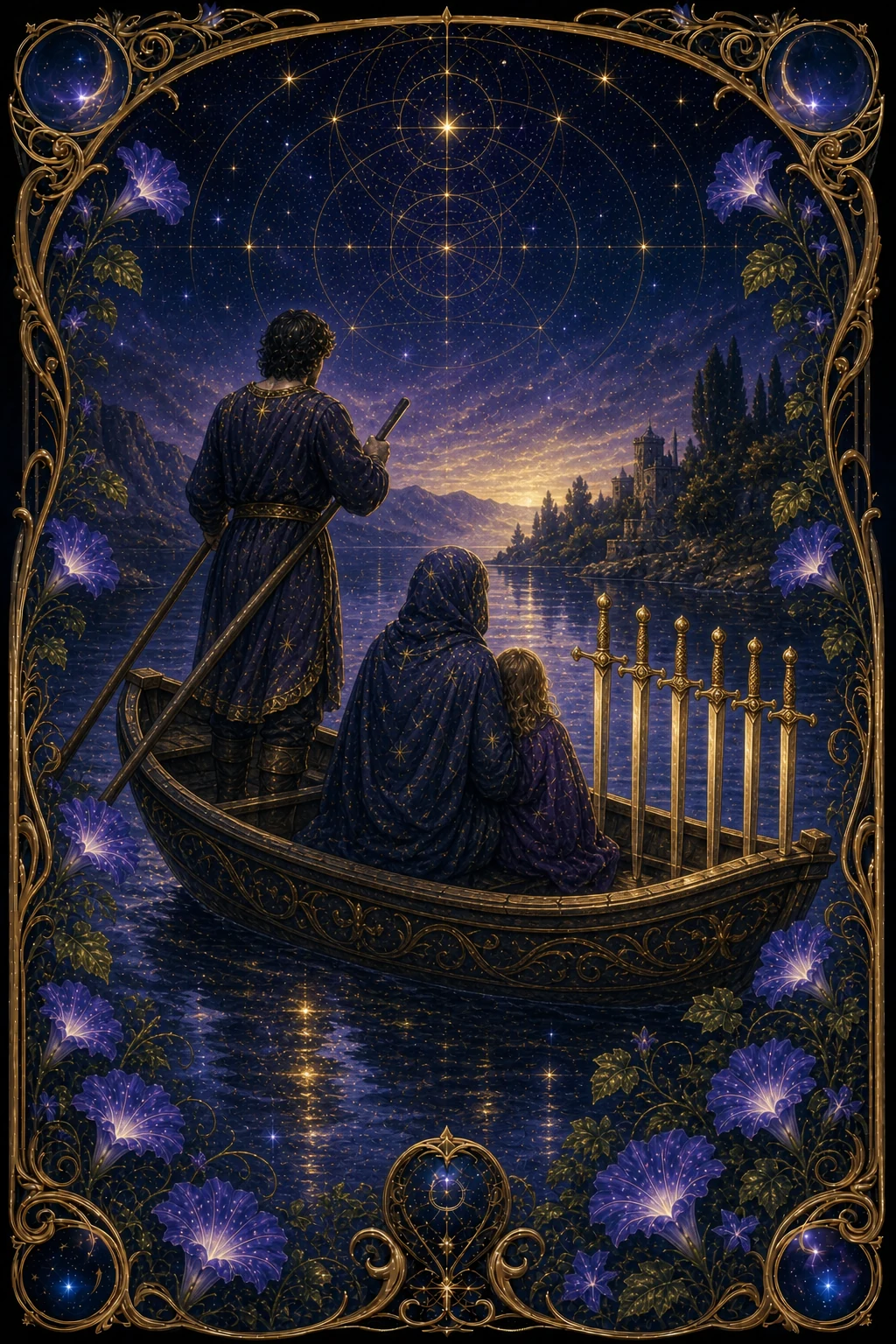
A ferryman poles a shallow punt across water that is choppy on one side of the boat and glassy on the other. A cloaked passenger and a child sit low with six swords standing upright in the hull. What it asks is what travels with you, and who is doing the work of the crossing.
Upright Six of Swords
Upright, this card belongs to the middle of a passage rather than to either shore. It is a quiet image and it is not a peaceful one exactly; the figures are hunched, the sky is drab, and nobody in the boat looks as though they chose this outing. What the card offers is the specific dignity of being underway. The swords, notably, come along. They are set into the boat rather than left on the bank, which readers have taken for centuries to mean that a departure does not require you to be finished with anything — you can leave a situation while still carrying the thoughts it gave you, and the crossing works anyway. That is more generous than most advice on the subject. The water tells the same story twice. Rough behind, smooth ahead, and the boat sits across the line between them, which is the honest location of most transitions. People generally want to know whether they have arrived. The Six declines to answer that and offers something more usable: you are moving, the movement is real, and the calm on the far side of the hull is not a promise so much as a direction the boat is pointed in.
Reversed Six of Swords
Reversed, the crossing becomes complicated. The most common reading is a departure that has not fully happened — the situation formally left and still occupying the majority of your attention, the move made without the mind following it. That is enormously common and is not a failure of will; minds relocate at their own pace, generally slower than the body. A second reading concerns the boat that keeps returning to the same bank. Some passages get made repeatedly, and if a change in your life has been embarked on more than once, the interesting question is not why it did not take but what is on the original shore that still holds a claim. Sometimes it is a person, sometimes an idea about yourself, occasionally something genuinely valuable that deserves the pull. Reversal is also read as delay imposed from outside — waiting for a document, a decision, another person's timing — which is a different situation from ambivalence and worth distinguishing. Nothing here forecasts whether any change occurs or when. The card asks only whether the effort you are currently spending is going into the crossing or into looking back over the stern.
Six of Swords in love and relationships
For relationships, the Six describes the passage from one arrangement to another: a couple moving cities, a friendship adjusting after one person's life changes shape, a family finding out what it is once somebody leaves the house. Nothing in it suggests an ending. What it emphasises is that transitions are undergone together or separately, and that people rarely check which they are doing. The child and the cloaked figure in the boat are travelling in the same craft and are not, from the picture, talking. There is a fair reflection there about the difference between shared circumstances and shared understanding of them. If you are the one poling the boat in your own life — the organiser, the one who books things and keeps the arrangements moving — this is a decent moment to ask what the crossing looks like from the seats.
Six of Swords in work and study
For work, the Six describes the interval between two positions in the widest sense: notice served, course begun, department reorganised around you, the period when your business card is accurate and nothing else about your situation is. Such intervals are underrated and rarely enjoyed. They are also, for most people, when the actual adjustment happens, since arriving somewhere new mainly reveals what you did or did not process on the way. There is a practical reflection about baggage. You are permitted to bring what you learned in a difficult role, including the parts that were hard-won and unpleasant to acquire. You are not obliged to bring the defensive habits that came with them. Sorting one from the other is slow work and the crossing is the correct time for it, since the far bank tends to reward whichever set you arrive holding.
Resources and security
Regarding security, the Six concerns the transitional stretch — the period between arrangements, when the shape of things is changing and the old assumptions no longer describe the situation. Such periods take more attention than settled ones and generate more worry than they usually warrant, in part because the mind treats an incomplete picture as a bad one. As reflection only: consider what in your current arrangements is genuinely in transit and what merely feels unsettled by proximity to it. Naming the difference tends to reduce the size of the whole. Reflection rather than advice, then; where an actual decision is involved, a qualified professional is the right place for it.
Attention and wellbeing
In terms of daily energy, the Six is chiefly interested in pace. Crossings ask for a slower and more repetitive rhythm than either shore does — fewer decisions, more routine, the same few reliable things done in the same order. That is not a lack of ambition; it is how people get across water. You might identify the two or three small anchors that keep your days recognisable regardless of what else is changing, and protect those first rather than last. Novelty can wait for the far bank. Familiar food, familiar hours and a familiar walk do a surprising amount of the work in a season of change.
Yes or no?
Yes
Yes, with the tempo of a boat rather than a decision. The card leans toward the option that moves you along, even slowly, over the one that keeps the situation exactly where it is.
Symbolism in the card
The drawing is one of Smith's most atmospheric. A ferryman stands at the stern of a flat punt, poling it from right to left across shallow water, while a seated figure wrapped in a heavy cloak leans forward beside a child. Six swords are planted upright through the floor of the boat, blades down, arranged in two rows. The water on the near side is drawn with short agitated strokes and on the far side with long smooth ones, a division most readers notice only after several viewings and never forget afterwards. A low, wooded shore lies ahead under a pale sky. The image draws on a long iconography of ferrymen and river crossings, from Charon to the ordinary punts of the English fens, and Waite's own note calls it a journey by water. Six across the suits generally carries the sense of adjustment after disturbance — the settling that follows a five. Here that settling is not arrival but conveyance: somebody is doing the work, the passengers are quiet, and the far bank is close enough to see and not close enough to describe.
Six of Swords as today's card
Pulled for the day, this card tends to favour movement over resolution. Take the next step in something you have been trying to complete in one go, and accept the step as sufficient. It also suggests looking at what you are hauling around — the mental cargo you carry between rooms, a grievance that travels with you into meetings that have nothing to do with it. You need not unload any of it today. Simply notice it is aboard. There is a modest companion practice: at some point, ask who is poling your boat this week, and whether you have thanked them or whether it is you.
In a three-card spread
First in a line, this Six usually indicates a passage already made, and the useful reflection is what you brought across that you no longer need. People carry old equipment for years without auditing it. Set in the middle, it stands for a transition currently under way, with the flanking cards suggesting what is being left and what is being approached. Placed last, keep it as a question of orientation rather than of destination. If this situation were treated as a crossing rather than a problem to solve today, what would the next stretch of water require, and what could stay in the boat without weighing it down?
Keywords
- Transition
- Progress
- Release
- Healing
Journal prompts
- What are you carrying that came from a situation you have already left?
- Who does the poling in your life, and what would change if you asked them how it is going?
- Where are you looking back over the stern, and what is still on that bank?
Cards read alongside Six of Swords
- Eight of Cups — Walking away, seeking truth, withdrawal, and transition.
- Temperance — Balance, moderation, patience, purpose.
- The Star — Hope, faith, purpose, renewal, spirituality.
- Three of Swords — Heartbreak, sorrow, painful truth, and emotional release.
- All 78 tarot card meanings — the full major and minor arcana in one place.
Combinations with Six of Swords
- Five of Swords and Six of Swords tarot combination
- Six of Swords and Seven of Swords tarot combination
- Four of Swords and Six of Swords tarot combination
- Six of Swords and Eight of Swords tarot combination
- Three of Swords and Six of Swords tarot combination
- Six of Swords and Nine of Swords tarot combination
- All 2,772 minor arcana combinations
Six of Swords by position
- Six of Swords as feelings tarot meaning
- Six of Swords as intentions tarot meaning
- Six of Swords as outcome tarot meaning
- Six of Swords as advice tarot meaning
- Six of Swords as an obstacle tarot meaning
- Six of Swords as action tarot meaning
- Six of Swords as a person tarot meaning
- Six of Swords as how someone sees you tarot meaning
- Six of Swords for a yes or no question tarot meaning
- All card meanings by position
Curious what Six of Swords means for your question? Turn a card on the home page — no account needed.
Draw a card freeOne card, one honest question, most evenings.
Start your free daily readingFree · One card a day · No credit card needed
Go deeper than one card
A personalized deep reading works a full spread around your question — Six of Swords included, if it falls to you. Deep readings run from the $1.99 Single Card Illumination and the $7 Three-Card Path, delivered straight away, to the $19 Five-Card Compass and the $29 Celtic Cross Atlas, composed in depth and delivered within 2–4 hours.
The $7 Three-Card Path, three cards read as one movement → · All reading options →
Prefer a rhythm to a one-off? Sparkle Pro ($8.99/month or $59/year) draws a three-card past, present and future spread for you every day. There is also a free eight-phase moon ritual guide to pair with today's card.
To sit with this card longer, the tarot journaling guide has prompt sets for daily draws, moon phases, and more.
Tarot content is for entertainment and personal reflection, not professional advice.