Seven of Swords Tarot Card Meaning
 Start your free daily reading
Free · One card a day · No credit card needed
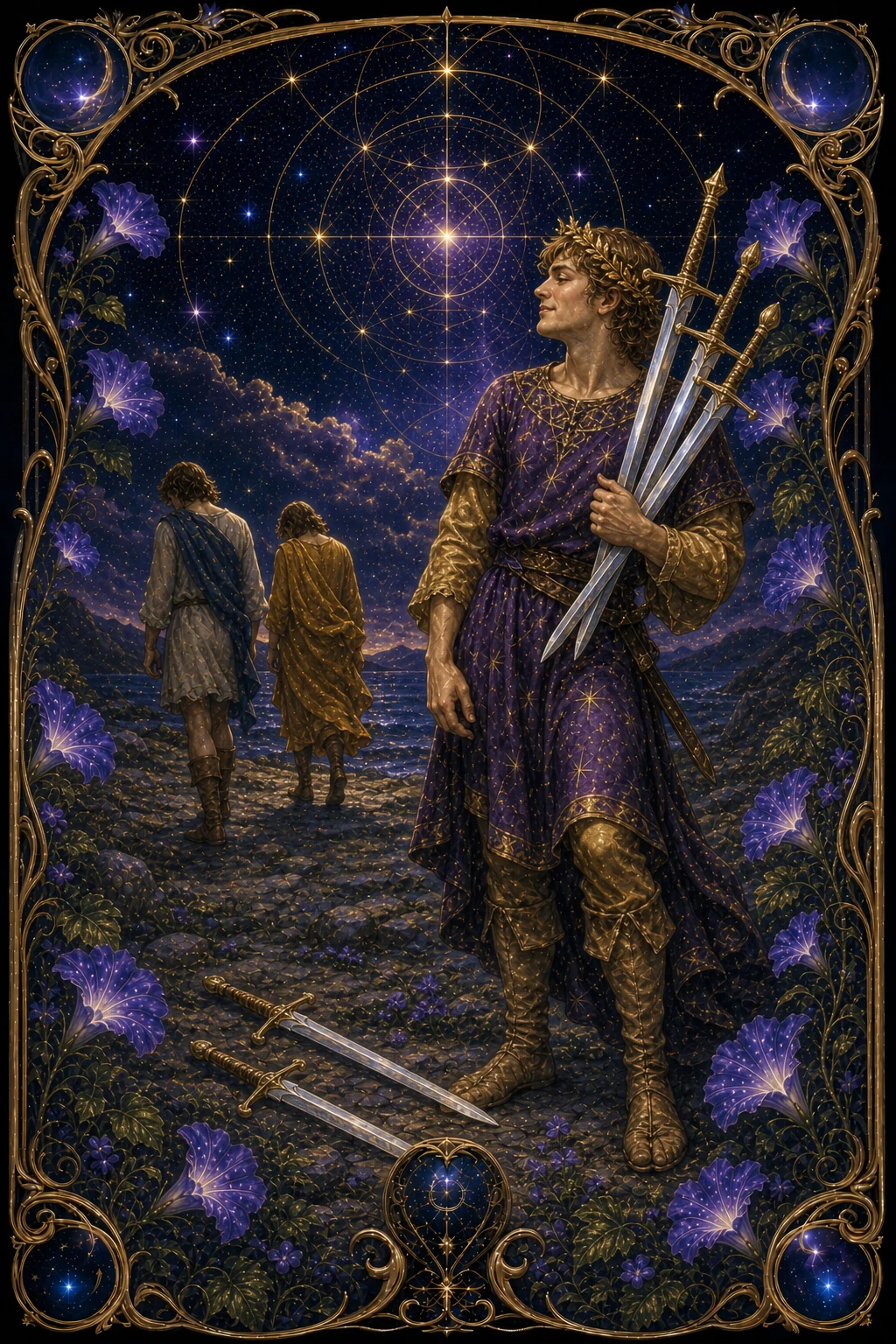
A figure moves away from a striped camp carrying five swords awkwardly by their blades, glancing back over one shoulder. Two swords remain planted in the ground behind him. Tents stand in the distance with people beside them. The card asks about the small edits you make when you are describing yourself.
Upright Seven of Swords
Upright, this card is traditionally about deception, and the only useful way to read it is inward. It has no capacity to tell you anything about anybody else's honesty, and used as a suspicion generator it does real damage for no return. Turned toward yourself, it becomes one of the more interesting cards in the deck. Everybody edits. The account of the week given to a colleague, the reason offered for declining an invitation, the slight rearrangement of a story so that it lands better — these are ordinary social lubricants and mostly harmless. The card is interested in the ones that are not quite. Consider the figure's grip. He is carrying five blades by the sharp parts, which is an unstable and slightly ridiculous way to carry anything, and he is looking behind him rather than where he is going. That is the honest picture of a shortcut: it works, it is uncomfortable, and it requires ongoing attention to maintain. There is also a legitimate reading about independent action — the choice made without announcing it, the plan kept private because explaining it would invite interference. Not every unshared thing is a deception. The card asks you to know which of yours is which.
Reversed Seven of Swords
Reversed, most readers turn the card toward disclosure. That covers the confession, in the small domestic sense of finally correcting a version of events you let stand, and it covers the quieter act of stopping a habit before anyone has noticed it. Both are underrated. A great deal of integrity is maintained privately and consists mainly of not doing things nobody would have found out about. A second reading is the return of the swords. Reversal sometimes describes putting back what was taken, in whatever form that takes for you: the credit passed on to the person who actually did the work, the exaggeration walked back, the shortcut redone properly. It is rarely as costly as anticipated and it is nearly always more awkward. A third reading concerns self-deception giving way, which is the harder version, since the two swords left standing in the camp are the ones you did not think you needed. Nothing here suggests that anyone is being dishonest with you, and the card should not be read that way. It works best as a question about your own accounts, kept in your own words.
Seven of Swords in love and relationships
Between people, this card sits with the small omissions rather than the large ones. The thing not mentioned because mentioning it would start a conversation. The plan made and mentioned afterwards. The slightly improved account of how something went. Most of these are trivial, and their significance lies in the pattern rather than the instance — an omission repeated becomes a policy, and policies eventually get discovered by both parties, usually at an inconvenient moment. Here is a reasonable place to examine your own habits of disclosure, without extending the enquiry to anybody else's. It is also worth considering the reverse question, gently: what do you avoid telling people because you suspect they would think less of you? That kind of editing costs the editor most, and it is almost always applied to something that would have been received more kindly than you assume.
Seven of Swords in work and study
At work, the Seven touches shortcuts and their maintenance costs. Some are entirely sensible; a great deal of professional competence consists of knowing which steps can be skipped safely. The card is interested in the other kind — the corner cut in a way that requires you to remember having cut it, since anything needing ongoing concealment accrues a running charge in attention. There is a second reflection about credit. Contributions get summarised, and summaries drift toward whoever is telling them. It is worth occasionally checking your own accounts of a project against what actually happened, not out of scruple but because an inaccurate story eventually meets somebody who was there. The card also allows for the strategic and private: the application not announced, the option kept open quietly. That is not dishonesty. It is discretion, and the difference is whether anyone is being harmed by the silence.
Resources and security
Where security is concerned, this card touches the numbers people round in their own favour. Household accounting is full of small kindnesses to oneself: the category left slightly vague, the recurring cost not quite added up, the purchase filed under a heading that makes it easier to look at. Purely as reflection, ask whether any part of your own picture is held up by a rounding you have chosen not to examine. Nobody else needs to see the exercise, and its value is mostly the relief of not having to keep the estimate afloat. This is not guidance about your own circumstances, which are yours to weigh, and best weighed with qualified advice.
Attention and wellbeing
The energy reading here has to do with the upkeep of anything concealed. Holding a version of events in place takes background effort, and that effort is easy to misfile as general tiredness. You might notice whether there is anything you would rather not be asked about directly, and how much room it occupies. Habits work the same way. The thing done and not mentioned tends to grow a small apparatus of management around it, and often the apparatus is more wearing than the thing. This is an observation about attention, not a judgement about behaviour, and it is best considered somewhere private and unhurried.
Yes or no?
It depends
It depends, largely on whether the plan requires anything to stay unsaid. The card leans toward whichever version you would be comfortable describing plainly to the people it involves.
Symbolism in the card
Smith draws a man leaving a military encampment on tiptoe, five swords bundled clumsily against his body with his hands around the blades, his head turned back toward the tents. Two swords stand upright in the ground behind him, and beyond them a group of small figures gathers by a striped marquee, apparently unaware, with a row of banners or pennants above. The setting is usually read as a camp fair or an army in the field, and the tents are drawn in the yellow that runs through this suit's brighter cards. Seven, in the numbered sequence, tends to concern the individual against circumstances — effort, cunning, or persistence applied alone. Older interpretations of this card ranged widely, from theft outright to a plan whose outcome is uncertain, and Waite gave it a notably unsettled description. The blades held by their edges are the detail that makes the picture. Whatever he has gained, he cannot put it down easily, cannot run with it, and has both hands occupied for as long as he keeps it.
Seven of Swords as today's card
As the card for a day, this one asks for one accurate sentence. Say the real reason you cannot make Thursday. Give an honest estimate rather than the optimistic one. Correct a small version of events that has been standing unchallenged because correcting it would have been mildly embarrassing. The scale is deliberately domestic, since integrity is largely built out of items this size. There is a second, quieter option: notice something you are keeping private and ask whether it is private or hidden. Those are different, and the difference is generally obvious to you within about ten seconds of asking.
In a three-card spread
Opening a spread, this Seven often points to something arranged quietly in the past whose consequences arrived later, or to a shortcut that shaped the ground you now stand on. In the present position it describes something being managed rather than settled, and neighbouring cards frequently indicate the cost of the management. As the last card, do not read it as a warning that somebody is working against you; it carries no such information. The useful form is a question about conduct: if this situation played out and everything involved became known, which parts would you be content to have described accurately?
Keywords
- Strategy
- Secrecy
- Independence
- Caution
Journal prompts
- What are you currently carrying in a way that requires constant attention to hold?
- Which version of a recent story did you improve slightly, and for whose benefit?
- What do you keep private, and would you still call it private if somebody asked you directly?
Cards read alongside Seven of Swords
- Five of Swords — Conflict, hollow victory, tension, and walking away.
- The Moon — Illusion, fear, anxiety, subconscious, intuition.
- Seven of Pentacles — Patience, long-term investment, assessment, and reward.
- Page of Swords — Curiosity, vigilance, new ideas, and direct communication.
- All 78 tarot card meanings — the full major and minor arcana in one place.
Combinations with Seven of Swords
- Six of Swords and Seven of Swords tarot combination
- Seven of Swords and Eight of Swords tarot combination
- Five of Swords and Seven of Swords tarot combination
- Seven of Swords and Nine of Swords tarot combination
- Four of Swords and Seven of Swords tarot combination
- Seven of Swords and Ten of Swords tarot combination
- All 2,772 minor arcana combinations
Seven of Swords by position
- Seven of Swords as feelings tarot meaning
- Seven of Swords as intentions tarot meaning
- Seven of Swords as outcome tarot meaning
- Seven of Swords as advice tarot meaning
- Seven of Swords as an obstacle tarot meaning
- Seven of Swords as action tarot meaning
- Seven of Swords as a person tarot meaning
- Seven of Swords as how someone sees you tarot meaning
- Seven of Swords for a yes or no question tarot meaning
- All card meanings by position
Curious what Seven of Swords means for your question? Turn a card on the home page — no account needed.
Draw a card freeOne card, one honest question, most evenings.
Start your free daily readingFree · One card a day · No credit card needed
Go deeper than one card
A personalized deep reading works a full spread around your question — Seven of Swords included, if it falls to you. Deep readings run from the $1.99 Single Card Illumination and the $7 Three-Card Path, delivered straight away, to the $19 Five-Card Compass and the $29 Celtic Cross Atlas, composed in depth and delivered within 2–4 hours.
The $7 Three-Card Path, three cards read as one movement → · All reading options →
Prefer a rhythm to a one-off? Sparkle Pro ($8.99/month or $59/year) draws a three-card past, present and future spread for you every day. There is also a free eight-phase moon ritual guide to pair with today's card.
To sit with this card longer, the tarot journaling guide has prompt sets for daily draws, moon phases, and more.
Tarot content is for entertainment and personal reflection, not professional advice.