Ace of Swords Tarot Card Meaning
 Start your free daily reading
Free · One card a day · No credit card needed
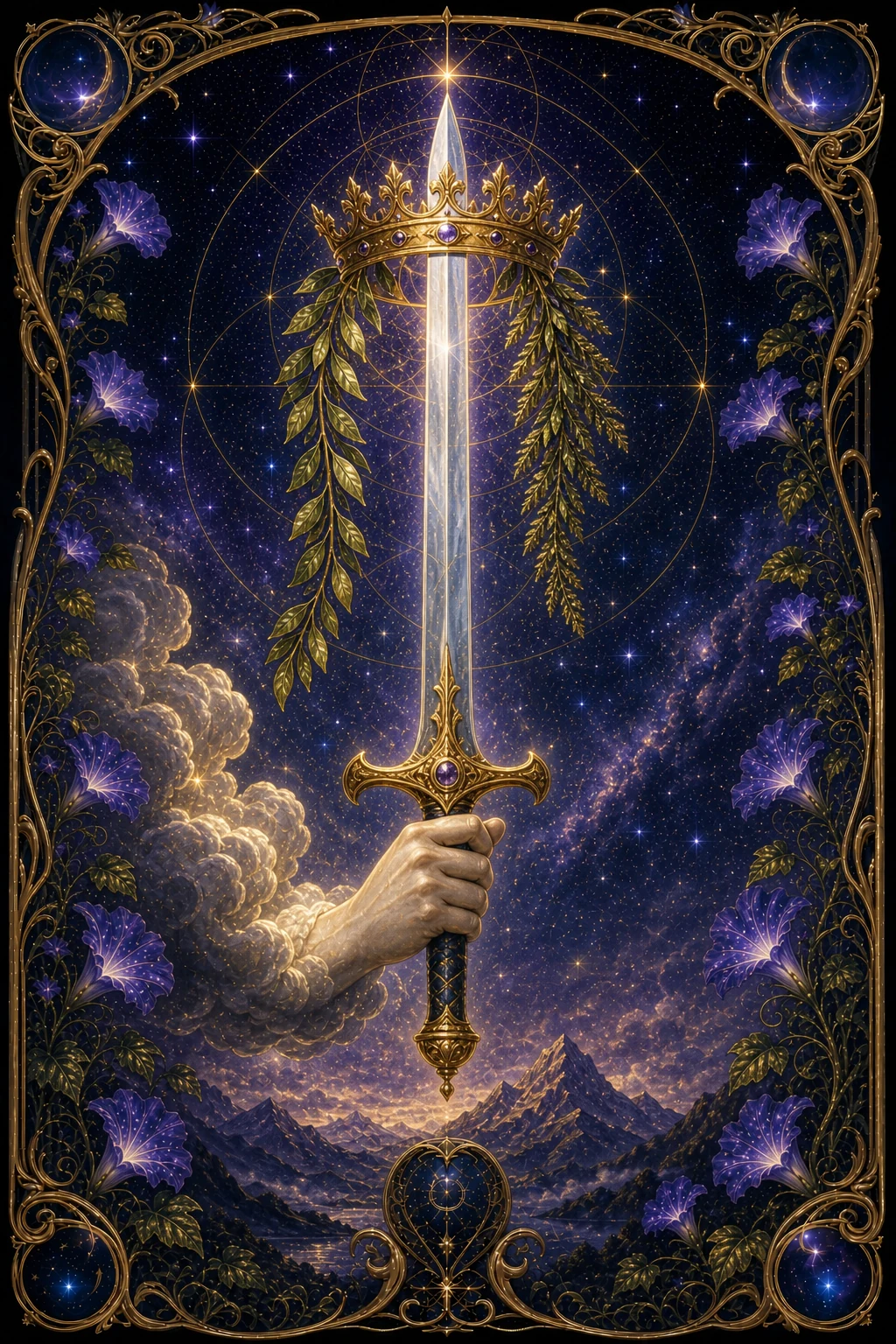
A hand comes out of a grey cloud holding one upright sword, and balanced on its point is a gold crown wreathed with laurel and palm. Below, a range of bare mountains waits for nobody. The Ace asks what you would have to say plainly before you could think about it clearly.
Upright Ace of Swords
Upright, this card holds the moment a muddle turns into a sentence. Much of what troubles people is not complicated so much as unnamed, and naming is a small violent act: once you have said what a situation actually is, the comfortable fog around it stops being available. The suit deals in thought, language and discernment, and the Ace is the raw form of all three, handed over before anyone has decided what to use it for. Two edges, one blade. That is the detail the tradition keeps returning to. The precision that lets you see a problem exactly also lets you injure someone with one well-aimed clause, and the card draws no line between the two uses. It offers a capability rather than a character. Sitting with it, the reflection tends to be about accuracy instead of force. Where have you been arguing when describing would have done more? Which of your positions could survive being stated once, in plain words, with no adjectives holding it up? A clear thought is not automatically a correct one, and the Ace is honest about that. It only suggests that vagueness has been doing you fewer favours than you assumed.
Reversed Ace of Swords
Turned, the blade points down and the crown is no longer balanced on anything. Readers describe this in two directions, and both are worth keeping. The first is cleverness that has lost its manners — the argument won so thoroughly that the relationship around it has quietly gone cold, the analysis so sharp that nothing survives it, including things you wanted. Being right is a genuine pleasure and it is not a substitute for being useful. The second direction is fog. Reversed, the card can describe thinking that circles: the decision reopened every evening, the same six considerations reshuffled, the sense that one more hour of turning it over would finally settle it. It rarely does. Somewhere in that loop there is usually a question you have been careful not to ask in a form that could be answered. One further thing is worth weighing: what goes unsaid. A withheld truth is still a truth doing work in the room, and the reversed Ace is a fair place to notice which sentence you have been rehearsing for weeks without delivering. None of this forecasts anything. It is an invitation to check whether your thinking is currently a tool or a treadmill.
Ace of Swords in love and relationships
Between people, this card belongs to plain speech and its consequences. Not confrontation — the Ace has no appetite for scenes — but the specific act of saying what you mean while the other person is still in the room. Many affections run for years on approximation, and approximation is comfortable until somebody needs something exact. The reflection here works in both directions. Consider what you have been softening past the point of recognition, and consider also whether every clarification you offer is genuinely for the other person or partly for the record. There is a version of honesty that is really a way of putting somebody in the wrong with better vocabulary. The card cannot tell them apart from the outside. You can, usually, if you look at what you want the sentence to accomplish before you say it.
Ace of Swords in work and study
For work and study, the Ace favours the sentence that survives scrutiny. It sits with the moment a proposal stops being a vague good idea and becomes something with a shape somebody else could argue with — which is uncomfortable and is also the only way an idea gets tested. If a project of yours has been living in the pleasant stage where it cannot fail because it does not yet exist, this is a quiet nudge toward writing the first hard paragraph. There is a second reading about discernment. Not everything that lands on your desk deserves the same attention, and the ability to say what a task is actually for is closer to skill than to seniority. The card also carries an old association with justice and with speaking on behalf of others. Whose case would you make well, if asked?
Resources and security
Money, in this card's terms, is the number rather than the feeling about the number. Finances are unusually good at hiding inside impressions — a vague sense of doing fine, a vague sense of not, both maintained by never quite looking. The Ace is the image of looking. As reflection only, and with no bearing on anything you should actually do: consider what you currently believe about your own arrangements, and how recently you checked whether the belief still matches. The relief people report after that kind of accounting is rarely about the figures improving. It is about no longer carrying an estimate around. Whatever you do about it stays your own decision, ideally taken with proper professional advice.
Attention and wellbeing
Where attention is concerned, the Ace marks the line between thinking and churning. Both feel like mental effort; only one of them moves. You might notice at what hour your thoughts stop being productive, because most people have a fairly reliable time, and most people ignore it. Writing a circling thought down tends to shrink it, not because the page is wise but because a sentence has to end somewhere. Clear attention also needs quiet around it, and quiet is a habit rather than a mood — a walk without headphones, the first ten minutes of a morning left unfilled. Small, dull, repeatable. That is the whole of what this card suggests.
Yes or no?
Yes
Yes, on the condition that the question is precisely worded. This card leans toward whichever option you could explain in one clear sentence to someone who is not you. Vagueness is the part it declines.
Symbolism in the card
Pamela Colman Smith draws a right hand emerging from a cloud at the left of the frame, gripping a double-edged sword point upward. Circling the tip is a gold crown, and threaded through the crown are two branches — laurel for victory and palm for triumph, both borrowed from classical Roman honours and both, in this drawing, hanging slightly askew rather than neatly wreathed. Six yods, the small flame-shaped marks of divine descent, fall through the air beside the blade. The landscape below is a line of bare, jagged peaks: the suit's usual country, high and cold and thinly populated. The Aces in this deck are all gifts from a cloud, offered rather than achieved, and this is the one that arrives edged. Swords descend from the sword suit of the older Italian and Spanish decks, associated with the nobility and with the exercise of judgement, and the suit's element is air. The crown resting on the point rather than a head is the detail most worth sitting with. Authority, in this picture, is balanced on something that could cut, and nothing in the image says it will stay balanced.
Ace of Swords as today's card
Pulled as the day's card, the Ace usually asks for one act of definition. Write the sentence you have been avoiding writing. Ask the question you have been asking around. Decide what a meeting is for before attending it. It is a small, brisk card to draw and it does not demand courage on any large scale, only that you stop leaving one particular thing at approximately. There is a companion habit worth trying: before speaking on something you feel strongly about, put the position in a single line first. Some positions get stronger under that treatment. Others turn out to have been mostly weather, which is useful to learn before lunch.
In a three-card spread
Set in the past, this Ace often marks a realisation that reorganised what came after it — the day a thing you had been calling one name turned out to have another. Those moments date a life more accurately than events do. In the middle position it describes a live need for definition: something in the situation is being held loosely and the looseness is costing more than it saves. Neighbouring cards tend to indicate what. Read last, treat it as a question about language rather than as an outcome. If this situation were described accurately, in words you would be willing to say aloud to the person most involved, what would the description be?
Keywords
- Clarity
- Breakthrough
- Truth
- Insight
Journal prompts
- What have you been describing vaguely on purpose, and what does the vagueness protect?
- When were you last right in a way that cost more than it was worth?
- Which sentence have you rehearsed and not delivered, and what is it waiting for?
Cards read alongside Ace of Swords
- Two of Swords — A difficult choice, stalemate, avoidance, and inner balance.
- Queen of Swords — Independence, clear boundaries, honesty, and perception.
- Page of Swords — Curiosity, vigilance, new ideas, and direct communication.
- Justice — Justice, fairness, truth, cause and effect, law.
- All 78 tarot card meanings — the full major and minor arcana in one place.
Combinations with Ace of Swords
- King of Cups and Ace of Swords tarot combination
- Ace of Swords and Two of Swords tarot combination
- Queen of Cups and Ace of Swords tarot combination
- Ace of Swords and Three of Swords tarot combination
- Knight of Cups and Ace of Swords tarot combination
- Ace of Swords and Four of Swords tarot combination
- All 2,772 minor arcana combinations
Ace of Swords by position
- Ace of Swords as feelings tarot meaning
- Ace of Swords as intentions tarot meaning
- Ace of Swords as outcome tarot meaning
- Ace of Swords as advice tarot meaning
- Ace of Swords as an obstacle tarot meaning
- Ace of Swords as action tarot meaning
- Ace of Swords as a person tarot meaning
- Ace of Swords as how someone sees you tarot meaning
- Ace of Swords for a yes or no question tarot meaning
- All card meanings by position
Curious what Ace of Swords means for your question? Turn a card on the home page — no account needed.
Draw a card freeOne card, one honest question, most evenings.
Start your free daily readingFree · One card a day · No credit card needed
Go deeper than one card
A personalized deep reading works a full spread around your question — Ace of Swords included, if it falls to you. Deep readings run from the $1.99 Single Card Illumination and the $7 Three-Card Path, delivered straight away, to the $19 Five-Card Compass and the $29 Celtic Cross Atlas, composed in depth and delivered within 2–4 hours.
The $1.99 Single Card Illumination, one card read in depth → · All reading options →
Prefer a rhythm to a one-off? Sparkle Pro ($8.99/month or $59/year) draws a three-card past, present and future spread for you every day. There is also a free eight-phase moon ritual guide to pair with today's card.
To sit with this card longer, the tarot journaling guide has prompt sets for daily draws, moon phases, and more.
Tarot content is for entertainment and personal reflection, not professional advice.