Two of Pentacles Tarot Card Meaning
 Start your free daily reading
Free · One card a day · No credit card needed
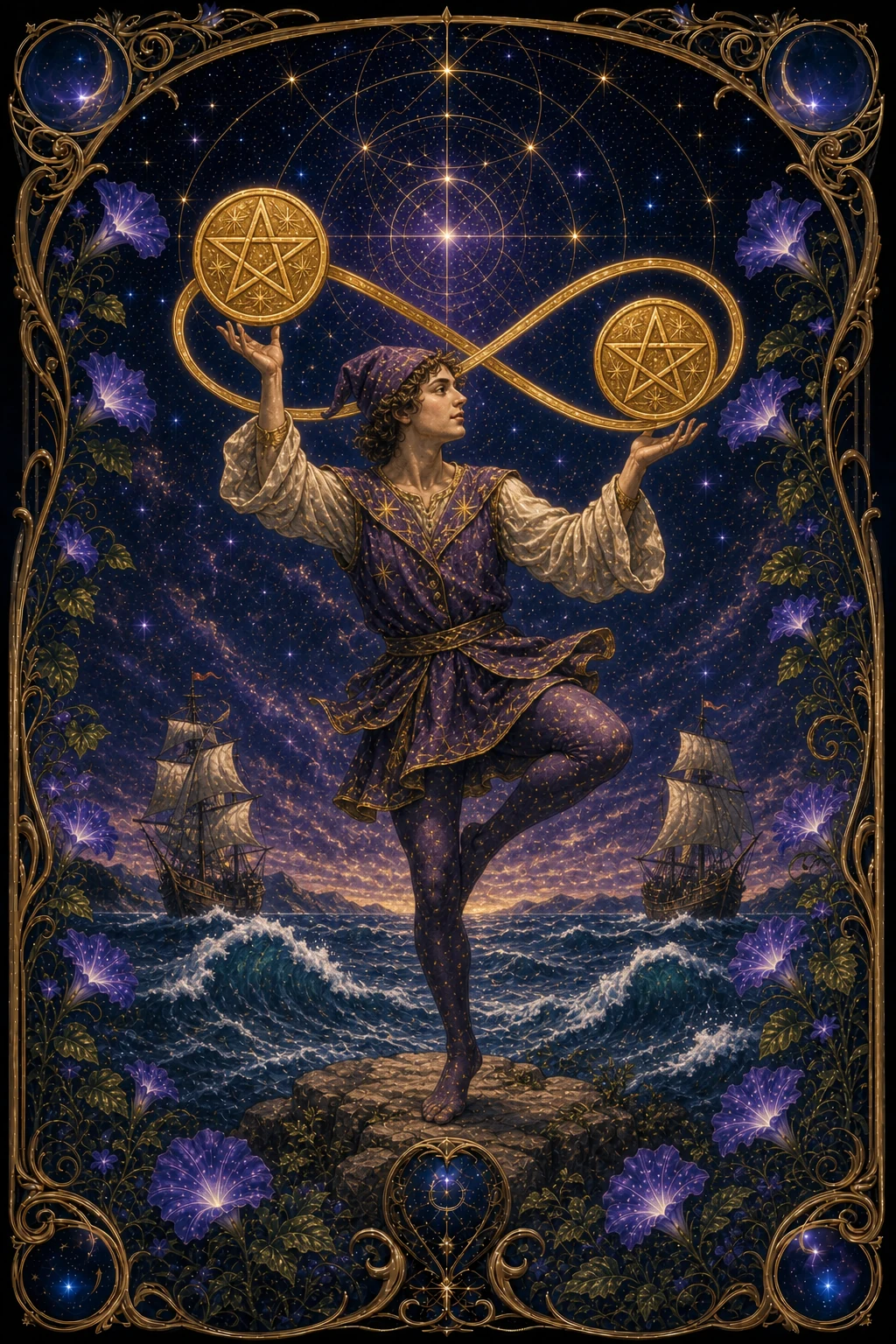
A figure dances on one foot, two coins looped in a green ribbon shaped like a sideways eight, while behind him two ships ride enormous waves. He is smiling and the sea is not calm. The card asks what your current tempo is actually costing, and whether you chose it.
Upright Two of Pentacles
Notice first that this is a dance and not a struggle. Smith could have drawn a man dropping things, and she drew someone light on his feet with an oversized hat, keeping two objects in continuous motion because motion is the only way they stay up. That is the card's central proposition: certain arrangements are not stable, they are dynamic, and they hold together because you keep moving. Household and work, two languages, a body of paid hours and a body of unpaid ones — many good lives are of this kind. The image refuses to call it a failure. What the Two does raise is the difference between a rhythm and a scramble. Both look identical from outside, and they feel entirely different from inside, and only the person doing the juggling can tell which one is currently underway. The ribbon connecting the coins matters here. It suggests the two things are related rather than competing, that the switching between them has a shape. Sitting with the card, it can be useful to ask which of your commitments are genuinely linked and which are simply happening at the same time. The answer often reorganises what feels heavy.
Reversed Two of Pentacles
Reversed, the loop breaks. The commonest reading is straightforward overload — too many objects in the air, the shape gone out of the movement, the day organised entirely by whatever is nearest to falling. If that is familiar, the card describes it without moralising, and without any suggestion that it is a permanent condition or a personal defect. Being stretched is usually a function of arrangements rather than character. A second reading turns on priority. The reversed Two is often described as motion without direction: enormous energy expended in keeping everything level, which is a way of never deciding anything. Levelling is not neutral. It has a cost, and the cost is generally paid by whichever thing complains least, which in most lives is the reader. There is a third possibility worth allowing. Sometimes reversal shows a juggler who has quietly put something down and not yet told anybody. That interval — where the outward arrangement continues and the inward one has already changed — is uncomfortable and quite common. Nothing here predicts anything. It is simply a fair place to look at what you are still holding out of habit, and what you are holding because it matters.
Two of Pentacles in love and relationships
Between people, this card usually concerns competing claims on the same finite week. Partner and parent, friendship and work, the person who wants Saturday and the person who needs Sunday. The Two is honest that attention is a material substance and cannot be produced by wanting to produce it. What it offers is not a solution but a question of accounting: who in your life currently receives your leftover hours, and did that happen by decision or by drift? Long connections often run on leftovers for years without anyone naming it. There is also the flirtatious version the tradition mentions, where someone is keeping two possibilities in the air because choosing would mean losing one. The card takes no moral position on that and does note the obvious thing about juggling, which is that it can be sustained for a while and cannot be sustained forever without someone's arms getting tired.
Two of Pentacles in work and study
For work and study, this is the card of the person carrying two roles under one job title, or a course alongside employment, or the freelance week that has to be reassembled every Monday. Its subject is not effort but scheduling — the specific skill of switching, which costs more than most people account for. Every change of context has a toll, and the toll is invisible on any timesheet. If your working life involves a great deal of switching, the reflection here is about grouping rather than reducing: what could sit next to what. The ships in the background are worth remembering too. They are on the same sea whatever the dancer does, and they stand for the conditions you do not set — the market, the rota, the reorganisation announced by someone else. Some of what feels like personal disorganisation is weather. Distinguishing your part from the sea's part is most of what this card is good for.
Resources and security
On the theme of security, the Two is about tempo rather than totals. Some periods of life are steady and some are variable, and the variable ones ask a different sort of attention — more frequent, more approximate, more tiring, regardless of any figure involved. As a reflection only, and not as guidance of any kind about your own affairs, you might consider how much of your mental energy currently goes to keeping track versus deciding. Tracking can expand until it fills whatever room it is given. The dancer keeps his eyes on the coins, not on the horizon, and the picture makes no comment on whether that is wise. It only shows what continuous attention looks like from outside.
Attention and wellbeing
This card belongs to rhythm rather than rest. A tempo that suits January will not necessarily suit June, and most people set theirs once and then defend it long after conditions changed. It can be worth noticing where your day actually has slack in it, and whether that slack is real or is simply the place where the next thing lands. Balance in this image is not stillness; it is correction, repeated, at whatever interval works. Nothing here is diagnostic and no card can say anything about your health. The modest observation on offer is that pace is a thing you can look at directly, and that most people examine everything else first.
Yes or no?
It depends
It depends, chiefly on capacity rather than merit. The card tends to reply with a question about what would have to be set down first. Treat that as a prompt for reflection, never as a prediction.
Symbolism in the card
Smith's dancer wears a tall red hat sometimes read as a nod to the fool's cap, and stands with one leg raised in what is unmistakably a step rather than a stumble. The two coins are enclosed by a green band drawn as a lemniscate, the sideways figure of eight that appears elsewhere in the deck above the Magician's head and over the woman in Strength; there it marks continuity or unbroken power, and here it binds two objects into one circuit. Behind him a green-blue sea carries two small ships up the faces of stylised waves, an image with a long history in the coin suit, where trade meant cargo and cargo meant the sea. Older Italian and Marseille versions of this card show the two coins wrapped in a decorative scroll, often bearing the printer's name — a piece of workshop bookkeeping that later readers inherited as symbolism. Waite's own commentary is characteristically terse and speaks of a person dancing while managing two coins, which leaves the tone of the thing genuinely open. The picture allows both delight and precariousness, and declines to choose.
Two of Pentacles as today's card
As the single card of a day, the Two often arrives on the days that are already full, which can feel like being told something you know. Used well, it prompts one specific act of sequencing: decide, before the day starts, which single thing gets the good hours. Everything else can have the ordinary ones. There is a version of this day where you deliberately do two things badly and one thing properly, and it is frequently the better version. If the day genuinely has no room in it, the card is not asking for reform. Noticing the shape of a crowded day is enough, and the noticing costs nothing.
In a three-card spread
Behind you, this card generally marks a stretch of life run at a tempo you would not choose again, and it is worth being accurate about whether it ended or simply became normal. In the middle position it describes an arrangement currently held in motion, and the cards on either side usually say what is being kept up and at whose expense. In the position people read as the future, avoid hearing it as a warning about strain. It works better as a question of design: if this continued at its present speed, what would have to be linked to what, and what would you want to have put down first?
Keywords
- Balance
- Adaptability
- Priorities
- Change
Journal prompts
- Which of the things you are holding are actually connected, and which merely happen at the same time?
- Who currently receives your leftover hours, and when was that arranged?
- What in your week is weather, and what is genuinely yours to set?
Cards read alongside Two of Pentacles
- Seven of Pentacles — Patience, long-term investment, assessment, and reward.
- Knight of Pentacles — Reliability, patience, routine, and steady progress.
- Temperance — Balance, moderation, patience, purpose.
- Eight of Pentacles — Diligence, mastery, repetition, and devoted craft.
- All 78 tarot card meanings — the full major and minor arcana in one place.
Combinations with Two of Pentacles
- Ace of Pentacles and Two of Pentacles tarot combination
- Two of Pentacles and Three of Pentacles tarot combination
- King of Swords and Two of Pentacles tarot combination
- Two of Pentacles and Four of Pentacles tarot combination
- Queen of Swords and Two of Pentacles tarot combination
- Two of Pentacles and Five of Pentacles tarot combination
- All 2,772 minor arcana combinations
Two of Pentacles by position
- Two of Pentacles as feelings tarot meaning
- Two of Pentacles as intentions tarot meaning
- Two of Pentacles as outcome tarot meaning
- Two of Pentacles as advice tarot meaning
- Two of Pentacles as an obstacle tarot meaning
- Two of Pentacles as action tarot meaning
- Two of Pentacles as a person tarot meaning
- Two of Pentacles as how someone sees you tarot meaning
- Two of Pentacles for a yes or no question tarot meaning
- All card meanings by position
Curious what Two of Pentacles means for your question? Turn a card on the home page — no account needed.
Draw a card freeOne card, one honest question, most evenings.
Start your free daily readingFree · One card a day · No credit card needed
Go deeper than one card
A personalized deep reading works a full spread around your question — Two of Pentacles included, if it falls to you. Deep readings run from the $1.99 Single Card Illumination and the $7 Three-Card Path, delivered straight away, to the $19 Five-Card Compass and the $29 Celtic Cross Atlas, composed in depth and delivered within 2–4 hours.
The $7 Three-Card Path, three cards read as one movement → · All reading options →
Prefer a rhythm to a one-off? Sparkle Pro ($8.99/month or $59/year) draws a three-card past, present and future spread for you every day. There is also a free eight-phase moon ritual guide to pair with today's card.
To sit with this card longer, the tarot journaling guide has prompt sets for daily draws, moon phases, and more.
Tarot content is for entertainment and personal reflection, not professional advice.