Eight of Pentacles Tarot Card Meaning
 Start your free daily reading
Free · One card a day · No credit card needed
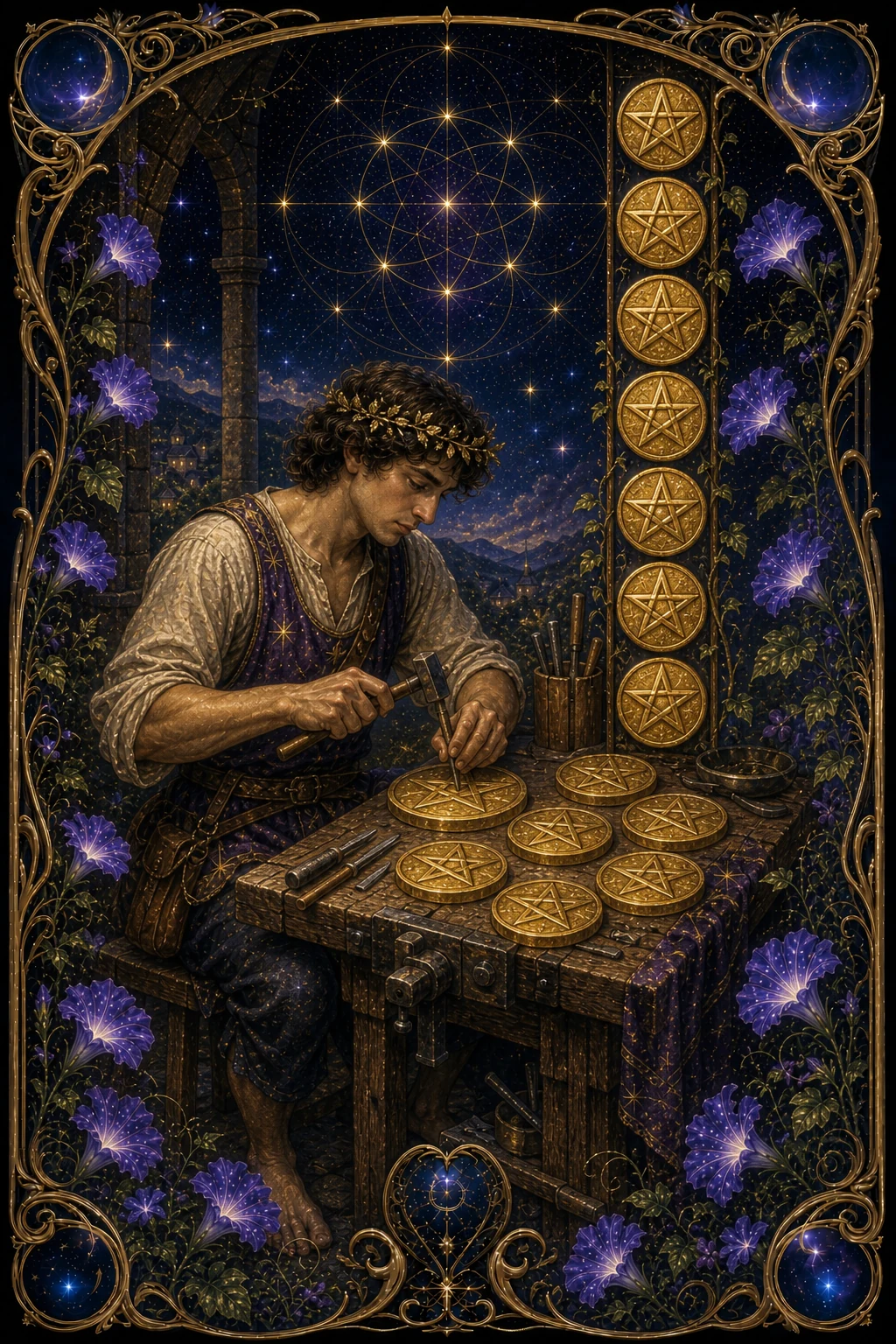
A craftsman sits at a bench with a chisel, cutting the design into a coin, while finished ones hang on the post beside him and one more waits at his feet. A town stands some distance off, and he has his back to it. The card asks what you are willing to do badly for long enough to do well.
Upright Eight of Pentacles
Upright, this is the tarot's picture of the hours nobody photographs. The work in front of him is the same work he did yesterday and will do again after lunch, and the only visible progress is the row of finished pieces on the post — evidence that is quietly persuasive and completely unexciting. Sitting with the card, the useful question is about tolerance rather than talent. Every skill worth having has a long stretch in the middle where you are competent enough to see your own mistakes and not yet good enough to correct them, and most abandonment happens there rather than at the start. The Eight is a reflection on whether you are prepared to be mediocre in public for a while. There is a second thing in the image, easily missed. He is not making one masterpiece; he is making eight of the same object. Repetition is the method, not the punishment. Something in us prefers to believe that skill arrives as insight, and mostly it arrives as the ninth attempt looking marginally less awkward than the eighth. What have you been trying to learn in one sitting that wants a hundred small ones instead?
Reversed Eight of Pentacles
Reversed, the bench is still there and something has gone out of the sitting. The most common reading is motion without attention: a task performed so many times that the hand does it while the person has left the room. That is not always a failure. Some work is meant to be automatic, and a life in which everything demanded full presence would be unliveable. But it is worth knowing which of your repetitions have become hollow, because hollowness has a way of spreading past the workbench and into evenings and conversations. The other reversal is the opposite pressure: care that has tightened into fuss. The chisel keeps going after the piece was finished. Perfectionism tends to present itself as high standards, and it is often easier to keep adjusting a thing than to let anyone look at it, which is the quieter reason the work never leaves the bench. A third reading concerns the town in the distance. Reversed, the figure can be someone who has practised so long and so privately that the practice became a place to hide. None of this is a verdict. It is an invitation to notice whether the repetition is still teaching you anything.
Eight of Pentacles in love and relationships
In connection, the Eight belongs to the part that is learned rather than felt. People arrive at relationships assuming feeling is the difficult bit, then discover it is the ninth time you have had a version of the same conversation and are trying to have it slightly better. Whatever you are good at with people, you got good at by doing it repeatedly and badly first. Which relational skills have you actually practised, and which have you merely hoped for? Apologising is a craft. So is asking a real question and staying for the answer. And then there is learning one specific person, which no amount of general competence covers — their tells, their bad hours, what they mean by fine. If something between you has been rough lately, this card points away from the grand gesture and toward the small repeated one, without any promise about what it might yield.
Eight of Pentacles in work and study
For work and study, the Eight sits with the apprentice rather than the master, and holds a plainer view of learning than most of the deck. The figure has not been promoted into anything; he has a bench, a tool, and a quantity of the same task. Read as reflection, it asks what your work is teaching you, if anything, and whether you can name the skill rather than the role. Titles are easy to describe; competence is harder, and most people struggle to say precisely what they have got better at in two years. Then there is visibility. Nothing in the picture suggests anyone is watching him work. Some kinds of improvement only happen when nobody is assessing you. If your effort lately has been shaped mostly by what gets noticed, this is a good place to wonder what you would practise with no prospect of it appearing on any record.
Resources and security
Security, in this card, is unusual for the suit: worth is shown being made rather than held. The coins here are objects he is working on, not funds he is counting. As reflection only, that points toward a question about where your sense of being worth something currently sits — in what you have, or in what you can do, or in something older than either. Most people find they have quietly chosen one and would rather not examine it. None of this touches anyone's actual situation, and a real decision belongs with you and with whoever is properly qualified to advise on it. The card only notices that skill is a kind of holding, and that it behaves differently from the other kinds.
Attention and wellbeing
As a reflection on attention, this card is interested in the difference between concentration and grinding. Both look identical from across the room. Concentration has a rhythm to it and leaves you tired in a way that resolves; grinding tends to accumulate and to make the work worse in the process, which is its own signal if you are willing to read it. You might notice at what hour your attention is genuinely sharp, and whether you spend it on anything you care about. Craftsmen have always known the tool needs sharpening and that sharpening is not a break from the work. Whatever the equivalent is for you — a walk, a night off, an unstructured hour — it belongs inside the practice rather than after it.
Yes or no?
Yes
Yes, but a yes with hours attached rather than a moment. The card leans toward whatever rewards being done repeatedly. If your question hoped for a shortcut, read the yes as applying to the long way round.
Symbolism in the card
Smith draws the eighth Pentacle as a workshop scene, which is rare in a deck that mostly shows figures posed rather than occupied. A young man in a leather apron sits on a low bench, mallet and chisel in hand, cutting the pentagram into a disc held on his knee. Six finished coins are fixed to the upright post beside him and a seventh lies at his feet, so the sequence of his morning is visible in the furniture. Behind him a road runs to a small walled town in the middle distance, painted small and pale, and he is turned away from it. Earlier decks in the Italian coin tradition rendered this number as an arrangement of eight discs with no human figure at all, sometimes with flowering vines between them; the craftsman is a Rider–Waite–Smith invention, and it changed the card from a picture of quantity into a picture of process. The apron is worth noticing as much as the tool. It is the costume of someone who assumes they will get dirty, and the card's whole argument sits inside that assumption.
Eight of Pentacles as today's card
As the day's card, the Eight of Pentacles is nobody's favourite draw and one of the most usable. It suggests choosing one thing and doing it for a set stretch of time, without checking whether it is working. Fifty minutes on the piece of work you have been circling. A scale, a paragraph, a language app, the tedious middle section. The card has no ambition beyond that, and it does not ask you to enjoy it. If today is already full of unavoidable repetition, the reading shifts slightly: do one of those repetitions with actual attention, as an experiment, and see whether the task or your relationship to it looks any different by the end.
In a three-card spread
In the past position, the Eight tends to point to a period of grind that you may now be undervaluing, having kept only the result. It is worth reconstructing how long it actually took. In the present, it describes being mid-practice — not at the start, where enthusiasm helps, and not near the end, where results do. Surrounding cards often indicate what the practice is in service of, since the figure himself gives no clue. In the future position, treat it as a question about method: if this situation were approached as something practised over months rather than solved this week, what would the first hour look like?
Keywords
- Diligence
- Mastery
- Practice
- Craft
Journal prompts
- What are you currently willing to be bad at, and for how long?
- Name a skill you have practised so often that you no longer notice having it.
- What would you keep working on if nobody were ever going to see it?
Cards read alongside Eight of Pentacles
- Three of Pentacles — Teamwork, skill, collaboration, and quality craft.
- Seven of Pentacles — Patience, long-term investment, assessment, and reward.
- Page of Pentacles — Study, manifestation, opportunity, and practical ambition.
- The Hermit — Soul-searching, introspection, being alone, inner guidance.
- All 78 tarot card meanings — the full major and minor arcana in one place.
Combinations with Eight of Pentacles
- Seven of Pentacles and Eight of Pentacles tarot combination
- Eight of Pentacles and Nine of Pentacles tarot combination
- Six of Pentacles and Eight of Pentacles tarot combination
- Eight of Pentacles and Ten of Pentacles tarot combination
- Five of Pentacles and Eight of Pentacles tarot combination
- Eight of Pentacles and Page of Pentacles tarot combination
- All 2,772 minor arcana combinations
Eight of Pentacles by position
- Eight of Pentacles as feelings tarot meaning
- Eight of Pentacles as intentions tarot meaning
- Eight of Pentacles as outcome tarot meaning
- Eight of Pentacles as advice tarot meaning
- Eight of Pentacles as an obstacle tarot meaning
- Eight of Pentacles as action tarot meaning
- Eight of Pentacles as a person tarot meaning
- Eight of Pentacles as how someone sees you tarot meaning
- Eight of Pentacles for a yes or no question tarot meaning
- All card meanings by position
Curious what Eight of Pentacles means for your question? Turn a card on the home page — no account needed.
Draw a card freeOne card, one honest question, most evenings.
Start your free daily readingFree · One card a day · No credit card needed
Go deeper than one card
A personalized deep reading works a full spread around your question — Eight of Pentacles included, if it falls to you. Deep readings run from the $1.99 Single Card Illumination and the $7 Three-Card Path, delivered straight away, to the $19 Five-Card Compass and the $29 Celtic Cross Atlas, composed in depth and delivered within 2–4 hours.
The $7 Three-Card Path, three cards read as one movement → · All reading options →
Prefer a rhythm to a one-off? Sparkle Pro ($8.99/month or $59/year) draws a three-card past, present and future spread for you every day. There is also a free eight-phase moon ritual guide to pair with today's card.
To sit with this card longer, the tarot journaling guide has prompt sets for daily draws, moon phases, and more.
Tarot content is for entertainment and personal reflection, not professional advice.