Seven of Pentacles Tarot Card Meaning
 Start your free daily reading
Free · One card a day · No credit card needed
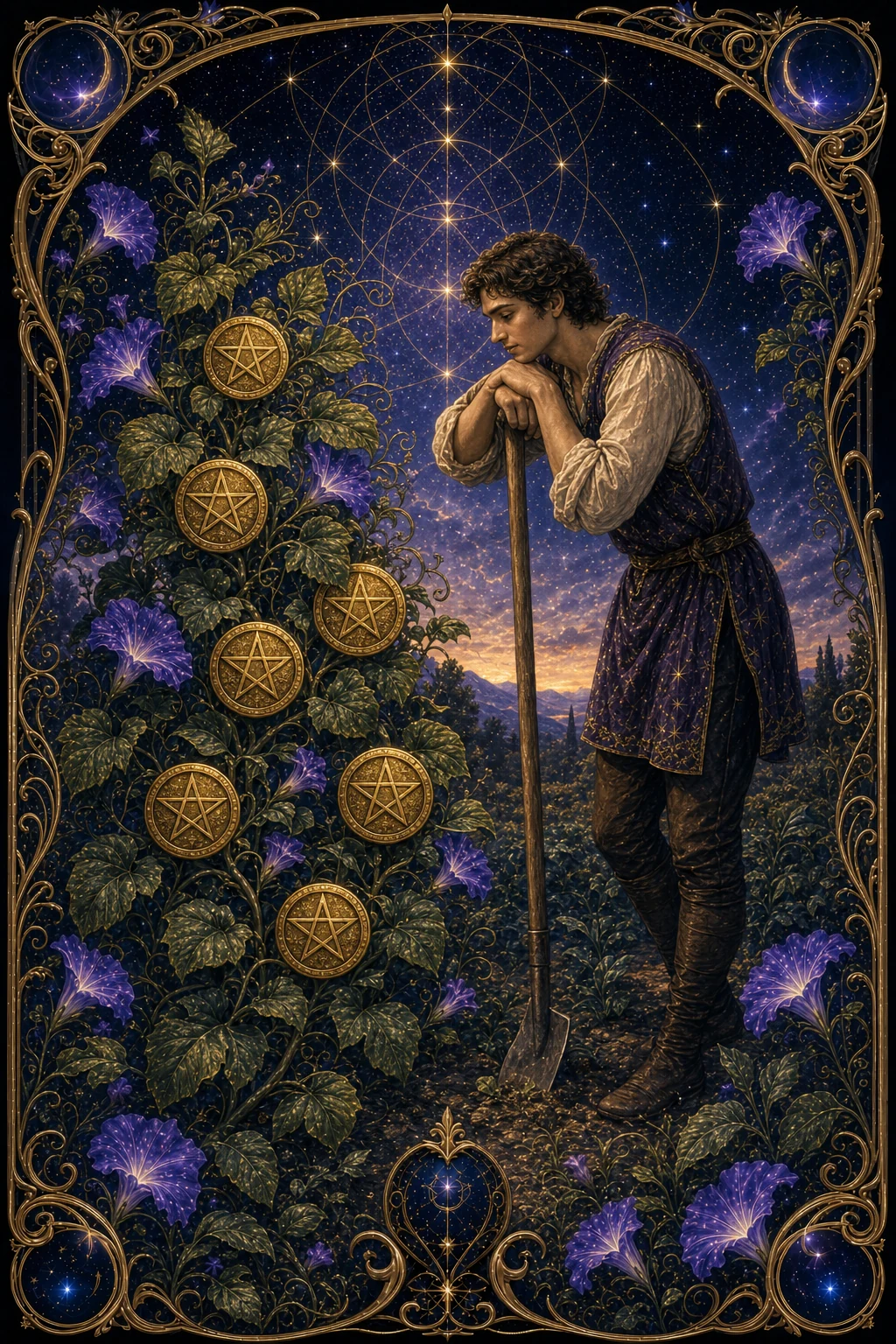
A gardener leans on the handle of his hoe at the edge of a heavy green bush, six coins bright in its leaves and one on the ground at his feet. He has stopped working and is looking at it. It asks what you are partway through, and how you are handling the stretch where nothing appears to be happening.
Upright Seven of Pentacles
This is the deck's study of the interval, and it is a peculiar image because nothing whatever is being done in it. The tools are set aside, the plant is doing what plants do, and a man is standing there assessing something that will not go faster for being assessed. Anyone who has grown anything, or learned anything, or waited out the middle of a long undertaking knows the posture. Upright, the card's subject is the distance between effort and result, and specifically the stretch where the effort has already been made and the result has not arrived and there is nothing to do but keep the ground clear. That stretch is where most projects are quietly abandoned, not out of laziness but because a long silence is genuinely hard to read. Is it growing, or is it finished and nobody has said so? The card does not answer, and the honest position is that the plant looks the same either way for a while. What it offers instead is permission to stand still and look, which is not the same as doing nothing. Assessment is work. It is simply work that produces no visible output, which in most people's private accounting means it does not count.
Reversed Seven of Pentacles
Turned over, the pause goes wrong in one of two directions. The commoner reading is impatience: pulling things up to check the roots, which is a fair description of a great deal of anxious behaviour and reliably makes the situation worse. The card is sympathetic rather than scolding here, since the impulse comes from not being able to bear the ambiguity, and ambiguity is genuinely unpleasant to hold. Naming that is often more useful than resolving to be patient, which nobody has ever successfully done by resolving. The other direction is tending something long past the point where you would choose it again. Sunk effort is heavy, and a plant you have watered for three years has a claim on you that a new one does not, which is a feeling rather than an argument. Reversed, this card is a reasonable place to separate the two. Nothing here predicts any outcome, and no card can say whether anything of yours will come to anything. What is available is a smaller and more useful exercise: identify what you would need to see, and by when, in order to know — and notice whether you have ever let yourself set that line before.
Seven of Pentacles in love and relationships
Between people, this card belongs to the long middle of things rather than to beginnings or endings. Connections have fallow periods, and they are widely misread, because everything in the culture suggests that a relationship not visibly growing must be dying. Sometimes it is simply in a season with nothing above ground. The Seven is a good place to consider what you are actually tending in your closest relationships, and whether it is getting the ordinary, boring, repeated attention that things need, or only the crisis kind. A second reflection concerns waiting on somebody. Waiting for a person to change, to decide, or to say the thing is a real and common position, and it deserves the same clear-eyed question the card puts to any other crop: what would you need to see, and how long have you been telling yourself it is nearly spring?
Seven of Pentacles in work and study
In working life, the Seven describes the stage after the launch and before the verdict. The application sent, the business in its second year, the skill practised long enough to be no longer novel and not yet good. It is an unglamorous position and it is where most durable things are actually made. The reflection concerns evidence: which signals you are using to decide whether something is working, and whether you chose those signals or absorbed them from people whose situation is nothing like yours. Comparison is particularly poor gardening. Nothing here recommends persisting or stopping, and no decision about your work is being suggested; that is entirely yours. What the card does note is that the gardener is looking rather than guessing, and that looking properly at what has actually grown is available at any point, including today.
Resources and security
Held as reflection only, the Seven takes up patience without attaching any promise to it. The suit's slower cards all circle the same idea: things built of matter accumulate at their own pace, largely indifferent to how closely they are watched. There is something worth examining in how often you check on the things you are growing, and what the checking is really for, since it is frequently reassurance rather than information. Nothing here forecasts anything about anyone's circumstances, and it offers no counsel about money or about the choices attached to it. The gardener's stance is the whole content: attention paid to something that will take the time it takes, with no bargain available.
Attention and wellbeing
Where attention is concerned, the Seven makes a case for the deliberate pause — the kind taken while standing up, mid-task, without any pretence that it is a reward for finishing. The figure has stopped and has not gone indoors. That middle state is undervalued and it is often where anything gets noticed at all. There is a note here about the difference between resting and monitoring, too: many people stop working and continue watching, which uses much the same energy and returns none of it. Nothing about this is medical or diagnostic. It is simply an observation that leaning on the hoe for a minute is part of the work rather than a lapse in it.
Yes or no?
It depends
It depends on timing more than merit. The card inclines toward not yet rather than no, and asks what you would need to see before answering. It offers no forecast of any kind.
Symbolism in the card
Smith draws a young labourer in a plain tunic and heavy boots, both hands folded over the handle of a hoe whose blade rests in the earth. Beside him a dense green bush or vine bears six pentacles among the leaves, while a seventh lies on the ground near his feet, sometimes read as a first fruit and sometimes as the one that fell. His head is inclined toward the plant and his expression is generally read as thoughtful rather than pleased, which is part of why the card resists a simple harvest interpretation. The soil is turned and the background is bare and pale, giving the scene no particular season. Waite's note describes a young man leaning on his staff and looking intently at the pentacles, and calls the card one of money, business and barter, which fits the older coin-suit tradition of trade more than it fits the picture. Later readers have preferred what the image plainly shows: not the harvest, and not the planting, but the long middle where somebody stands and looks.
Seven of Pentacles as today's card
Drawn for the day, this card generally recommends review over production. Look at something you have been building and take an honest measure of it, in writing if possible, since the version in your head has been quietly editing itself for months. It is also a fair day to leave something alone on purpose — the message unsent, the number unchecked, the thing not poked at. Both of those are activities, whatever they feel like. If today has already been busy, the card's smallest form is a minute spent noticing what is actually further along than it was, which is usually more than expected.
In a three-card spread
Set behind you, the Seven often marks a waiting period whose outcome you now know, and it can be worth remembering how uncertain it felt at the time, since hindsight flattens that completely. Sitting in the present, it marks a live interval, and its neighbours generally suggest whether the ground is worth continuing to clear. Placed ahead of you, it makes no promise about any result. The question that suits it is one of measurement: if this were still going in six months, what would you want to be able to look at, and would you trust yourself to look at it plainly?
Keywords
- Patience
- Investment
- Assessment
- Reward
Journal prompts
- What are you tending that you would not plant again today?
- What would you need to see, and by when, to know whether something is working?
- When you check on the things you are growing, are you gathering information or seeking reassurance?
Cards read alongside Seven of Pentacles
- Eight of Pentacles — Diligence, mastery, repetition, and devoted craft.
- The Hermit — Soul-searching, introspection, being alone, inner guidance.
- Knight of Pentacles — Reliability, patience, routine, and steady progress.
- Ace of Pentacles — A material opportunity, prosperity, grounding, and growth.
- All 78 tarot card meanings — the full major and minor arcana in one place.
Combinations with Seven of Pentacles
- Six of Pentacles and Seven of Pentacles tarot combination
- Seven of Pentacles and Eight of Pentacles tarot combination
- Five of Pentacles and Seven of Pentacles tarot combination
- Seven of Pentacles and Nine of Pentacles tarot combination
- Four of Pentacles and Seven of Pentacles tarot combination
- Seven of Pentacles and Ten of Pentacles tarot combination
- All 2,772 minor arcana combinations
Seven of Pentacles by position
- Seven of Pentacles as feelings tarot meaning
- Seven of Pentacles as intentions tarot meaning
- Seven of Pentacles as outcome tarot meaning
- Seven of Pentacles as advice tarot meaning
- Seven of Pentacles as an obstacle tarot meaning
- Seven of Pentacles as action tarot meaning
- Seven of Pentacles as a person tarot meaning
- Seven of Pentacles as how someone sees you tarot meaning
- Seven of Pentacles for a yes or no question tarot meaning
- All card meanings by position
Curious what Seven of Pentacles means for your question? Turn a card on the home page — no account needed.
Draw a card freeOne card, one honest question, most evenings.
Start your free daily readingFree · One card a day · No credit card needed
Go deeper than one card
A personalized deep reading works a full spread around your question — Seven of Pentacles included, if it falls to you. Deep readings run from the $1.99 Single Card Illumination and the $7 Three-Card Path, delivered straight away, to the $19 Five-Card Compass and the $29 Celtic Cross Atlas, composed in depth and delivered within 2–4 hours.
The $7 Three-Card Path, three cards read as one movement → · All reading options →
Prefer a rhythm to a one-off? Sparkle Pro ($8.99/month or $59/year) draws a three-card past, present and future spread for you every day. There is also a free eight-phase moon ritual guide to pair with today's card.
To sit with this card longer, the tarot journaling guide has prompt sets for daily draws, moon phases, and more.
Tarot content is for entertainment and personal reflection, not professional advice.