Three of Pentacles Tarot Card Meaning
 Start your free daily reading
Free · One card a day · No credit card needed
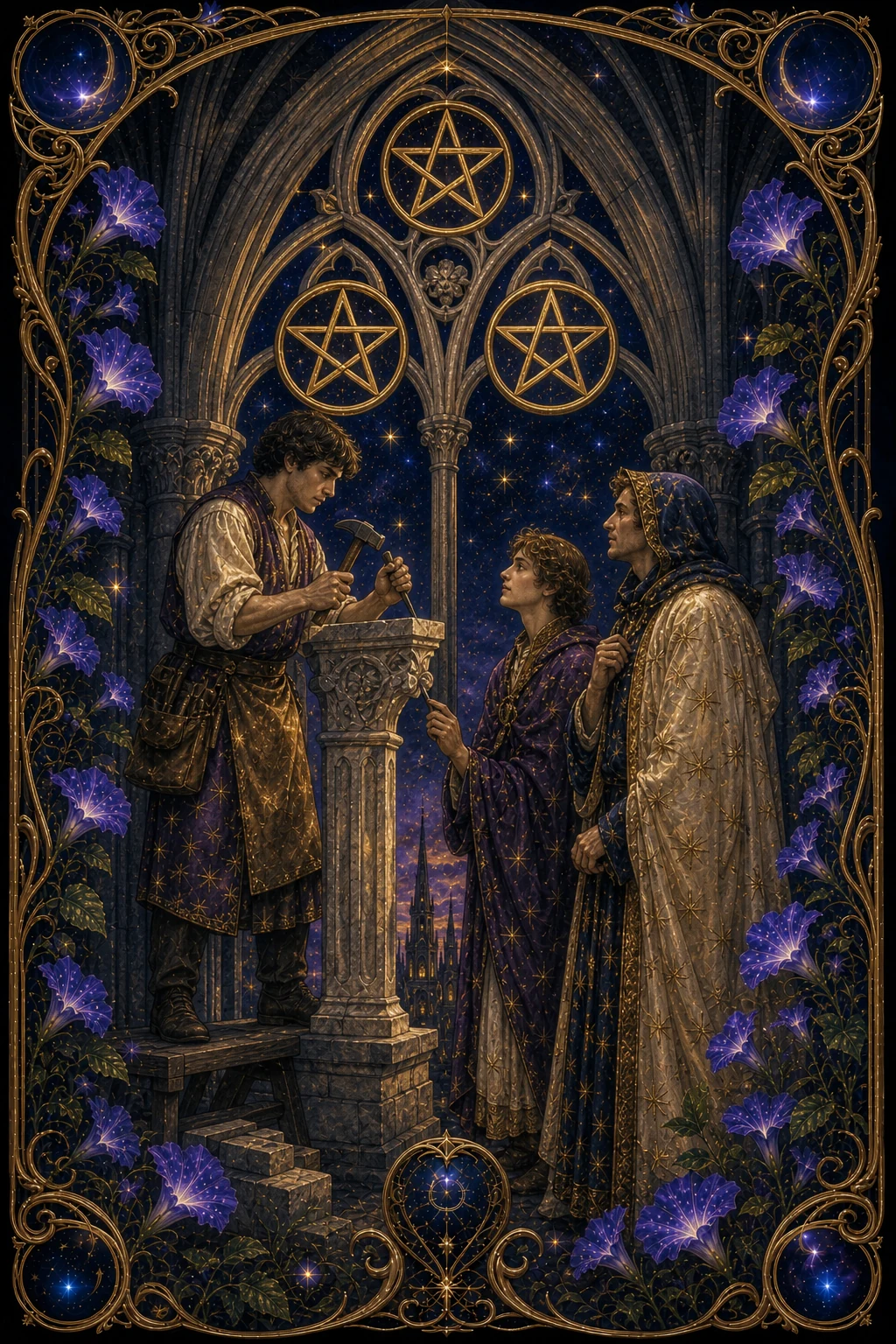
A young sculptor stands on a bench in a cathedral with his tool still in hand, turning to speak with a monk and a hooded figure who hold a drawing between them. Three coins are set into the stonework above the arch. The card asks how you behave when the work is not finished and other people are looking at it.
Upright Three of Pentacles
The scene is a consultation, and the interesting part is who is standing where. The craftsman is elevated on his bench, which puts the person with the chisel physically above the people with the plan, and Smith almost certainly did that on purpose. Neither party can produce the cathedral alone. Drawings do not cut stone and stone does not know what it is meant to become. Upright, the card sits with collaboration of the unromantic kind — the sort that involves being interrupted, being asked to explain a choice, and occasionally being told the drawing says otherwise. The reflection concerns visibility. Work done alone can stay in the state where it is still going to be good. Work shown becomes a specific thing with specific faults, and most people have a strong preference for one of those conditions over the other. It can be revealing to notice which. There is also a quiet argument here about apprenticeship and about the ordinary dignity of being mid-skill. Three is a small number. Nothing is complete, the coins are set but the building is not, and the card is content with that. If you are somewhere in the unfinished middle of something, this figure is not asking you to hurry.
Reversed Three of Pentacles
Turned over, the conversation goes wrong in one of several ordinary ways. The commonest reading is a collaboration where the roles were never actually agreed: everyone assumed a division of labour and nobody said it aloud, and the friction that follows gets attributed to personalities. That misattribution is doing a great deal of quiet damage in a great many teams and households. A second reading concerns standards. Reversed, this card is often described as work rushed, or work done to a level nobody is proud of because the conditions did not permit better. It is worth separating that from carelessness, since the two feel identical from inside and have entirely different remedies. Some poor work is an effort problem and a good deal of it is a resourcing problem. The third version turns inward and is possibly the most common. It describes the person who cannot let anyone see the bench: revision without end, the thing never quite ready to show, perfection functioning as a hiding place. No prediction is being made here about any project of yours. Reversed, the card simply asks whether what stands between you and finishing is the work itself or the prospect of it being looked at.
Three of Pentacles in love and relationships
Between people, this card concerns the shared undertaking rather than the feeling underneath it. Households are built things. So are friendships that survive relocations, and family arrangements that hold up under strain, and all of them run on a division of labour that is usually assumed rather than negotiated. The Three is a good place to look at how work gets allocated in your closest connections, and particularly at the invisible categories — remembering, arranging, noticing what is running out. Someone is doing that, and the doing rarely appears in any conversation about fairness. There is a warmer note too. This card values being seen at your craft by people whose judgement you respect, and the same holds in love: the pleasure of someone watching you do the thing you are good at and understanding what it took. If that has been in short supply lately, it is worth naming rather than resenting.
Three of Pentacles in work and study
This is one of the deck's clearest working-life cards, and its subject is competence in public. Being reviewed, being briefed, having a plan handed to you that does not survive contact with the material — all of it lives here. The card does not take the craftsman's side against the planners, which is notable, since most readings drift that way. It shows three people in a functioning arrangement, each holding something the others need. If you are partway through a long build, the reflection is about feedback: what you actually do with it, whether you can distinguish a note about the work from a note about you, and how often you ask for any. If you are further along, the question turns toward the bench. Somebody is standing on it now with a tool in hand, and how much room they are given is a decision somebody makes, possibly you.
Resources and security
The theme of worth appears here as recognition rather than accumulation. Skill accrues quietly and is often valued last by the person who has it, since nothing is more invisible than the thing you can do easily. As a reflection only, and with no guidance intended about anyone's arrangements, it can be worth writing down what you are genuinely good at, in plain language, without the qualifiers you would add if anyone else were reading. Most people undercount by a wide margin. The three coins in the picture are set into the fabric of the building rather than held in a hand — worth as something built in, which is a different image from worth as something carried, and the difference repays a little thought.
Attention and wellbeing
On the subject of attention, the Three favours the sustainable working session over the heroic one. Craft accumulates through repetition at a bearable intensity, and cathedrals were not built by anybody's remarkable fortnight. There is a practical note about interruption here too: the card shows the sculptor turning away from the stone mid-task, which is what most days consist of, and the returning costs something each time. You might simply observe how many times you were pulled off a task today, without drawing conclusions from it. Nothing in this is medical, and rest here means the ordinary sort — stopping when the light goes, rather than when the work is done.
Yes or no?
Yes
Yes, conditionally, and the condition is other people. The card leans toward the option that involves someone else's hands or judgement. Read it as an invitation to consult rather than as any sort of forecast.
Symbolism in the card
Smith sets this scene inside a church or abbey, identifiable by the pointed arch and the pale grey stonework, with three pentacles worked into the masonry above the archway in a trefoil arrangement. The sculptor is young, in a workman's apron, standing on a low wooden bench with a mallet or chisel held down at his side. Facing him are two figures: one a monk or friar in a plain habit, one hooded in patterned cloth sometimes read as a lay master or donor, and between them they hold an unrolled plan. Trefoils and the number three carry obvious ecclesiastical weight, and Waite's brief note calls the young man a sculptor at his work in a monastery. The older Marseille version of this card is purely geometric, three coins arranged with foliage, and the entire narrative scene is a Rider–Waite–Smith invention. That is worth knowing, because much of what readers now take as the card's traditional meaning — teamwork, expertise, the mid-build consultation — descends from Smith's staging rather than from centuries of doctrine.
Three of Pentacles as today's card
Drawn for a single day, this card usually points at a conversation about work rather than the work itself. Show someone the draft. Ask the person who has done it before. Say plainly which part you are stuck on, which is harder than it sounds and shortens most problems considerably. There is a second, quieter use of the day: notice who did something well near you and tell them specifically what it was. Not a general compliment — the specific detail, the choice they made. It takes ten seconds and it is remembered for years, which is an unusually good return for a Tuesday.
In a three-card spread
Placed behind you, this card often refers to a period of learning under other people's eyes, and to whatever you concluded then about being watched while you work. Those conclusions tend to outlive their evidence. In the central position it describes an undertaking that currently involves other hands, and the surrounding cards usually indicate whether the arrangement is functioning or merely continuing. Ahead of you, take it as a question rather than an outcome: were this approached as a build instead of a decision, who would need to be in the room, and what would need showing before it was ready?
Keywords
- Teamwork
- Skill
- Collaboration
- Craft
Journal prompts
- What are you revising rather than showing, and what would showing it actually risk?
- In your closest connections, who does the remembering, and when was that decided?
- What can you do easily that you have stopped counting as a skill?
Cards read alongside Three of Pentacles
- Eight of Pentacles — Diligence, mastery, repetition, and devoted craft.
- Seven of Pentacles — Patience, long-term investment, assessment, and reward.
- The Hierophant — Spiritual wisdom, religious beliefs, conformity, and tradition.
- Page of Pentacles — Study, manifestation, opportunity, and practical ambition.
- All 78 tarot card meanings — the full major and minor arcana in one place.
Combinations with Three of Pentacles
- Two of Pentacles and Three of Pentacles tarot combination
- Three of Pentacles and Four of Pentacles tarot combination
- Ace of Pentacles and Three of Pentacles tarot combination
- Three of Pentacles and Five of Pentacles tarot combination
- King of Swords and Three of Pentacles tarot combination
- Three of Pentacles and Six of Pentacles tarot combination
- All 2,772 minor arcana combinations
Three of Pentacles by position
- Three of Pentacles as feelings tarot meaning
- Three of Pentacles as intentions tarot meaning
- Three of Pentacles as outcome tarot meaning
- Three of Pentacles as advice tarot meaning
- Three of Pentacles as an obstacle tarot meaning
- Three of Pentacles as action tarot meaning
- Three of Pentacles as a person tarot meaning
- Three of Pentacles as how someone sees you tarot meaning
- Three of Pentacles for a yes or no question tarot meaning
- All card meanings by position
Curious what Three of Pentacles means for your question? Turn a card on the home page — no account needed.
Draw a card freeOne card, one honest question, most evenings.
Start your free daily readingFree · One card a day · No credit card needed
Go deeper than one card
A personalized deep reading works a full spread around your question — Three of Pentacles included, if it falls to you. Deep readings run from the $1.99 Single Card Illumination and the $7 Three-Card Path, delivered straight away, to the $19 Five-Card Compass and the $29 Celtic Cross Atlas, composed in depth and delivered within 2–4 hours.
The $7 Three-Card Path, three cards read as one movement → · All reading options →
Prefer a rhythm to a one-off? Sparkle Pro ($8.99/month or $59/year) draws a three-card past, present and future spread for you every day. There is also a free eight-phase moon ritual guide to pair with today's card.
To sit with this card longer, the tarot journaling guide has prompt sets for daily draws, moon phases, and more.
Tarot content is for entertainment and personal reflection, not professional advice.