The Empress Tarot Card Meaning
 Start your free daily reading
Free · One card a day · No credit card needed
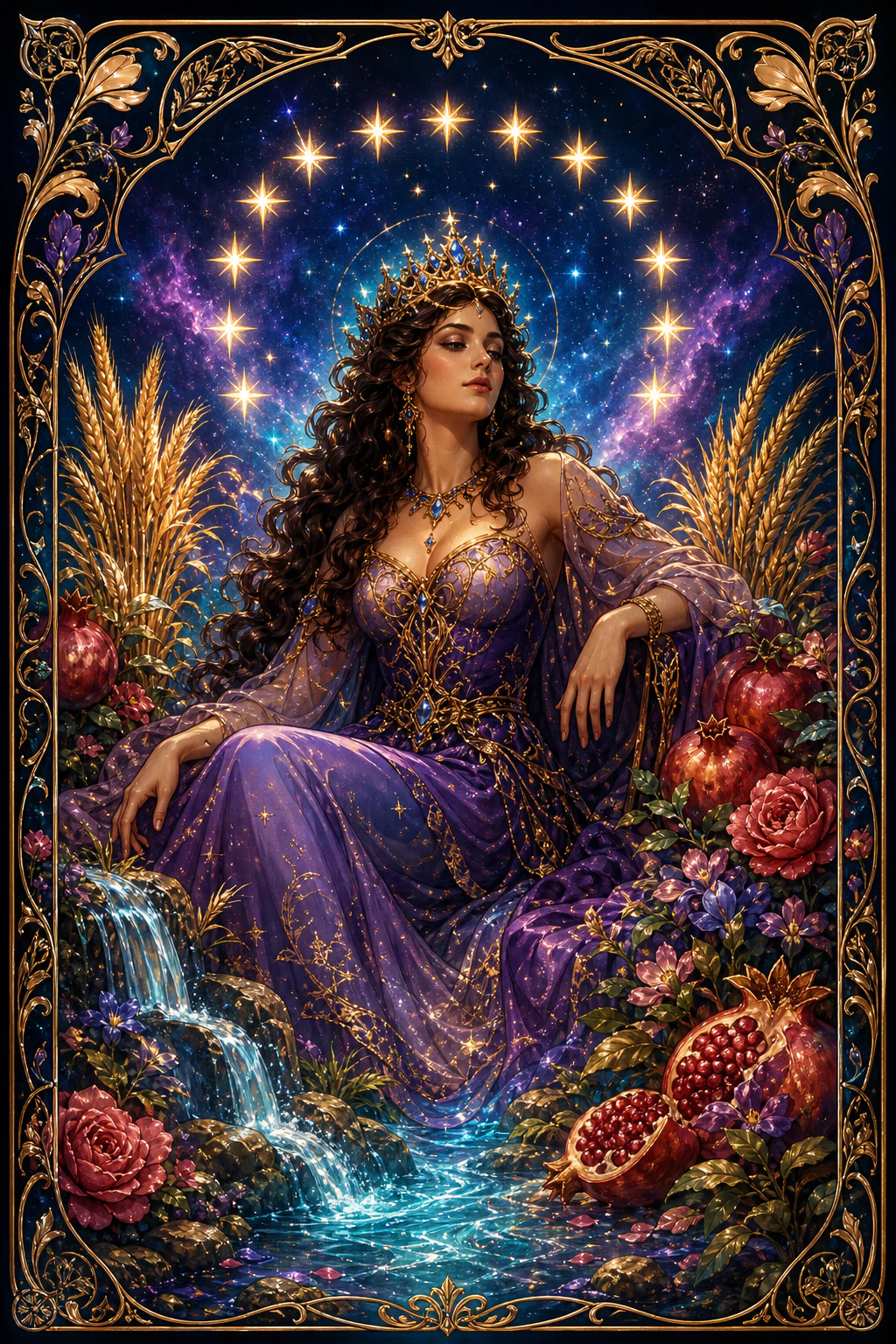
A woman reclines on cushions in a field of ripe wheat, a shield marked with the sign of Venus propped beside her, a stream falling through the trees behind. Her crown is a ring of stars and she is in no hurry whatsoever. The card asks what you tend, and whether you allow yourself any of it.
Upright The Empress
Everything in this picture is already growing. The wheat stands at full height, the trees are in leaf, the water arrives without being fetched — the scene is set in the season after effort, when the work consists of tending rather than starting. Upright, the Empress sits with creation of the slow kind: the book at chapter nine, the garden in its third summer, the friendship fed weekly for a decade. None of those arrive; all of them are kept. She also concerns the senses, which this deck otherwise mostly ignores. Comfort, texture, warmth, food that took time, a room arranged for pleasure instead of efficiency — the card treats such things as substantial rather than decorative, and it is worth asking when you last treated them that way yourself. A harder reflection is folded inside the warm one. People who are good at tending very often do it outward only. The figure here is reclining rather than working, a detail easy to skim past. Consider what you are currently growing, and whether any of the harvest is arranged to reach you.
Reversed The Empress
Turned over, the card's generosity tends to run in one direction until something gives. The familiar reading is care that has stopped including the person doing it: the household everyone leans on, the colleague who absorbs the difficult parts, the friend who is always the one who asks. Depletion of that sort is quiet and cumulative, and it is generally noticed by everybody except its source. A second reading concerns creative work gone stale. Anything tended long enough can turn into obligation, and the reversed card makes a reasonable moment to wonder whether a project you once loved is still yours or has become a thing you owe. Neither answer demands action this week. Then there is smothering, which the older sources mention and which is unflattering enough that most readers skip it. Care can be a way of remaining necessary. If a person close to you is quietly outgrowing the shape of your help, that is worth noticing early rather than late. Reversed, the card asks who your attention is really serving, and answers nothing on your behalf.
The Empress in love and relationships
This card's dialect of affection is sensory and practical: feeding people, making a place comfortable, noticing what somebody likes and remembering it a year later. That is a real language and it is easily mistaken for background. There is worth in asking whether you receive it as fluently as you speak it, since many generous givers are surprisingly poor listeners in this particular register. The Empress offers no verdict on anyone's relationship, and predicts nothing about one. What she raises instead is enjoyment. Some connections are maintained conscientiously and enjoyed rarely, which is an odd fate for something originally chosen for pleasure. Consider the last occasion a relationship in your life was simply nice, and what conditions made that possible.
The Empress in work and study
For work, this card describes the long middle of making something. Not the idea, not the launch, but the stretch where the thing exists and requires steady attention nobody is applauding. If you are in that stretch, she is unusually good company; it is the only part of any project that reliably produces anything. She raises a question of conditions as well. The figure is surrounded by a landscape that suits her, and the deck is straightforward about the link between setting and growth. What in your working environment actually helps you think — the hour, the room, the noise level, the order of tasks — and how much of that arrangement has been surrendered to other people's convenience? A small question with unusually large consequences across a year.
Resources and security
On the theme of enough, this card takes the agricultural view: things accumulate slowly, in season, and the interesting quantity is not the total but the yield. As reflection only, consider which parts of your life are currently producing something — skill, comfort, company, work you would do anyway — and what merely sits. No recommendation is being made about anything you own or decide. But the Empress does raise an old and slightly uncomfortable question about pleasure and permission: whether you keep a private rule about what you are allowed to spend on being comfortable, where that rule came from, and whether its author would still write it today.
Attention and wellbeing
As a reflection on rest, this is the deck's most direct picture of it: someone reclining in a landscape that is doing perfectly well without supervision. The habit worth borrowing is not a technique but a category. Time that produces nothing, is owed to no one, and does not count as recovery from anything — most weeks contain none of it, and the absence is rarely registered as a loss. Notice where the hours drift on days you are obliged to nobody. The card makes no claims about your health of any kind. It only notices that tending is easier to schedule than being tended.
Yes or no?
Yes
Yes, in a slow and seasonal register. The card leans toward whatever grows with attention rather than whatever resolves quickly. It forecasts nothing; treat the yes as a comment on tempo.
Symbolism in the card
Smith's third trump reclines on a low couch heaped with cushions, set outdoors rather than in a hall. Her gown is patterned with pomegranates, a heart-shaped shield bearing the symbol of Venus leans at her side, and a crown of twelve stars circles her head — a detail borrowed from the woman clothed with the sun in Revelation. Ripe wheat grows at her feet, cypress trees stand behind, and a stream falls in a small cascade at the right of the card. A sceptre topped with a globe rests in her hand. The imagery draws on much older figures of the earth as sovereign: the Empress of the Marseille pack, and behind her the classical goddesses of grain and cultivated land. The wheat is the detail most often misread. In the tradition it stands for what has been cultivated and gathered rather than for anything simply given, and the card's whole argument sits in that distinction.
The Empress as today's card
As a single card for the day, this one usually reads as an instruction to make the hours pleasant rather than efficient, which is a surprisingly difficult brief. Cook something. Sit outside for the length of a cup of tea. Put the good thing on the table instead of saving it for a visitor who has not been scheduled. She can also arrive on a day already spoken for by other people, in which case there is no reproach in it, only a question of proportion: whether any part of today was arranged by you, for you, and how long it has been since one was. The answer is allowed to be the entire reading.
In a three-card spread
Placed in the past, this card often stands for a period of growth you now treat as background — something you built, or somebody who kept you steady, since quietly reclassified as ordinary. Naming it is the work. In the present position, she describes a matter requiring tending rather than solving, which frustrates anyone hoping for a decision. The cards around her usually indicate what is being asked to grow. Where a spread turns forward, treat her as an enquiry into care rather than a prediction of any sort: if this were fed weekly for a year, what would the dull weeks ask of you?
Keywords
- Abundance
- Nurturing
- Creativity
- Fertility
Journal prompts
- What are you tending, and is any of it arranged to reach you?
- When was the last unhurried hour that belonged to nobody but you?
- What private rule governs how much comfort you allow yourself, and who wrote it?
Cards read alongside The Empress
- The Emperor — Authority, establishment, structure, and a father figure.
- Nine of Pentacles — Abundance, independence, refinement, and earned comfort.
- Ace of Pentacles — A material opportunity, prosperity, grounding, and growth.
- The Star — Hope, faith, purpose, renewal, spirituality.
- All 78 tarot card meanings — the full major and minor arcana in one place.
Combinations with The Empress
- The Empress and The High Priestess tarot combination
- The Empress and The Emperor tarot combination
- The Empress and The Magician tarot combination
- The Empress and The Hierophant tarot combination
- The Empress and The Fool tarot combination
- The Empress and The Lovers tarot combination
- All 231 major arcana combinations
The Empress by position
- The Empress as feelings tarot meaning
- The Empress as intentions tarot meaning
- The Empress as outcome tarot meaning
- The Empress as advice tarot meaning
- The Empress as an obstacle tarot meaning
- The Empress as action tarot meaning
- The Empress as a person tarot meaning
- The Empress as how someone sees you tarot meaning
- The Empress for a yes or no question tarot meaning
- All card meanings by position
Curious what The Empress means for your question? Turn a card on the home page — no account needed.
Draw a card freeOne card, one honest question, most evenings.
Start your free daily readingFree · One card a day · No credit card needed
Go deeper than one card
A personalized deep reading works a full spread around your question — The Empress included, if it falls to you. Deep readings run from the $1.99 Single Card Illumination and the $7 Three-Card Path, delivered straight away, to the $19 Five-Card Compass and the $29 Celtic Cross Atlas, composed in depth and delivered within 2–4 hours.
The $29 Celtic Cross Atlas, ten cards read position by position → · All reading options →
Prefer a rhythm to a one-off? Sparkle Pro ($8.99/month or $59/year) draws a three-card past, present and future spread for you every day. There is also a free eight-phase moon ritual guide to pair with today's card.
To sit with this card longer, the tarot journaling guide has prompt sets for daily draws, moon phases, and more — including journal prompts for every major arcana card.
Tarot content is for entertainment and personal reflection, not professional advice.