King of Cups Tarot Card Meaning
 Start your free daily reading
Free · One card a day · No credit card needed
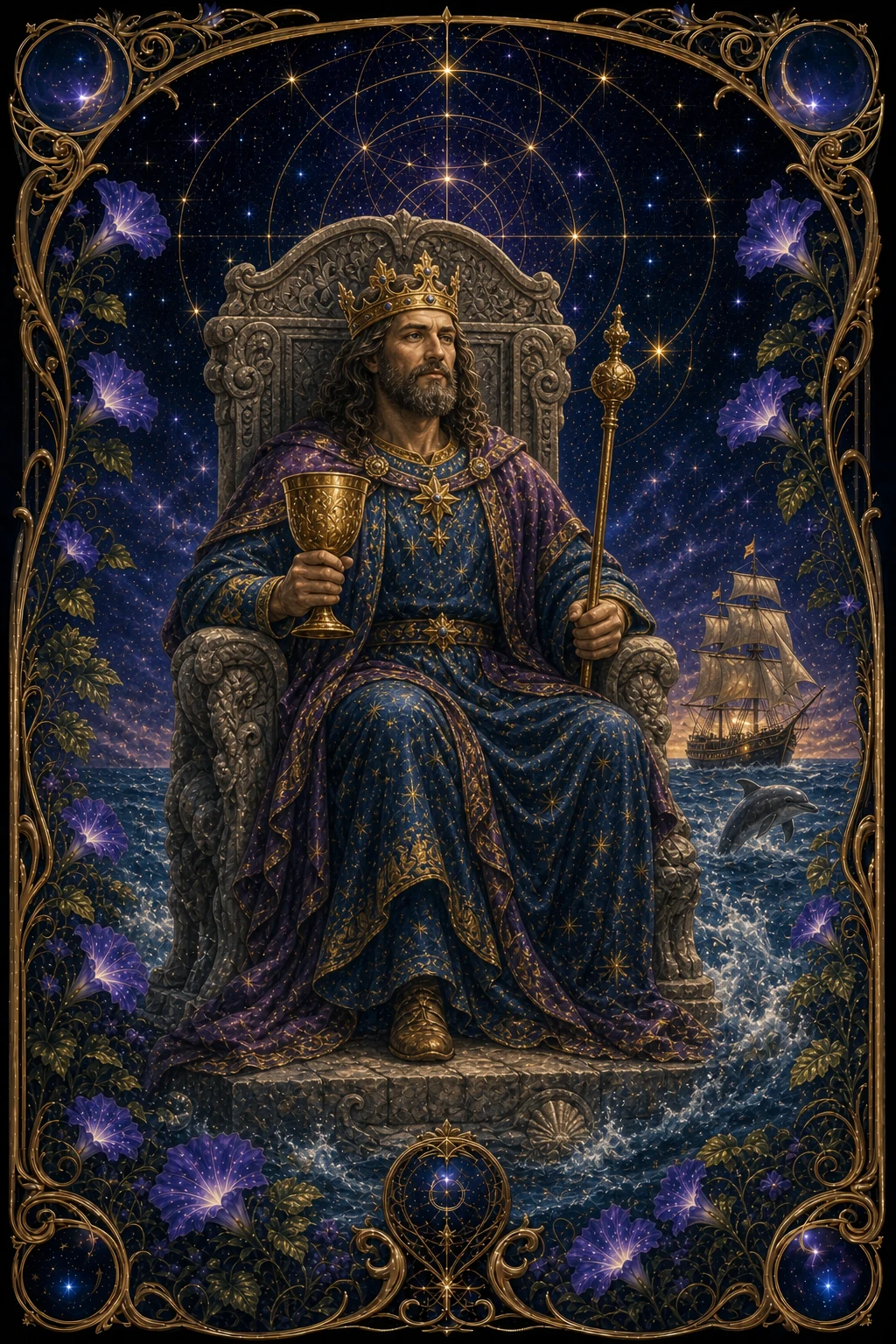
His throne floats on a slab of stone in a heaving sea. A ship pitches on one side of him, a fish leaps clear of the water on the other, and he sits between them holding a cup, a fish carved on a chain at his neck, his feet entirely dry. Nothing about the water is calm. The card concerns what composure costs the person maintaining it.
Upright King of Cups
The sea is the reading. It is rough, it is going to stay rough, and he is not doing anything about it, because nobody has ever done anything about a sea. What he is doing is remaining upright on a slab of rock in the middle of it, dressed, seated, holding a cup steady, which is a far more demanding activity than the stillness of the picture suggests. This is the deck's argument that calm is a practice rather than a temperament. People who never appear rattled are almost never people who feel nothing; they are people running a continuous, invisible, energetically expensive process, and the process is the skill. Notice how he holds the cup. He does not gaze into it and he does not extend it to anyone. He holds it level, which is the only way to carry a full vessel across moving ground. In the ordinary world this figure is whoever keeps a conversation from becoming an argument, hears the worst version of a problem without flinching, and says the accurate thing at a volume that does not escalate. It is genuinely valuable and it is rarely thanked, largely because the whole point of it is that nothing visible happens.
Reversed King of Cups
Reversed, the practice fails in one of two directions and the tradition knows both. In the first, the composure holds but has become something else: not regulation but suppression, a flat professional warmth extended in every direction and no access granted to anyone, so that the person is easy to be around and impossible to reach. Nothing is felt out loud, which eventually means nothing is felt with company. In the second, the slab tips. The person who absorbs everyone else's weather for two years discovers there was a limit after all, usually over something small, and the disproportion of the eventual reaction is what everyone remembers. There is a third and quieter reading about steadiness used as a tactic, where remaining calm is how you win, since the visibly upset party is always the one who looks unreasonable. That is worth naming even though it is uncomfortable. None of these predicts anything or describes anyone else. Reversed, the fair question is who you are calm for, and where the rest of it goes when the room empties.
King of Cups in love and relationships
In closeness of any kind, this figure is the reliable temperature: the person whose reaction can be forecast, who does not slam anything, who can be told difficult news without the telling becoming an event in itself. That reliability is a real gift and it is usually described as boring by people who have never lived without it. The card takes no view on anyone's situation and says nothing about where any connection stands. What it raises instead is the particular loneliness available to steady people. Being easy to be around and being known are different achievements, and the first can substitute for the second for a very long time before anybody notices, including the steady person. There is a question worth sitting with: when did you last say something that had not already been edited for its effect on the listener?
King of Cups in work and study
For work, this King is judgement under pressure. The capacity to hear a bad report without reacting, to hold a decision open while it is still genuinely open, to mediate between people who have stopped being reasonable, and to say the unpopular thing without theatre. It is the least visible form of authority in the deck and often the most load-bearing. Two reflections attach to it. The first concerns whether that role was chosen or simply fell to you because you were the one who did not raise your voice, which is how most people acquire it. The second concerns what happens to your own position. Diplomats spend so long representing everyone's interests fairly that they occasionally lose track of which outcome they actually wanted, and this is one occasion to check whether you still know yours.
Resources and security
There is no land anywhere in this picture, which makes it an odd card for the subject of security and an interesting one. Offered as reflection alone, and containing no financial advice at all, it points at the entanglement of mood and money: the way a difficult fortnight makes ordinary spending feel like management, and a settled one makes the same numbers unremarkable. Most people have a version of this and few have looked at it directly. There is something in noticing which of your habits around money are doing emotional work rather than practical work, without needing to change any of them today. Whatever you settle on stays entirely yours, taken with proper advice where that is useful.
Attention and wellbeing
The dry feet are the detail worth keeping. Staying dry in that sea requires constant small adjustment, and, taken purely as an observation about stamina rather than health, that is the honest picture of self-regulation: not a state you achieve but a thing you do, repeatedly, at a cost that does not appear on any list. People who are good at it typically underestimate the bill. The habit this card suggests is not more discipline but a scheduled hour of not hosting, in which nothing is being managed, nobody is being kept level, and no room requires your temperature. That is different from rest as recovery and it is easy to skip precisely because nothing feels wrong. No claim about anybody's health is meant by any of it.
Yes or no?
Yes
Yes, at a measured pace and with the feeling handled rather than acted on. The card leans toward the answer you would still endorse in a fortnight. It knows nothing of your circumstances and predicts nothing.
Symbolism in the card
Smith gives the fourth Cups court no ground at all. His throne stands on a slab of grey stone that appears to float in open, choppy water, and the horizon behind him is busy: a ship under sail rides the swell on one side, a large fish breaks the surface on the other. He wears a blue robe and a yellow mantle, with a fish amulet hung on a chain at his breast, a motif carrying both early Christian and alchemical associations with the soul and with what lives beneath. He carries a short sceptre in one hand and a cup in the other, held level and unregarded. His feet do not touch the water and his boots are dry, which is either impossible or the entire point. Where the earth courts of this deck are seated among gardens and built walls, this throne is set on the one element that cannot be improved, fenced or inherited. The ship is a traditional emblem of commerce and of the world's ordinary business proceeding at a distance, which it does here without any evident help from him.
King of Cups as today's card
Pulled as the only card for a day, this King usually points at one conversation. Somewhere in the hours ahead there is an exchange that could go up in temperature, and the card's suggestion is the least dramatic available: reply after the pause rather than during it. That is the whole practice and it is harder on tired days than on rested ones, which is itself worth knowing. A second reading applies when no such conversation exists. On quiet days the figure is a prompt to check your own weather rather than manage anyone else's, since the people who are good at this often go weeks without being asked. The card cannot know your day and offers no assurance about how any of it goes.
In a three-card spread
In a spread's opening seat, this King tends to indicate a stretch when you held things steady, possibly at some expense that was never itemised. Naming the expense afterwards is worth more than the credit. In the middle he describes a live requirement for composure and the surrounding cards generally show whether it is being met from strength or from depletion, which look identical from outside and feel nothing alike. In the last position he is a posture rather than a person and forecasts nothing about anyone. The conditional is the honest form: if this were handled at low volume, with nothing said in the first hour, what would you want to have said by the end of the week?
Keywords
- Balance
- Diplomacy
- Wisdom
- Calm
Journal prompts
- Who are you calm for, and where does the rest of it go?
- When did you last say something that had not been edited for its effect?
- In the situation you are mediating, which outcome do you actually want?
Cards read alongside King of Cups
- Queen of Cups — Compassion, emotional security, intuition, and care.
- King of Swords — Intellect, authority, truth, and ethical judgment.
- Temperance — Balance, moderation, patience, purpose.
- The Star — Hope, faith, purpose, renewal, spirituality.
- All 78 tarot card meanings — the full major and minor arcana in one place.
Combinations with King of Cups
- Queen of Cups and King of Cups tarot combination
- King of Cups and Ace of Swords tarot combination
- Knight of Cups and King of Cups tarot combination
- King of Cups and Two of Swords tarot combination
- Page of Cups and King of Cups tarot combination
- King of Cups and Three of Swords tarot combination
- All 2,772 minor arcana combinations
King of Cups by position
- King of Cups as feelings tarot meaning
- King of Cups as intentions tarot meaning
- King of Cups as outcome tarot meaning
- King of Cups as advice tarot meaning
- King of Cups as an obstacle tarot meaning
- King of Cups as action tarot meaning
- King of Cups as a person tarot meaning
- King of Cups as how someone sees you tarot meaning
- King of Cups for a yes or no question tarot meaning
- All card meanings by position
Curious what King of Cups means for your question? Turn a card on the home page — no account needed.
Draw a card freeOne card, one honest question, most evenings.
Start your free daily readingFree · One card a day · No credit card needed
Go deeper than one card
A personalized deep reading works a full spread around your question — King of Cups included, if it falls to you. Deep readings run from the $1.99 Single Card Illumination and the $7 Three-Card Path, delivered straight away, to the $19 Five-Card Compass and the $29 Celtic Cross Atlas, composed in depth and delivered within 2–4 hours.
The $19 Five-Card Compass, five positions and a keepsake → · All reading options →
Prefer a rhythm to a one-off? Sparkle Pro ($8.99/month or $59/year) draws a three-card past, present and future spread for you every day. There is also a free eight-phase moon ritual guide to pair with today's card.
To sit with this card longer, the tarot journaling guide has prompt sets for daily draws, moon phases, and more.
Tarot content is for entertainment and personal reflection, not professional advice.