Queen of Cups Tarot Card Meaning
 Start your free daily reading
Free · One card a day · No credit card needed
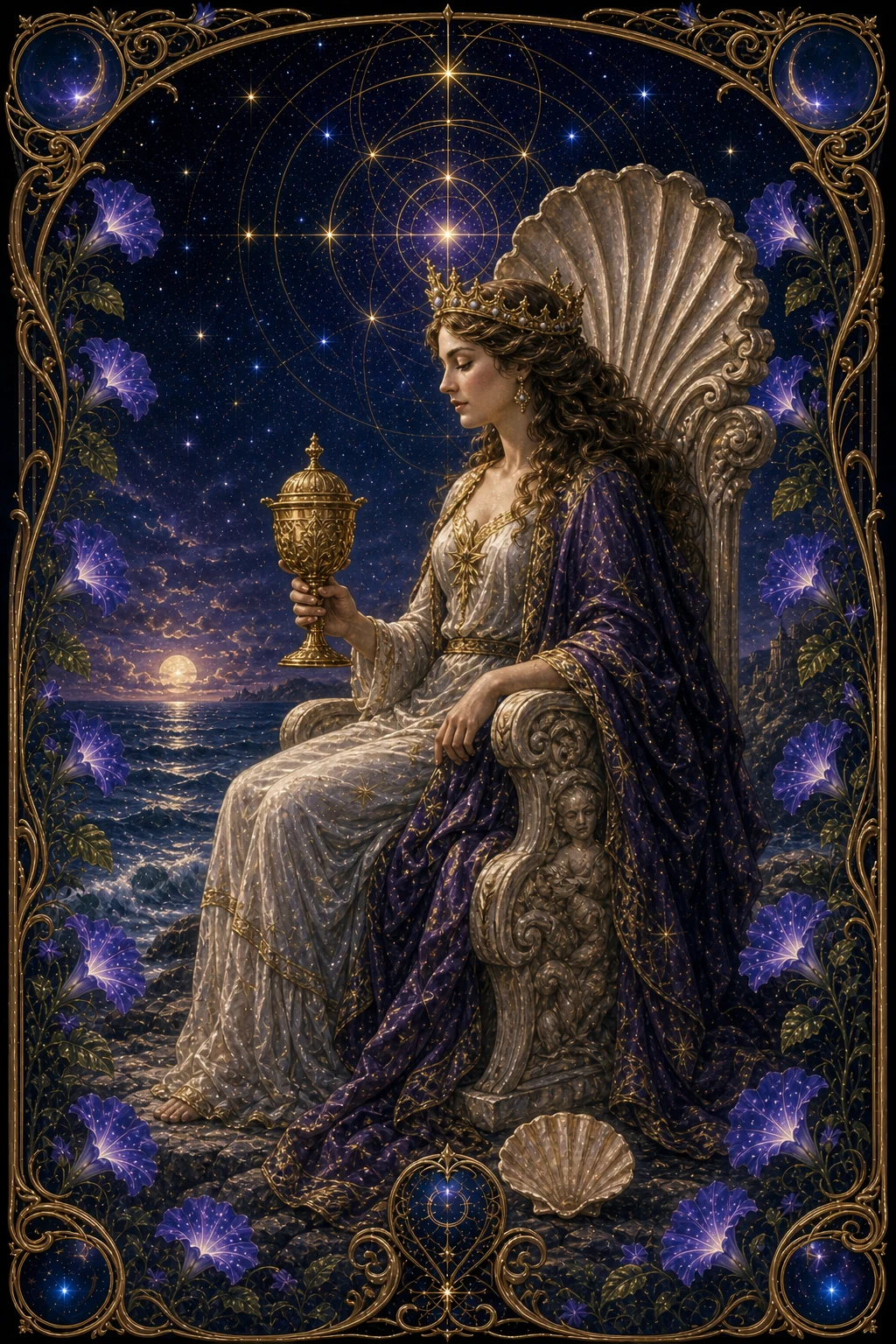
She sits on a stone throne at the water's edge, carved with small sea-children, and she holds a cup unlike any other in the deck: closed with a lid, its handles shaped like angels, ornate as a reliquary. She is looking into it. No other figure in the seventy-eight looks into their own cup. The card concerns what you keep inside, and how much of it belongs to other people.
Upright Queen of Cups
The lid is the first thing to notice and the last thing most readings mention. Every other cup in this suit is open, offered, poured, stared past. Hers is shut, elaborately, and she alone is looking at it. That is not secrecy in any sinister sense. It is interiority: a life that continues at full volume behind an unremarkable face, known in detail to one person. This Queen shows feeling as a capacity rather than as an event, which is why she is seated and why the throne is heavy. Attunement is her real subject. She is the figure who registers the mood of a room within four seconds of entering it, who knows something is wrong before it has been said, and who has probably been performing that service for a family or a team since she was young enough for it to have been a survival adaptation rather than a gift. Both those descriptions can be accurate at once. The upright card is warm and it is not naive. Note where she is sitting: at the boundary between water and land, on dry stones, with the sea reaching her feet and no further. Feeling everything and being made of it are separate conditions, and the picture holds the line between them deliberately.
Reversed Queen of Cups
Reversed, the boundary gives way in one direction or the other. In the first, the water comes over the stones and everything is taken personally: other people's moods arrive as weather you are somehow responsible for, and a day can be reorganised entirely around a tone of voice that was probably about traffic. Anyone who absorbs readily knows the exhaustion of a week spent processing feelings that were never theirs to begin with. In the other direction the lid clamps down. Access is refused, including to yourself, and the person becomes pleasant, capable and slightly unreachable, which can go unremarked for years because nothing appears to be wrong. There is a third and less flattering reading in which sensitivity is used, where knowing exactly what will land is turned toward getting a result. Most people who recognise that recognise it in a specific fortnight rather than in their character. None of these describes anybody in your life. Reversed, the card asks where your own edge currently sits, and whether you put it there.
Queen of Cups in love and relationships
In closeness of every kind, this Queen is the one who notices. The changed voice on the phone, the sentence left unfinished, the thing about somebody's mother that they mentioned once eight years ago. Being on the receiving end of that attention is a particular experience and people who have it rarely say so out loud. The card raises two questions and takes no view on either. First, whether you are ever noticed in return, or whether you have become so reliably the perceptive one that nobody thinks to ask. Second, whether the noticing has quietly replaced asking. Divining what someone needs is a virtuoso skill and it is also, sometimes, a way of avoiding the more exposed act of saying what you need yourself. None of that is a description of your circumstances. Anything genuinely painful in a close relationship deserves people who know you and support of the ordinary human kind, not a card.
Queen of Cups in work and study
For work and study, this Queen occupies the role that appears on no organisational chart: the person colleagues come to, the one who can tell that a project is going wrong from the way meetings feel rather than from the figures. That perception is real and useful and almost never counted as a contribution, which is worth naming plainly. The reflection here concerns cost. Attending to other people's states takes energy from the same reservoir as the work itself, and because it is invisible it does not get planned for. If your working week includes an hour of nobody's business but everybody's benefit, it is worth knowing roughly how large that hour actually is. The card also sits with any craft where reading a person accurately is the craft. Being good at that is not the same as being obliged to do it constantly.
Resources and security
Security, for this figure, is mostly a feeling rather than a figure, which cuts in two directions. Money can be entirely adequate and still register as precarious if the mood is wrong, and it can be genuinely tight while a good week makes it seem manageable. As reflection only, and not as anything approaching financial guidance: it may be useful to know which of your assessments of your situation are arithmetic and which are atmosphere, since they change on different schedules. Actual choices are yours to make, with qualified help where it is wanted. The card only observes that this Queen keeps her cup closed, and that people who hold things privately often carry a private ledger too.
Attention and wellbeing
Understood as a remark about noticing, with nothing diagnostic in it, the relevant detail is the shoreline. She has water at her feet and dry ground beneath her. People who take in a great deal need somewhere to put it down, and for most that means solitude of an unglamorous, non-restorative-sounding kind: an hour that is not for anyone, in which nothing is being processed on anyone's behalf. Water helps a striking number of people, which the card notices without explaining. The habit worth considering is a small regular emptying, whatever form that takes, placed before you need it rather than after. No health claim is intended, only the plain observation that a container which is never emptied stops working as a container.
Yes or no?
It depends
It depends on what your instinct has already told you, which this card treats as data rather than noise. Sit with the first answer that arrived before you started reasoning. That is a reflection, not a forecast.
Symbolism in the card
Smith seats her on an elaborate stone throne at the edge of a still lake, its back and arms carved with shells and with small naked water-children, one holding a scallop above her shoulder. The cup she holds is the strangest object in the suit: lidded, footed, with two angel-shaped handles, closer to a church ciborium than to a drinking vessel. It is the only covered cup among the fourteen and she is the only figure regarding her own. Coloured pebbles fill the foreground and her pale robe spills over them and appears to become the water itself, dissolving the line between the figure and her element. The lake behind is flat calm, which is worth registering against the turbulent sea Smith gives the King of the same suit. Queens in the older decks hold their cups plainly and preside; the Marseille reine de coupe sits frontally with an open vessel and no landscape. The introspection, the lid and the shoreline are all Rider-Waite-Smith additions, and together they make the card an argument about containment rather than about emotion in general.
Queen of Cups as today's card
Drawn alone for a day, this Queen tends to point at the first impression you had and dismissed. Most people have several before lunch: about a message, a meeting, a person's tone, a decision that looks fine on paper. The card's suggestion is not to obey those impressions but to write one down and see, by evening, whether it held. Doing that a few times teaches you more about your own accuracy than any amount of theory. A second use, for days that are already crowded with other people, is simpler still. Find twenty minutes in which nobody needs anything from you. That is a legitimate reading of this card and often the more honest one.
In a three-card spread
Looking back, this Queen frequently marks a season when you were the one holding things for other people, and it is worth asking who was holding anything for you at the time. The answer is often nobody, and often nobody noticed, including you. In the central position she describes present attunement, either as a resource being used well or as a leak, and the neighbouring cards usually make clear which. In the closing seat she should be read as posture rather than person and never as a prediction about anyone. The useful form is a question about your own conduct: if you approached this situation by trusting what you already sense, without requiring proof first, what would change about how you handle it?
Keywords
- Compassion
- Security
- Intuition
- Care
Journal prompts
- Whose feelings did you carry this week that were never yours to carry?
- Where is your edge, and did you put it there or did somebody else?
- What have you been divining for someone that you could simply ask about?
Cards read alongside Queen of Cups
- The High Priestess — Intuition, sacred knowledge, divine feminine, and the subconscious.
- Queen of Pentacles — Practical care, comfort, resourcefulness, and nurture.
- Four of Swords — Rest, recovery, contemplation, and quiet renewal.
- The Empress — Femininity, beauty, nature, nurturing, and abundance.
- All 78 tarot card meanings — the full major and minor arcana in one place.
Combinations with Queen of Cups
- Knight of Cups and Queen of Cups tarot combination
- Queen of Cups and King of Cups tarot combination
- Page of Cups and Queen of Cups tarot combination
- Queen of Cups and Ace of Swords tarot combination
- Ten of Cups and Queen of Cups tarot combination
- Queen of Cups and Two of Swords tarot combination
- All 2,772 minor arcana combinations
Queen of Cups by position
- Queen of Cups as feelings tarot meaning
- Queen of Cups as intentions tarot meaning
- Queen of Cups as outcome tarot meaning
- Queen of Cups as advice tarot meaning
- Queen of Cups as an obstacle tarot meaning
- Queen of Cups as action tarot meaning
- Queen of Cups as a person tarot meaning
- Queen of Cups as how someone sees you tarot meaning
- Queen of Cups for a yes or no question tarot meaning
- All card meanings by position
Curious what Queen of Cups means for your question? Turn a card on the home page — no account needed.
Draw a card freeOne card, one honest question, most evenings.
Start your free daily readingFree · One card a day · No credit card needed
Go deeper than one card
A personalized deep reading works a full spread around your question — Queen of Cups included, if it falls to you. Deep readings run from the $1.99 Single Card Illumination and the $7 Three-Card Path, delivered straight away, to the $19 Five-Card Compass and the $29 Celtic Cross Atlas, composed in depth and delivered within 2–4 hours.
The $19 Five-Card Compass, five positions and a keepsake → · All reading options →
Prefer a rhythm to a one-off? Sparkle Pro ($8.99/month or $59/year) draws a three-card past, present and future spread for you every day. There is also a free eight-phase moon ritual guide to pair with today's card.
To sit with this card longer, the tarot journaling guide has prompt sets for daily draws, moon phases, and more.
Tarot content is for entertainment and personal reflection, not professional advice.