King of Swords Tarot Card Meaning
 Start your free daily reading
Free · One card a day · No credit card needed
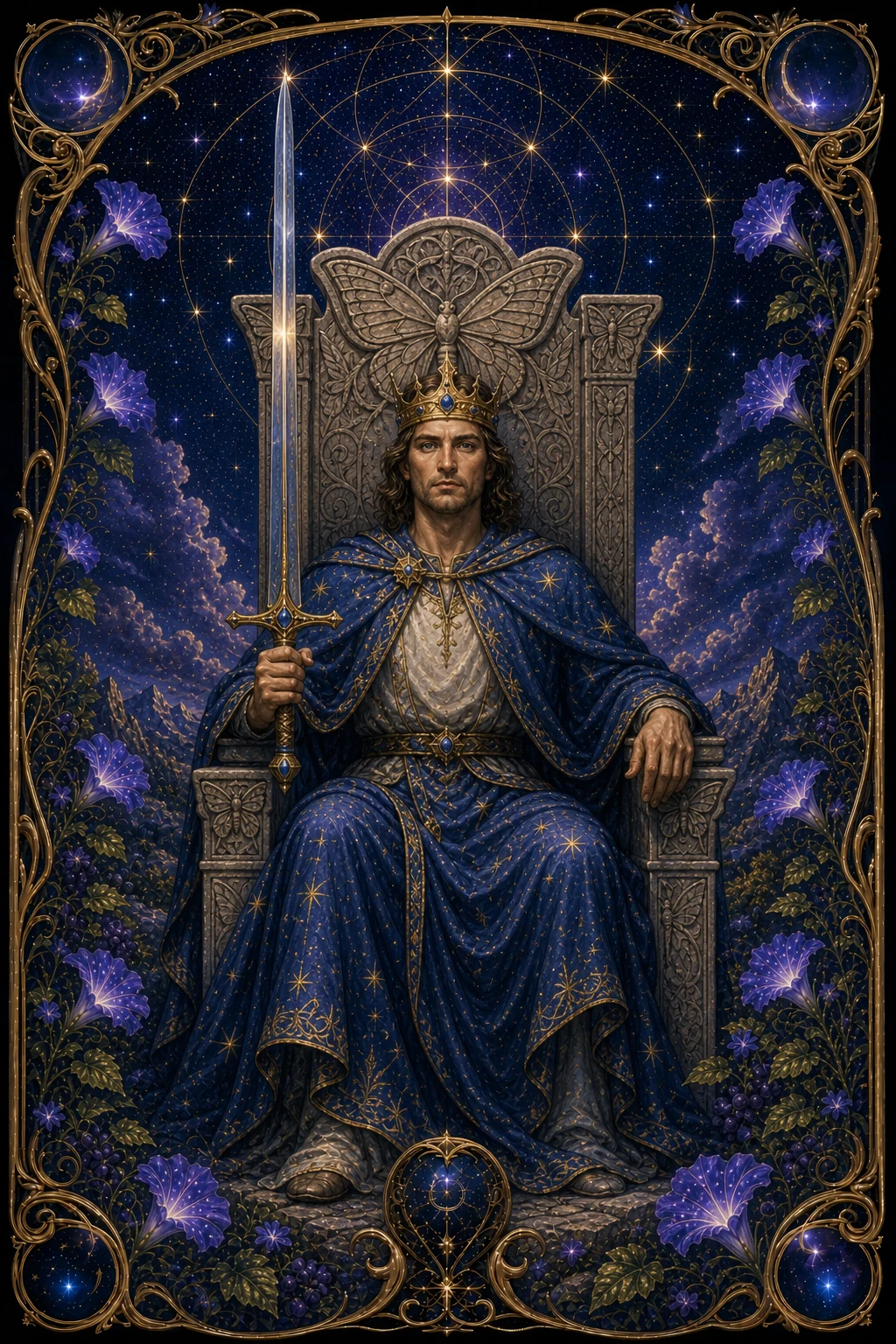
A king in a blue robe sits facing forward on a plain stone throne, a double-edged sword upright in his right hand and tilted a few degrees off true. Two butterflies appear in the carving of the throne behind his head. Judgement is the subject, and the difficulty of applying a principle to a person.
Upright King of Swords
He faces you directly, which none of the other Swords figures do. That frontality is the deck's way of saying this card is a position rather than a scene: somebody whose business is to decide, and who has to be looked at while doing it. His authority does not come from force. It comes from having a standard and applying it the same way twice, including on the occasions when applying it is expensive. Consistency of that kind is genuinely rare, and it is the reason people bring things to him. The interesting part is the tilt. The sword is not vertical; it leans slightly, a few degrees off, and readers have made a good deal of that — a deliberate refusal to draw perfect impartiality, in a card otherwise entirely about it. Anyone who has made a real decision about a real person knows that no principle survives contact with the particulars completely upright. What the card leaves you with is a question about standards: which of yours do you hold because you have examined them, and which because holding them has become part of how you recognise yourself?
Reversed King of Swords
Reversed, the same authority curdles in several familiar ways, and the older sources are not gentle about any of them. The first is judgement used as a shield. The mind is very good at producing reasons, and a sufficiently articulate person can construct an airtight case for a position that was arrived at emotionally about four minutes earlier. It looks exactly like thinking. The second is the principle held past the point where it serves anybody: a rule applied to a situation it was never designed for, defended on the grounds that it is the rule. A third and quieter version deserves naming. Reversal sometimes describes intelligence that has become an ornament rather than an instrument — argument enjoyed for its own sake, opinions held mainly because they are well phrased. That one is comfortable enough to live in for years. None of this is a verdict on anyone's character, and none of it describes a particular person in your life. Reversed, the card is a place to check whether a conclusion you are defending was reasoned into or reasoned backwards from.
King of Swords in love and relationships
In matters of closeness, this King describes a way of relating rather than somebody arriving in your life. Its posture is fairness: the person who keeps their word, states their position clearly, and does not use ambiguity as a tool. That is a real form of care and it is easy to overlook when it comes without warmth attached. The difficulty in the posture is what it does with feeling. Somebody expert at the reasoned account can end up presenting conclusions rather than states — arriving at a conversation with the verdict already written and no space in it for anyone to say something unreasonable and true. If you recognise the habit of preparing your case before an intimate conversation, that is worth noticing, and noticing is not the same as condemning it. Precision and closeness are not opposed, though they do have to be introduced.
King of Swords in work and study
For work, the King belongs to the position where your decisions land on other people. Setting a policy, running a process, arbitrating a dispute, choosing whom to hire — the card sits with the specific loneliness of authority, which is that the right decision and the popular one part company regularly and you have to keep making it anyway. It also holds the ethical question this suit keeps returning to. It is possible to be entirely correct in a way that does damage, and possible to be technically fair while knowing the outcome is wrong. The card does not resolve that, and the tradition never has either. What it does suggest is that anyone in the deciding seat benefits from a written account of their own reasoning, which is harder to fool than memory.
Resources and security
Applied to security, this card touches the difference between a decision and a rationalisation. Numbers are unusually easy to argue with, in the sense that a sufficiently clever case can be built for very nearly anything you already wanted. As reflection alone: consider whether the reasoning behind a recent choice of yours would still stand if it were read aloud to somebody with no stake in it. That is a test of clarity rather than a plan, and it says nothing at all about what any choice should be. None of this is financial advice. The actual decision remains yours, with qualified help if you want a second view.
Attention and wellbeing
Turned to the question of attention, this figure raises the matter of a mind that does not stop working. Analysis is a genuine pleasure for some people, and it also has no natural end point — there is always one more consideration, and the sensation of being productive continues long after the thinking has stopped being useful. What the card can hold is the habit question: whether there is any hour of your week in which nothing is being decided or assessed. Not emptied of thought, which is a tall order, just off duty. The throne in the picture is a workplace, and even judges go home.
Yes or no?
It depends
It depends, and the card would want to know the terms. Its instinct is to define the question before answering it, which is frequently more useful than the answer you came for.
Symbolism in the card
This King sits square to the viewer on a plain grey throne, robed in blue with a crimson mantle over one shoulder, a gold crown with a small winged ornament, and a double-edged sword held upright in his sword hand, angled a few degrees to the left. The left hand rests on the thigh with a ring visible. Two butterflies are carved into the top of the throne back, with a crescent shape between them, and a sylph's head appears lower on the side. The sky behind is thin and pale, and the trees at the horizon are still — the only Swords court not being blown about. Waite associated this figure with law, judgement and the offices of authority, and the double-edged blade was long read as a reminder that a ruling cuts in both directions and touches whoever makes it. The court of Swords descends from the sword suit of the older Italian decks, associated in later systems with air, discourse and the trained mind.
King of Swords as today's card
Drawn as the day's card, this King suggests deciding one thing and writing the reason down. One matter, one paragraph, kept somewhere you can find it later. The value is not in the decision; it is in having a record of the reasoning that memory cannot quietly edit afterwards. His other daily use is fairness of a small kind. Somewhere today there is probably a situation where the consistent response and the convenient one differ slightly and nobody would notice which you chose. The card has an opinion about that, delivered without any drama. If nothing needs deciding, it can simply mean hearing out a case you were inclined to dismiss.
In a three-card spread
Placed in the past, he often marks a principle you adopted at some point, possibly from somebody else, and have been running ever since without review. Locating where it came from is usually more interesting than defending it. In the present, he stands for a demand for clear thinking rather than a person exercising it, and the cards nearby generally indicate what is being weighed and who bears the result. In the future position, keep him as a question rather than an outcome. If a decision in this matter had to be explained plainly to somebody you respect, which parts of your reasoning would you be willing to read out?
Keywords
- Intellect
- Authority
- Truth
- Judgment
Journal prompts
- Which of your principles have you actually examined, and which did you inherit?
- When did being consistent last cost you something, and did you pay it?
- Where in your week is nothing being assessed?
Cards read alongside King of Swords
- Ace of Swords — Clarity, breakthrough, truth, and a new intellectual path.
- Queen of Swords — Independence, clear boundaries, honesty, and perception.
- Justice — Justice, fairness, truth, cause and effect, law.
- The Hierophant — Spiritual wisdom, religious beliefs, conformity, and tradition.
- All 78 tarot card meanings — the full major and minor arcana in one place.
Combinations with King of Swords
- Queen of Swords and King of Swords tarot combination
- King of Swords and Ace of Pentacles tarot combination
- Knight of Swords and King of Swords tarot combination
- King of Swords and Two of Pentacles tarot combination
- Page of Swords and King of Swords tarot combination
- King of Swords and Three of Pentacles tarot combination
- All 2,772 minor arcana combinations
King of Swords by position
- King of Swords as feelings tarot meaning
- King of Swords as intentions tarot meaning
- King of Swords as outcome tarot meaning
- King of Swords as advice tarot meaning
- King of Swords as an obstacle tarot meaning
- King of Swords as action tarot meaning
- King of Swords as a person tarot meaning
- King of Swords as how someone sees you tarot meaning
- King of Swords for a yes or no question tarot meaning
- All card meanings by position
Curious what King of Swords means for your question? Turn a card on the home page — no account needed.
Draw a card freeOne card, one honest question, most evenings.
Start your free daily readingFree · One card a day · No credit card needed
Go deeper than one card
A personalized deep reading works a full spread around your question — King of Swords included, if it falls to you. Deep readings run from the $1.99 Single Card Illumination and the $7 Three-Card Path, delivered straight away, to the $19 Five-Card Compass and the $29 Celtic Cross Atlas, composed in depth and delivered within 2–4 hours.
The $19 Five-Card Compass, five positions and a keepsake → · All reading options →
Prefer a rhythm to a one-off? Sparkle Pro ($8.99/month or $59/year) draws a three-card past, present and future spread for you every day. There is also a free eight-phase moon ritual guide to pair with today's card.
To sit with this card longer, the tarot journaling guide has prompt sets for daily draws, moon phases, and more.
Tarot content is for entertainment and personal reflection, not professional advice.