Six of Pentacles Tarot Card Meaning
 Start your free daily reading
Free · One card a day · No credit card needed
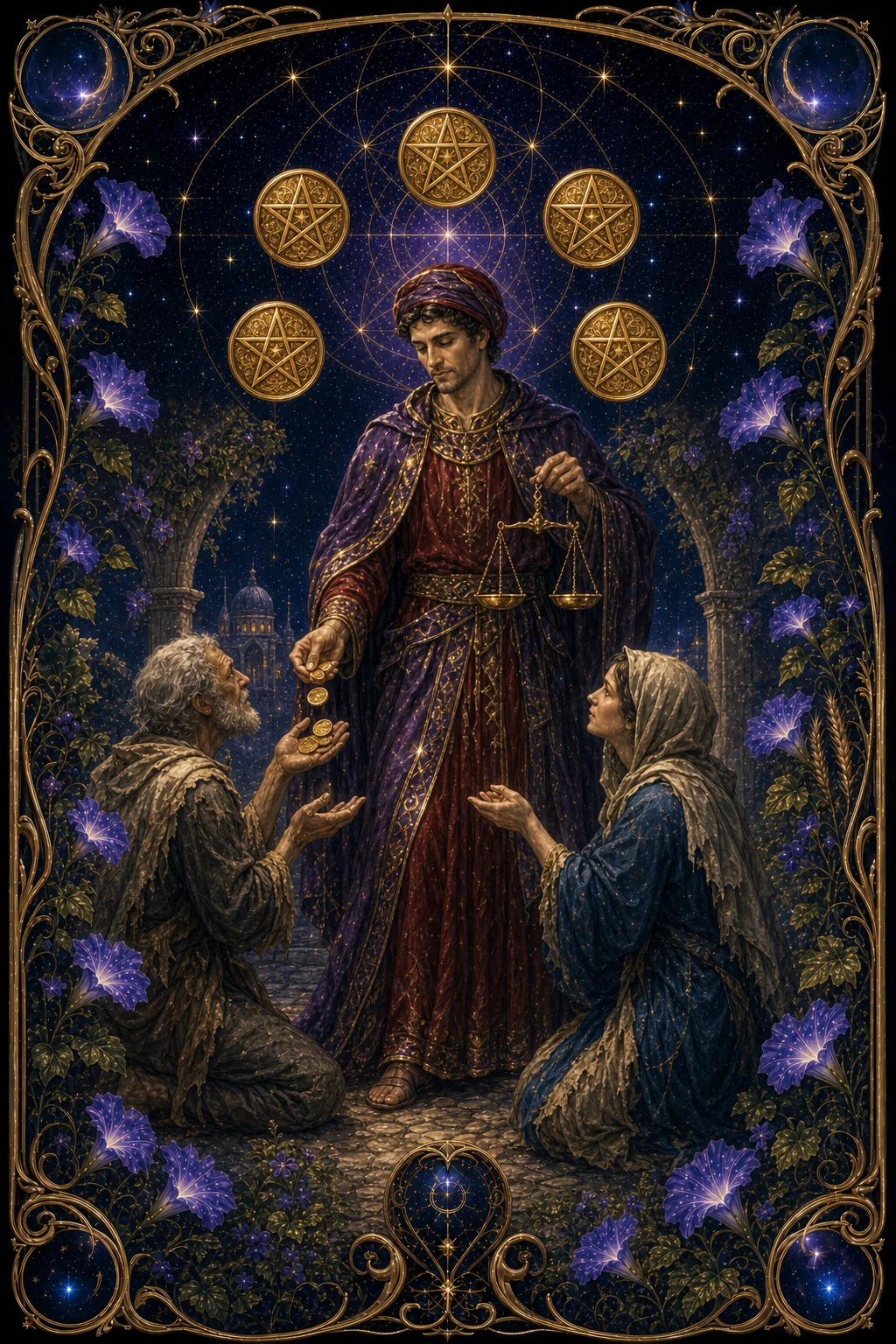
A merchant in red stands between two kneeling figures, dropping coins into the hand of one while holding a pair of balance scales level in the other hand. Six pentacles float in the air around them. The card asks who is holding the scales in your situation, and how they came to be holding them.
Upright Six of Pentacles
Most readings of this card sort quickly into giving and receiving, and the picture is more awkward than that. There are three people in it and only one of them is standing. Whatever else is being depicted, a difference in position is being depicted, and the scales in the merchant's hand mean that one party is measuring and the others are being measured. That is not a criticism of generosity. It is an observation about the structure that generosity often arrives inside, and the tradition has quietly noticed it for a long time. Upright, the card sits well with any exchange where the terms are set by one side: mentoring, inheritance, a favour from someone senior, the help of a friend who has more of something than you do. None of that is bad and all of it has a shape. The reflection is about comfort. Many people are entirely at ease in one of the three positions in this image and deeply uncomfortable in the others, and knowing which is yours explains a surprising amount about how you behave when help is in the room. There is also the simple matter of the scales being level. Whatever else the merchant is doing, he is trying to be fair, and fairness is a thing you have to keep adjusting.
Reversed Six of Pentacles
Reversed, the scales tip, and the readings gather around exchange that has stopped being even. One familiar version is the gift with a bill attached — help offered in a way that creates an obligation, sometimes deliberately, more often through nobody's intention at all. Another describes a flow that has run one way for so long that neither party can remember agreeing to it, which happens in families constantly and is almost never discussed until something forces it. The card makes no judgement about either party in these arrangements, and nothing here suggests that giving or receiving is the better position to occupy. A third reading turns the question inward toward what you allow yourself. There are people who find it straightforward to be generous with everyone but themselves and would be embarrassed to phrase it that way. Reversed, the Six is a good place to examine the accounts you keep without meaning to. No prediction is intended and nothing here implies that anyone will or will not receive help from anyone. It is only an invitation to notice which direction things have been running, and for how long.
Six of Pentacles in love and relationships
Among close connections, the Six concerns the ledger nobody admits to keeping. Most close relationships run on a rough sense of balance which works well precisely because it stays rough, and gets into difficulty when someone starts counting properly. That usually happens when one person has felt short for a while without saying so. The Six is useful for looking at the currencies involved, since they are rarely the same for both people: time, patience, money, planning, the emotional work of being the one who raises things. It is entirely possible for two people to be equally generous in currencies the other does not value, and to both feel unappreciated. There is also the harder note about care that comes with power. Being consistently the helper in a friendship is a position as well as a kindness, and it is worth knowing whether you would still be there if the direction reversed.
Six of Pentacles in work and study
In work, the Six attaches to everything that gets distributed: credit, budget, opportunity, the interesting piece of the project. Somebody decides those things, and the deciding is often invisible to whoever is on the receiving end, which is why the card's attention to position is worth keeping. If you are the one who allocates anything, even informally, the reflection concerns consistency — whether the same conduct gets the same response regardless of who it comes from. If you are on the kneeling side, it concerns clarity about what was actually agreed, since a great deal of workplace resentment grows in the gap between an implied promise and a stated one. Mentorship belongs here too, in its better form: the person who gives you time expecting nothing legible in return. That is real and it is worth acknowledging out loud to whoever has done it for you.
Resources and security
Read as reflection rather than as anything approaching guidance, this card raises the theme of enough-ness in relation to other people. Worth in this suit is easy to treat as a private matter and it is almost never experienced privately, since most people measure their own position against whichever group happens to be visible to them. That comparison set is largely accidental and it is worth knowing which one you use. No advice about money, or about anything decided on the strength of it, is offered or implied; no claim is made about anybody's circumstances; and a real question of that kind belongs with you and with people properly qualified to answer it. The card only notes that scales require a second object, and asks what yours is currently weighed against.
Attention and wellbeing
As a reflection on attention, this card concerns where your energy goes rather than how much of it there is. Some people give attention out steadily all day and arrive at evening with nothing left for their own affairs, having never once considered this a distribution problem. Looking at a week as an allocation rather than an effort tends to change what feels tiring about it. There is a plainer note as well: receiving is a skill, and people who are practised at giving are often clumsy at it. Nothing in this is diagnostic or medical. It is only an observation that the scales in the picture need adjusting continually, and so does everything else that stays level.
Yes or no?
It depends
It depends on the terms, which the card considers more interesting than the answer. Consider what is being asked in return and whether it has been said plainly. Nothing here is a forecast.
Symbolism in the card
The merchant wears a red robe of a kind Smith uses elsewhere for authority and stands under a plain sky with a small suggestion of buildings behind. In his left hand he holds a pair of balance scales, level, an emblem carried in Western art by Justice and by the archangel Michael weighing souls, and in medieval commerce by the ordinary regulated market trader. With his right he drops coins into the cupped hands of one of two kneeling figures, both in simpler dress, one grey and one red. Six pentacles are arranged in the air in two vertical columns, which some readers connect to the sixth sphere on the kabbalistic Tree of Life, with its associations of balance and mercy. The earlier Marseille card is once again a decorative arrangement of coins with no figures at all, so this staging is Smith's own. Waite describes a merchant weighing money and distributing it to the needy, a phrasing that has fixed the card's charitable reputation ever since, though the image itself keeps the question of position visibly open.
Six of Pentacles as today's card
Pulled as the day's only card, the Six usually asks for a small correction somewhere in the flow of things. Thank the person who has been quietly doing something for you. Pass on the piece of information that would take you a minute and save someone else an afternoon. Or, if you are the one who never asks, allow one person to do one thing today, which for some readers is much the harder version of this card. There is no scale of virtue attached to any of it. The Six is an unusually practical draw, and the practical form of it is generally one message that has not been sent.
In a three-card spread
Behind you, the Six often marks an arrangement of giving and receiving that shaped how you handle help now, frequently one set up long before you had any say in it. Held in the middle, it describes a live exchange, and its neighbours usually indicate whether the terms are understood by everyone involved. Where the future is read, it must not be heard as a promise that anything will come to you or be asked of you. Hold it as a question of terms instead: if this continued as it is, what would be owed, to whom, and would either party be able to say so plainly?
Keywords
- Generosity
- Charity
- Sharing
- Exchange
Journal prompts
- Of the three positions in this picture, which one are you most comfortable occupying, and why that one?
- Which currency do you give in, and which one do you count when you feel short?
- What are you currently weighing yourself against, and did you choose the comparison?
Cards read alongside Six of Pentacles
- Five of Pentacles — Hardship, isolation, worry, and help within reach.
- Justice — Justice, fairness, truth, cause and effect, law.
- Ten of Pentacles — Legacy, family wealth, stability, and lasting success.
- Queen of Pentacles — Practical care, comfort, resourcefulness, and nurture.
- All 78 tarot card meanings — the full major and minor arcana in one place.
Combinations with Six of Pentacles
- Five of Pentacles and Six of Pentacles tarot combination
- Six of Pentacles and Seven of Pentacles tarot combination
- Four of Pentacles and Six of Pentacles tarot combination
- Six of Pentacles and Eight of Pentacles tarot combination
- Three of Pentacles and Six of Pentacles tarot combination
- Six of Pentacles and Nine of Pentacles tarot combination
- All 2,772 minor arcana combinations
Six of Pentacles by position
- Six of Pentacles as feelings tarot meaning
- Six of Pentacles as intentions tarot meaning
- Six of Pentacles as outcome tarot meaning
- Six of Pentacles as advice tarot meaning
- Six of Pentacles as an obstacle tarot meaning
- Six of Pentacles as action tarot meaning
- Six of Pentacles as a person tarot meaning
- Six of Pentacles as how someone sees you tarot meaning
- Six of Pentacles for a yes or no question tarot meaning
- All card meanings by position
Curious what Six of Pentacles means for your question? Turn a card on the home page — no account needed.
Draw a card freeOne card, one honest question, most evenings.
Start your free daily readingFree · One card a day · No credit card needed
Go deeper than one card
A personalized deep reading works a full spread around your question — Six of Pentacles included, if it falls to you. Deep readings run from the $1.99 Single Card Illumination and the $7 Three-Card Path, delivered straight away, to the $19 Five-Card Compass and the $29 Celtic Cross Atlas, composed in depth and delivered within 2–4 hours.
The $7 Three-Card Path, three cards read as one movement → · All reading options →
Prefer a rhythm to a one-off? Sparkle Pro ($8.99/month or $59/year) draws a three-card past, present and future spread for you every day. There is also a free eight-phase moon ritual guide to pair with today's card.
To sit with this card longer, the tarot journaling guide has prompt sets for daily draws, moon phases, and more.
Tarot content is for entertainment and personal reflection, not professional advice.