Wheel of Fortune Tarot Card Meaning
 Start your free daily reading
Free · One card a day · No credit card needed
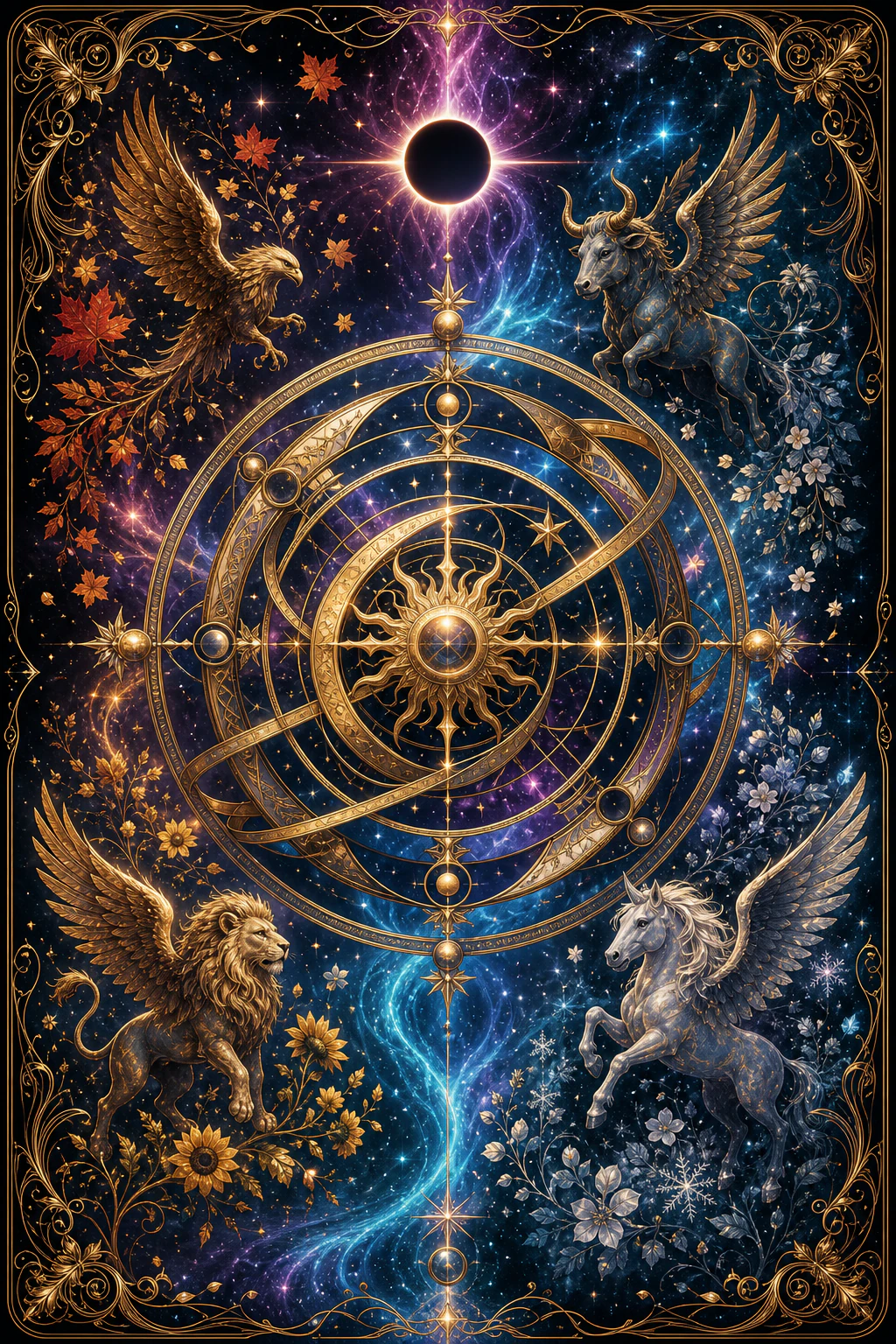
A great wheel turns in an empty sky, lettered around its rim, with strange figures riding up one side and down the other. In each corner of the card sits a winged creature reading a book. The Wheel asks how you tend to behave when something changes without consulting you.
Upright Wheel of Fortune
Everyone's life contains a category of thing they did not arrange, and this card is about your relationship with that category rather than with any particular item in it. The wheel is drawn mid-turn, which is the only state a wheel is ever really in. Some readers use it for luck, and the word is misleading enough that it is worth setting down. Nothing here concerns chance in the gambling sense, and the card makes no suggestion whatsoever about outcomes, windfalls or timing. Held as reflection, its subject is cyclicality: the ordinary observation that circumstances move, that most positions are temporary, and that people are generally worse at anticipating this than they believe. The interesting question is what happens to your sense of self when the position changes. Some people are so identified with a good stretch that any downturn feels like a personal verdict. Others brace so permanently against a bad one that they cannot register when it lifts. Both are ways of not being where you actually are. There is also something in noticing which parts of your present situation you are treating as permanent. Very few of them are, in either direction, and the card is unusually even-handed about that fact. It offers no comfort and no warning.
Reversed Wheel of Fortune
Reversed, the wheel's rotation is usually read as resisted, delayed or personally taken. The most common version is the sense of being stuck — a period where the same week keeps arriving, and effort seems to produce no visible movement in anything. That experience is real enough, and the reversal at least refrains from telling you it is your fault. What it does raise is the difference between a situation that is not moving and one that is moving too slowly to see from close up. People are poor judges of this from inside a given month. A second reading concerns the habit of taking circumstance personally. When something inconvenient happens, there is a strong human instinct to construct a narrative in which it happened at you, and that narrative is almost always more elaborate than the facts require. If you have been assembling one lately, the inverted card is a decent place to notice the assembly. A third, gentler possibility: reversal can describe the reluctance to let a good period simply be a good period. Some people cannot enjoy anything for waiting for the turn, which is its own way of standing outside your own life.
Wheel of Fortune in love and relationships
Applied to close relationships, this card is about seasons rather than compatibility. Long connections of any kind go through stretches that feel effortless and stretches that feel like work, and one of the more useful things anyone learns is that the difficult stretch is not necessarily evidence about the relationship. It may only be evidence about the year. It is worth asking which phase you are currently in with the people who matter to you, and whether you have been reading a temporary condition as a permanent fact. The card also touches timing, though not in any predictive sense. People meet each other at particular points in their own rotations, and the same two people at different points would make a different thing entirely. That is worth holding lightly rather than mournfully. Nothing in the picture suggests any particular position is deserved or earned, which cuts both ways: it removes the blame and also the credit.
Wheel of Fortune in work and study
In working life, the Wheel sits with everything you do not control — the reorganisation, the market, the manager who leaves, the project that becomes fashionable for reasons unconnected to its quality. Careers are usually narrated afterwards as sequences of decisions, and they are in fact substantially made of circumstance. Recognising that tends to be liberating rather than deflating, because it makes the good stretches less smug and the poor ones less shameful. The reflection worth having concerns your response pattern. Some people become extremely busy when things shift, others go still, and most of us do the same thing every time without ever having examined it. There is a further question about position. If your current role were rearranged tomorrow, what would you actually miss: the work, the standing, the people, the routine? Knowing the answer in advance is more useful than any amount of planning, and it costs one honest afternoon.
Resources and security
Security here is a question about your relationship to variability rather than about any amount. Circumstances alter, and the more interesting question is how much of your steadiness is contingent on things staying arranged as they are. Nothing here suggests any change, predicts any change, or offers a view on what anyone should do. As reflection: some people build lives with a great deal of slack in them and feel constrained; others build tightly and feel exposed whenever the wind gets up. Neither is the correct answer, but most of us landed on ours by accident rather than by choosing. Noticing which you have, and whether it still suits the life you are actually living, is as far as the card can usefully take you.
Attention and wellbeing
As a reflection on energy, the Wheel notices that people are not the same all year, and that most schedules are built as though they were. Attention has seasons — daily, weekly, and longer — and a fair amount of self-criticism comes from asking the low part of a cycle to perform like the high part. You might track, for a fortnight, the hours in which you are genuinely sharp, and see how much of that time is currently spent on things that do not need it. The habit suggestion here is about accommodation rather than improvement: arranging the demanding work for the good hours and forgiving the rest, which is less inspiring than discipline and considerably more durable.
Yes or no?
It depends
It depends, largely because the card resists fixed answers by temperament. It reads better as a comment on timing than on merit. Consider whether the question would look different asked again in a season.
Symbolism in the card
Smith's design is the most crowded major in the deck. A golden wheel hangs in a blue sky, its rim inscribed with the letters T, A, R and O — read variously as TAROT, TORA or ROTA, the Latin for wheel — interleaved with the four Hebrew letters yod, he, vau, he that spell the divine name. Inside the rim are alchemical marks for mercury, sulphur, water and salt. A yellow sphinx sits crowned at the top holding a sword, a red figure with a serpent's or jackal's head descends on the left, and a serpent slides down the right side. In the four corners rest the winged creatures of Ezekiel and of the evangelists — angel, eagle, lion and bull — each reading an open book, and each also standing for a fixed sign of the zodiac. The books are the detail worth pausing on. Whatever is turning in the middle, the figures at the corners are studying rather than riding, which is as close as the card comes to offering a posture.
Wheel of Fortune as today's card
Drawn on its own, this card mostly recommends a light grip on the plan. Days rarely go as drafted, and the difference between a tolerable one and an irritating one is often just how attached you were to the draft. A practical use: identify the one thing today that genuinely has to happen, and hold the remainder loosely. There is also a reading for anyone stuck inside a long, apparently unchanging stretch. The wheel is a reminder that nothing much stays put, which is not a prediction and is not meant as consolation. It is simply an observation about how situations behave over time. If today has been out of your hands entirely, the card at least keeps you company in that.
In a three-card spread
In the earliest position, the Wheel commonly indicates a turn already taken, and the useful work is separating what you did from what merely happened, since hindsight blends the two enthusiastically. Centrally placed, it suggests a situation currently in motion where your influence is partial, and the adjacent cards usually show which part is yours. Where a spread points forward, resist reading it as an event or a reversal of fortune, because nothing about a shuffled deck knows anything of the kind. Read it instead as an enquiry: if this arrangement did not stay as it is, which parts would you be relieved to lose?
Keywords
- Luck
- Karma
- Destiny
- Cycles
Journal prompts
- What in your present circumstances are you quietly treating as permanent?
- How do you usually behave in the first week after something changes without warning?
- Which recent piece of good fortune have you been busily explaining as merit?
Cards read alongside Wheel of Fortune
- The World — Completion, integration, accomplishment, travel.
- Two of Pentacles — Balance, adaptability, priorities, and managing change.
- The Magician — Manifestation, resourcefulness, power, and inspired action.
- Six of Wands — Victory, recognition, confidence, and public success.
- All 78 tarot card meanings — the full major and minor arcana in one place.
Combinations with Wheel of Fortune
- Wheel of Fortune and The Hermit tarot combination
- Wheel of Fortune and Justice tarot combination
- Wheel of Fortune and Strength tarot combination
- Wheel of Fortune and The Hanged Man tarot combination
- Wheel of Fortune and The Chariot tarot combination
- Wheel of Fortune and Death tarot combination
- All 231 major arcana combinations
Wheel of Fortune by position
- Wheel of Fortune as feelings tarot meaning
- Wheel of Fortune as intentions tarot meaning
- Wheel of Fortune as outcome tarot meaning
- Wheel of Fortune as advice tarot meaning
- Wheel of Fortune as an obstacle tarot meaning
- Wheel of Fortune as action tarot meaning
- Wheel of Fortune as a person tarot meaning
- Wheel of Fortune as how someone sees you tarot meaning
- Wheel of Fortune for a yes or no question tarot meaning
- All card meanings by position
Curious what Wheel of Fortune means for your question? Turn a card on the home page — no account needed.
Draw a card freeOne card, one honest question, most evenings.
Start your free daily readingFree · One card a day · No credit card needed
Go deeper than one card
A personalized deep reading works a full spread around your question — Wheel of Fortune included, if it falls to you. Deep readings run from the $1.99 Single Card Illumination and the $7 Three-Card Path, delivered straight away, to the $19 Five-Card Compass and the $29 Celtic Cross Atlas, composed in depth and delivered within 2–4 hours.
The $29 Celtic Cross Atlas, ten cards read position by position → · All reading options →
Prefer a rhythm to a one-off? Sparkle Pro ($8.99/month or $59/year) draws a three-card past, present and future spread for you every day. There is also a free eight-phase moon ritual guide to pair with today's card.
To sit with this card longer, the tarot journaling guide has prompt sets for daily draws, moon phases, and more — including journal prompts for every major arcana card.
Tarot content is for entertainment and personal reflection, not professional advice.