Two of Wands Tarot Card Meaning
 Start your free daily reading
Free · One card a day · No credit card needed
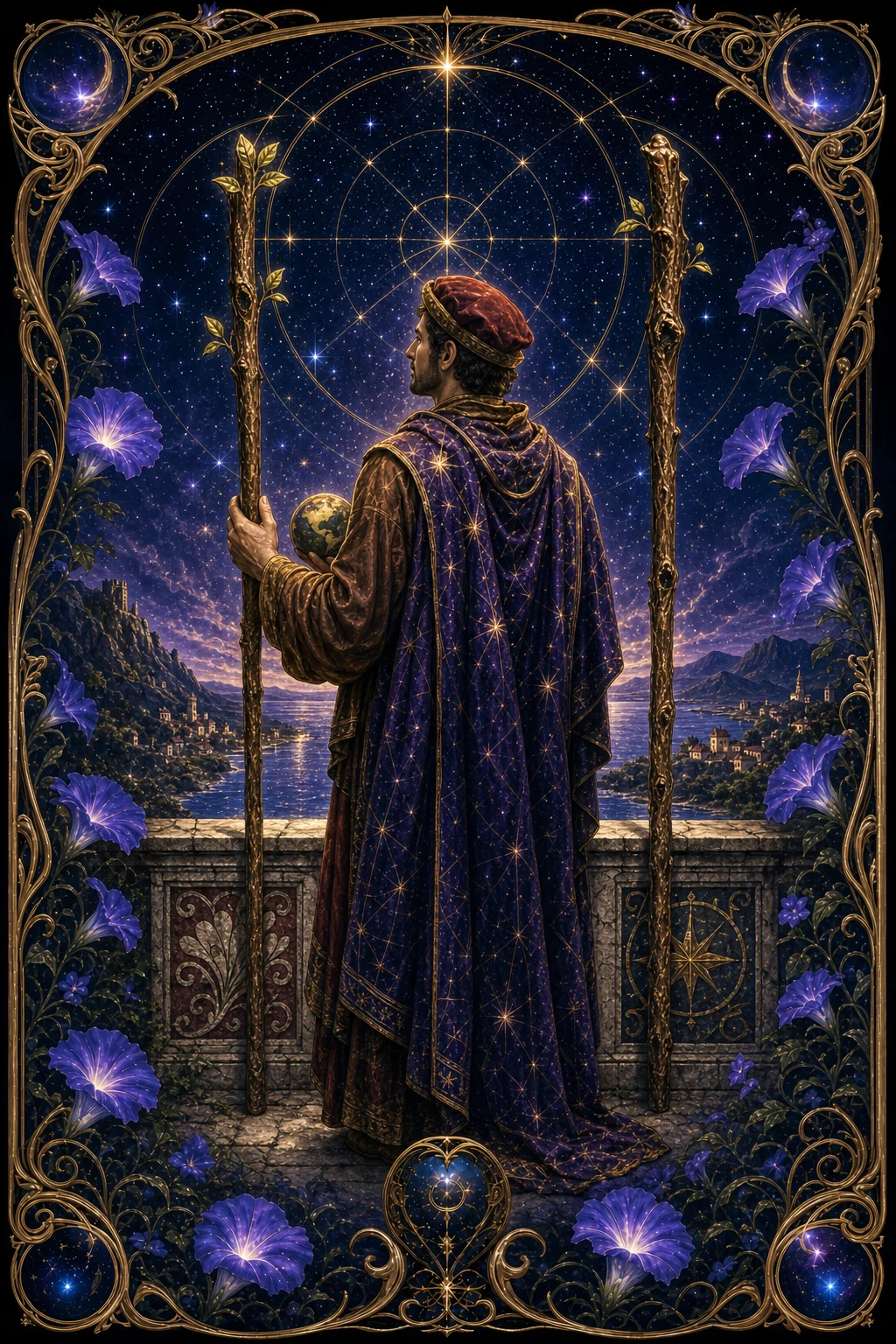
A figure in a red cap stands on a castle terrace with a small globe cradled in one hand, one staff strapped to the wall beside him and the other held loosely. He is looking out over a coastline he is not standing on. The card asks what you are surveying, and whether the looking has begun to stand in for going.
Upright Two of Wands
Everything in this picture concerns a body facing one way and a mind facing another. The man has a castle behind him, which means something was built and is working; he has a globe in his hand, which is the smallest possible version of everywhere else. The tradition reads the Two as planning, and planning is accurate as far as it goes, though the card is more precisely about the moment a success starts to feel like a boundary. There is a particular flavour to that. Nothing is wrong. Described from outside, the situation is enviable. And still there is a coastline, and you keep looking at it. Older readings speak of dominion and of the wider world, but the interesting tension is domestic: one staff is bolted to the masonry and one is in the hand, and the picture declines to tell you which he means to keep. That is the reflection on offer. Which of your commitments are fixed to the wall, and which are you merely holding? Answering honestly matters more than answering quickly, and the card seems content to wait.
Reversed Two of Wands
Inverted, the Two most often reads as the survey that never ends. Options are pleasant to hold. A future that stays a globe in the hand cannot disappoint anybody, and there are people who spend a decade comparing coastlines with real skill and considerable pleasure. If any of that lands, ask whether the deliberation is genuinely unfinished or has quietly become a place to live. A second reading concerns fear of the small. Grand plans are easier to entertain than modest ones, because a grand plan need never be tested this month. Reversal can point at a version of ambition that protects you from the ordinary, slightly humiliating first step. There is a third and kinder reading, which older sources allow: sometimes the terrace is where you actually belong for now, and the restlessness is weather rather than message. Telling those apart is not the deck's work. Reversed, this card mostly asks for an honest account of how long you have stood in this particular spot, and whether the view has altered at all in that time.
Two of Wands in love and relationships
In connection, this card sits with the difference between choosing someone and continuing to consider them. Two staves, one held and one fixed — the imagery is unhelpfully apt for anyone keeping a quiet reserve while appearing entirely present. That reserve is not always cowardice. Sometimes it is residue from an earlier arrangement that ended badly and taught you to keep one hand free. Even so, the card raises the cost. Being surveyed is a strange thing to be on the other side of, even when nobody says the word aloud. There is also the outward-looking version: partners or friends whose lives point at different horizons, both perfectly fond of each other, neither wanting to name the geography. Naming it is not the same as deciding it.
Two of Wands in work and study
For working life, the Two describes someone competent enough to see past the current role. That is a specific and slightly uncomfortable position. The skills are proven, the castle stands, and the interest has relocated to a coastline visible only from here. What the card holds up is the difference between a plan and a preference. A preference can be carried indefinitely; a plan has a next action, a person to speak to, a thing to learn on Tuesday evenings. Neither is superior, but confusing them is where years go. If you are early on, the reflection inverts: what have you not yet built that would give you somewhere to stand while you look? The globe is small in the picture, and it is only useful to somebody with a wall underfoot.
Resources and security
Security, in this card, is a matter of the survey rather than the sum. A view of somewhere else usually has a price attached, and the price is rarely the interesting part; what is interesting is what you would be willing to hold steady while the looking goes on. As reflection: consider whether your sense of having enough currently rests on the castle or on the coastline — on what is under you, or on what remains possible. Many people find they have quietly moved their security into a future they have not begun. What you would hold steady, and for how long, tends to be the more answerable half of the question. Nothing here is advice about your circumstances.
Attention and wellbeing
Attention, in this card, is divided, and division carries a tiredness that looks nothing like exertion. Standing in one life while considering another takes a low, continuous effort that never appears as a task. Notice how much of your week goes into researching, comparing or imagining, and whether that leaves you rested or vaguely drained. There is no correct amount. But the habit is worth seeing, particularly if evenings disappear into it. Putting the globe down for one day, deliberately, is the modest practice the picture suggests, and it asks nothing else of you. A terrace makes a fine place to stand and a poor one to live on without ever saying so.
Yes or no?
It depends
It depends, and this card is unusually comfortable saying so. The Two sits where a question is still being framed. Consider whether you have gathered enough to decide, or only enough to keep considering.
Symbolism in the card
The figure stands on a stone terrace in a long robe and red cap, a small terrestrial globe in his right hand. One staff is strapped to the battlement at his left; the other he grips without support. Cut into the stonework beside him are crossed roses and lilies, an old pairing for desire and thought — the same emblems Smith uses elsewhere for appetite balanced against understanding. Beyond the wall lie a bay, a hilly shore and open water. Waite's own commentary here is oddly melancholy for a picture of achievement; he writes of a lord looking out over a possession that brings him little joy, which is why the card has never read as straightforwardly triumphant. The globe is a comparatively modern object to find in a tarot, and it does a great deal of work: it makes the wider world portable, and therefore, in the odd way of portable things, easy to carry about instead of visiting.
Two of Wands as today's card
As a single card for the day, the Two suits an hour spent looking rather than doing, provided the looking is deliberate. Sketch the shape of something. Read about the place. Write out what a change would actually require, in specifics, including the boring items. It makes a good Sunday card and an awkward Wednesday one. Held lightly, its daily form is a question you can carry: what did you look at today that you have looked at for years? The answer occasionally surprises people, and finding out costs nothing. Two staves, and only one of them going anywhere: that is the day's smallest usable image.
In a three-card spread
In the past position, the Two often refers to a fork you can see clearly now and could not see at the time — the year you stood on the terrace deciding, without knowing that was what you were doing. In the present, it describes an active weighing, and the cards on either side usually show what sits on each scale. Read for what is ahead, it belongs firmly to reflection rather than prediction; nothing in a shuffled deck knows your circumstances. The workable phrasing is conditional. If this direction were taken seriously for a season, what would need building first, and what would you set down? A globe is portable and a terrace is not, which is generally where the row's tension sits.
Keywords
- Planning
- Progress
- Decisions
- Discovery
Journal prompts
- Which of your commitments are bolted down, and which are you only holding?
- What have you been comparing for longer than the comparison has been useful?
- If the coastline you keep looking at were reachable this year, what would you have to give up first?
Cards read alongside Two of Wands
- Ace of Wands — Inspiration, creative potential, and a powerful new spark.
- Three of Wands — Expansion, foresight, enterprise, and opportunities ahead.
- The Chariot — Control, willpower, success, action, and determination.
- Two of Pentacles — Balance, adaptability, priorities, and managing change.
- All 78 tarot card meanings — the full major and minor arcana in one place.
Combinations with Two of Wands
- Ace of Wands and Two of Wands tarot combination
- Two of Wands and Three of Wands tarot combination
- The World and Two of Wands tarot combination
- Two of Wands and Four of Wands tarot combination
- Judgement and Two of Wands tarot combination
- Two of Wands and Five of Wands tarot combination
- All 2,772 minor arcana combinations
Two of Wands by position
- Two of Wands as feelings tarot meaning
- Two of Wands as intentions tarot meaning
- Two of Wands as outcome tarot meaning
- Two of Wands as advice tarot meaning
- Two of Wands as an obstacle tarot meaning
- Two of Wands as action tarot meaning
- Two of Wands as a person tarot meaning
- Two of Wands as how someone sees you tarot meaning
- Two of Wands for a yes or no question tarot meaning
- All card meanings by position
Curious what Two of Wands means for your question? Turn a card on the home page — no account needed.
Draw a card freeOne card, one honest question, most evenings.
Start your free daily readingFree · One card a day · No credit card needed
Go deeper than one card
A personalized deep reading works a full spread around your question — Two of Wands included, if it falls to you. Deep readings run from the $1.99 Single Card Illumination and the $7 Three-Card Path, delivered straight away, to the $19 Five-Card Compass and the $29 Celtic Cross Atlas, composed in depth and delivered within 2–4 hours.
The $7 Three-Card Path, three cards read as one movement → · All reading options →
Prefer a rhythm to a one-off? Sparkle Pro ($8.99/month or $59/year) draws a three-card past, present and future spread for you every day. There is also a free eight-phase moon ritual guide to pair with today's card.
To sit with this card longer, the tarot journaling guide has prompt sets for daily draws, moon phases, and more.
Tarot content is for entertainment and personal reflection, not professional advice.