Two of Cups Tarot Card Meaning
 Start your free daily reading
Free · One card a day · No credit card needed
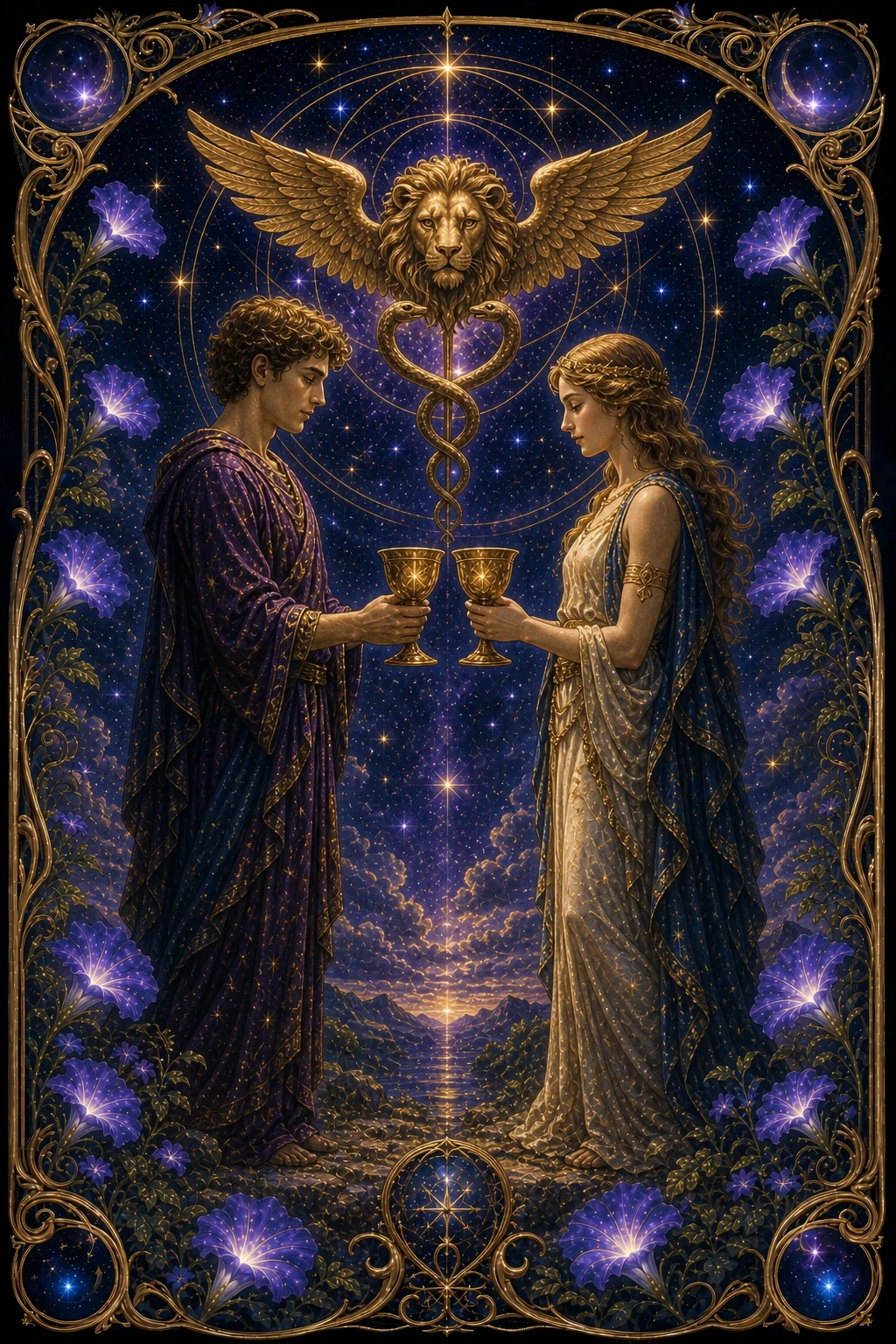
A man and a woman face one another and lift their cups toward the space between them. Above that space floats a winged lion's head over the twined serpents of the caduceus, strange heraldry for so domestic a scene. The Two asks what an exchange requires from both sides in order to stay an exchange.
Upright Two of Cups
Twos in the minors concern relation: one thing meeting another and neither dissolving. Here two people hold their own vessels and raise them toward each other, an arrangement worth dwelling on, because it is neither merger nor trade. Each keeps hold of what they brought. The card is often flattened into romance, and romance is one of its rooms, but the structure it describes covers any two-way arrangement in which both parties remain distinct: a collaboration, a truce, a friendship that survived a disagreement, a working partnership that outlasted the enthusiasm which started it. What the upright card puts a finger on is symmetry. Pledges made across an uneven table are a different object entirely, and most people can name at least one connection in their life where the cups are not the same size. Noticing that is not an accusation; some asymmetries are temporary and generous and correct. The reflection is simply whether you know which of yours is which. Then there is the matter of the vow itself. Both figures have stopped walking in order to make it. Whatever else exchange requires, it appears to require standing still long enough to face somebody.
Reversed Two of Cups
Reversed, the two cups no longer meet at the same height. Readers reach for imbalance, and the word covers several very different situations, so it repays being specific. One is effort: two people, one of whom does the arranging, the remembering and the repairing. Another is disclosure — one party consistently the one who says the true thing first. A third is simply timing, where neither is at fault and the meeting keeps not happening. None of these is a verdict on anyone, and a card cannot tell you which, if any, describes your life. The inverted Two also speaks to the self that appears in company. Some people carry a version to the table that is a little more agreeable than the one at home, and maintain it for years without meaning any dishonesty. If a connection has begun to feel like work, one thing to sit with is which of you is actually present for it. The traditional gloss includes rupture, and it should be said plainly that a reversal foretells nothing about anybody. Where a bond has become genuinely painful or lopsided in ways that worry you, that is a matter for people you trust and for proper support, not for a drawing.
Two of Cups in love and relationships
This is the card most often asked to make promises, and it can make none. What it offers instead is a description of a mechanism: two people, facing, each holding something, each choosing to lift it. Every part of that is voluntary and has to be re-chosen, which is the least romantic and most durable thing anyone has said about affection. If you are drawn to the card's warmth, a useful question is what you are actually raising your cup toward — the person as they are on a Wednesday, or a composite assembled out of good evenings. Both exist. Only one of them can hold a cup. Where a bond has ended or gone quiet, resist reading anything here about return; the picture shows two figures already present, and says nothing whatever about anyone's coming or going.
Two of Cups in work and study
At work, the Two stands for the person you can think aloud in front of. Most substantial working relationships run on something no contract captures: a colleague who tells you the truth about the draft, a collaborator whose taste you trust more than your own at four in the afternoon, an old manager you still send things to. These arrangements are usually unspoken and therefore easy to let lapse. The Two is a decent prompt to name yours. It also raises the harder subject of reciprocity at work, where the accounting is genuinely difficult. Being generous with credit, time and introductions is one of the few professional habits that reliably compounds, and it is also possible to be so generous that generosity becomes the whole job. Where your own line sits is a question about temperament rather than ethics, and the card asks it without proposing an answer.
Resources and security
Twos in this suit concern what passes between people rather than what accumulates in one place, which makes the security question here a question about mutual obligation. As a reflection: think of the arrangements in your life where someone else's resources or your own are shared — a household, a loan between friends that nobody wrote down, a family habit about who pays. Most of these were never negotiated; they set, like plaster. The card's contribution is to observe that an exchange only remains an exchange while both parties can still describe it the same way. Nothing here is advice about your circumstances, which remain yours to decide on with people properly qualified.
Attention and wellbeing
On the question of energy, the Two concerns the particular cost and refund of company. Some people are restored by an evening with one other person and depleted by a room of six; others are the reverse, and a surprising number of adults have never checked which they are, having inherited a social calendar from an earlier version of themselves. The Two proposes the smallest social unit as a unit of measurement. You might look back across the last month and mark which encounters left you holding more than you brought. That is data rather than a verdict, and it obliges you to cancel nothing. It simply tends to be clarifying to see it set down on paper.
Yes or no?
Yes
Yes, but only half of one. This is a two-sided picture, and agreement from a single side settles very little. Take it as being about your own willingness rather than anybody else's.
Symbolism in the card
Smith shows a young man and a young woman on level ground, each holding a cup, he reaching toward hers with his free hand, she wearing a wreath in her hair. Between and above them floats the caduceus of Hermes — two snakes wound about a winged staff — surmounted by the head of a red lion with wings. The caduceus is an ancient emblem of exchange, commerce and messages passing between parties, and it doubles as a sign of opposing forces balanced rather than resolved. The winged lion's head is stranger and less settled. Readers have connected it to alchemical illustration, where a red lion frequently marks a conjunction of substances, and to the winged lion of Venice; Waite left it unexplained, which has never slowed anyone down. Behind the figures a small house sits on a green rise, easily missed. In the Marseille tradition this card is simply two decorated vessels with a floral stem between them and no human beings at all. The people, the vow and the lion are Smith's staging of an abstract idea about pairs.
Two of Cups as today's card
As the single card of a day, the Two tends to point at one specific person rather than at your social life in general, and most people know who within a few seconds. That reaction is the reading. Practically, it suits days containing a conversation you have been circling: the thank-you not yet sent, the apology owed at low interest for months, the friend who migrated from your week into your intentions. Its suggestion is modest — one exchange, made properly, with attention. Nothing is being asked to resolve. Meeting somebody as they are for the length of a coffee is the whole of what the picture depicts.
In a three-card spread
In the first position, this card usually indicates a meeting that set terms you are still living inside, for better or otherwise. Some of the arrangements you regard as your nature were agreed with somebody, once. In the middle, it describes an exchange currently live and probably unfinished, and the neighbouring cards tend to show whether it is being tended or assumed. In the last position, keep it firmly as a question, since nothing in a shuffled deck knows anyone's future. The workable version: if this situation were approached as something two-sided, what would you need to bring that you have so far been waiting to receive?
Keywords
- Partnership
- Unity
- Attraction
- Connection
Journal prompts
- Which of your relationships would look different if the cups were the same size?
- Who tells you the truth, and when did you last make that easy for them?
- What are you waiting to be offered before you offer it?
Cards read alongside Two of Cups
- Ace of Cups — Love, compassion, creativity, and emotional renewal.
- The Lovers — Love, harmony, relationships, and values alignment.
- Four of Wands — Celebration, harmony, homecoming, and a joyful milestone.
- Ten of Cups — Emotional fulfillment, family harmony, love, and lasting joy.
- All 78 tarot card meanings — the full major and minor arcana in one place.
Combinations with Two of Cups
- Ace of Cups and Two of Cups tarot combination
- Two of Cups and Three of Cups tarot combination
- King of Wands and Two of Cups tarot combination
- Two of Cups and Four of Cups tarot combination
- Queen of Wands and Two of Cups tarot combination
- Two of Cups and Five of Cups tarot combination
- All 2,772 minor arcana combinations
Two of Cups by position
- Two of Cups as feelings tarot meaning
- Two of Cups as intentions tarot meaning
- Two of Cups as outcome tarot meaning
- Two of Cups as advice tarot meaning
- Two of Cups as an obstacle tarot meaning
- Two of Cups as action tarot meaning
- Two of Cups as a person tarot meaning
- Two of Cups as how someone sees you tarot meaning
- Two of Cups for a yes or no question tarot meaning
- All card meanings by position
Curious what Two of Cups means for your question? Turn a card on the home page — no account needed.
Draw a card freeOne card, one honest question, most evenings.
Start your free daily readingFree · One card a day · No credit card needed
Go deeper than one card
A personalized deep reading works a full spread around your question — Two of Cups included, if it falls to you. Deep readings run from the $1.99 Single Card Illumination and the $7 Three-Card Path, delivered straight away, to the $19 Five-Card Compass and the $29 Celtic Cross Atlas, composed in depth and delivered within 2–4 hours.
The $7 Three-Card Path, three cards read as one movement → · All reading options →
Prefer a rhythm to a one-off? Sparkle Pro ($8.99/month or $59/year) draws a three-card past, present and future spread for you every day. There is also a free eight-phase moon ritual guide to pair with today's card.
To sit with this card longer, the tarot journaling guide has prompt sets for daily draws, moon phases, and more.
Tarot content is for entertainment and personal reflection, not professional advice.