The Hanged Man Tarot Card Meaning
 Start your free daily reading
Free · One card a day · No credit card needed
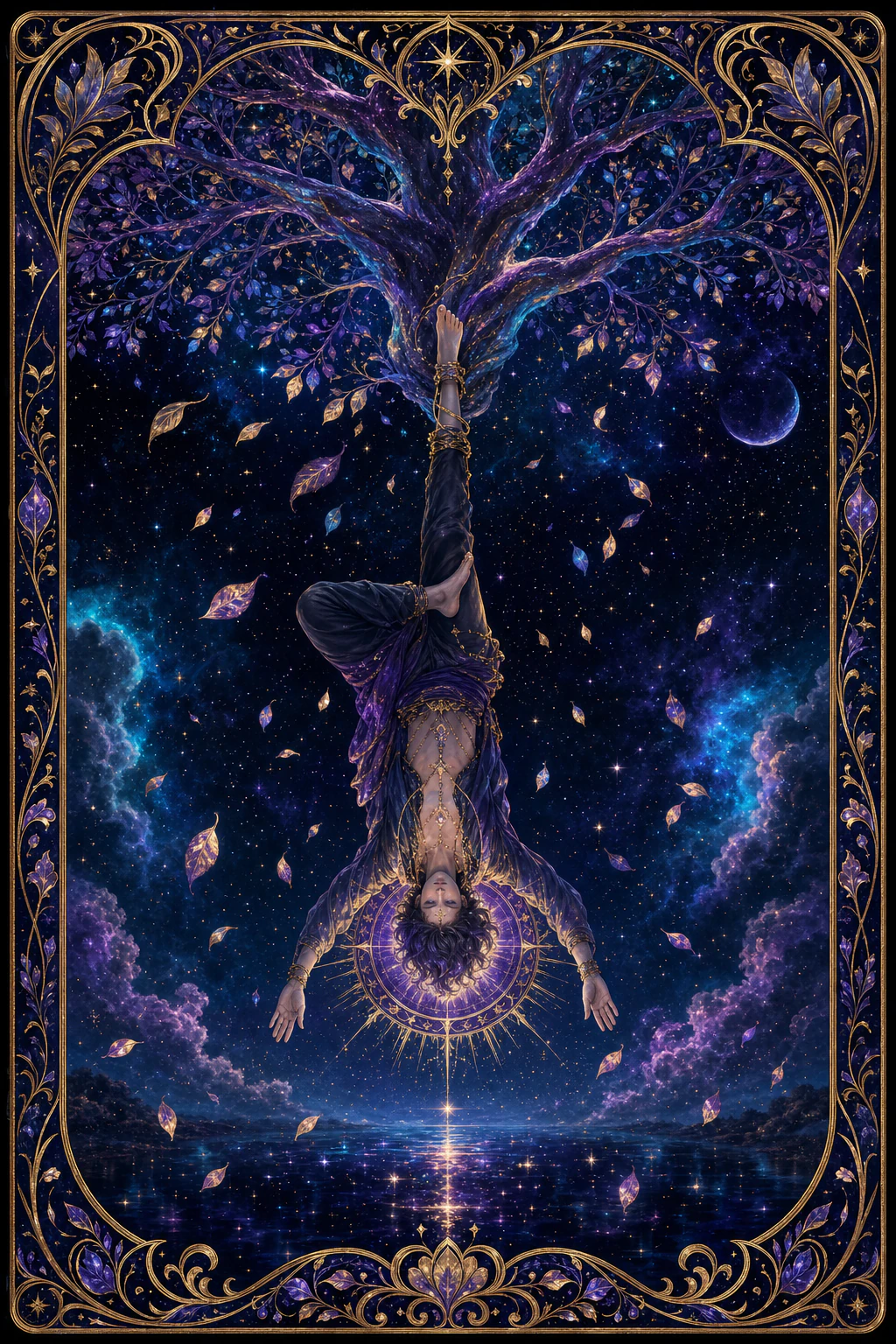
A man hangs upside down from a living wooden cross, one leg bent behind the other, hands out of sight, a soft golden light around his head. His expression is entirely untroubled, which is the strangest thing in the picture. The Hanged Man asks what a situation might look like if you stopped trying to get out of it for a moment.
Upright The Hanged Man
Suspension is the whole subject, and the tradition has been consistent that this is a chosen suspension rather than an accident. He is tied by one ankle to a beam that is visibly still growing, and nothing in his face indicates distress. The card belongs to the periods in a life that cannot be hurried: the wait between applying and hearing, the months after a decision when nothing has yet taken shape, the argument that will not be resolved by another round of talking tonight. What makes such periods hard is rarely the waiting itself. It is the low, constant expenditure of trying to make them end. The card's proposition — and it is a proposition rather than an instruction — is that some things become legible only when you stop pushing at them. The inverted view is not merely a novelty. Seen upside down, the proportions of a situation genuinely change: what looked urgent looks smaller, what you had been ignoring moves into the middle. A further strand concerns surrender, which is easily misread as passivity. Choosing not to act is itself an act, and it costs something. The halo in the picture suggests the tradition regarded that cost as productive, which you are free to find consoling or irritating depending on how long you have been hanging there.
Reversed The Hanged Man
Turned the other way up, the figure lands on his feet, and readers have taken this in two quite different directions. The first is release: the end of a suspended stretch, the sense of movement returning to something that had been stalled for a long time. That reading is gentler than most reversals and worth allowing when it fits. The second is less comfortable. Reversal can describe suspension that has calcified — waiting that began as patience and became a way of not choosing. The distinction matters and is difficult to make from inside. One rough test is whether you could say what you are waiting for in a single sentence. If the sentence has gone vague, the waiting may have quietly changed jobs. There is a third reading about pointless sacrifice, which the older sources treat sternly and which deserves a lighter touch. People give things up for reasons that made sense at the time and then continue out of consistency long after the reason has lapsed. Noticing one such arrangement, without necessarily ending it, is a reasonable use of an evening. Nothing here requires a decision, and the card is notably unhurried about all of it.
The Hanged Man in love and relationships
Between people, this card sits with the pause rather than the resolution. Sometimes a connection reaches a point where neither person can honestly say what happens next, and the temptation is to force a shape onto it simply because the ambiguity is unpleasant. Forced shapes rarely hold. Ask whether the discomfort you feel belongs to the situation or to not knowing, since they produce identical symptoms and call for opposite responses. The card also raises the matter of seeing someone from an unfamiliar angle. Long acquaintance builds a fixed picture, hard to revise even when the person has changed underneath. You might consider whether anyone close to you is being read from a version of them that is several years out of date. Suspension in love is neither romantic nor a failure. It is a common condition, and the card's only real counsel is not to spend the whole of it struggling.
The Hanged Man in work and study
For work and study, this figure describes the stalled interval that every long project contains and no plan accounts for. Approval pending. Funding undecided. A manuscript sitting with somebody who has not replied. The professional instinct is to fill such intervals with activity that looks like progress, and some of that activity is genuinely useful while a good deal of it is anxiety wearing a lanyard. The reflection here is about which is which. There is a second application for anyone whose work has stopped making sense in its current framing. Problems that resist direct assault sometimes yield to a change of position — explaining it to somebody outside the field, working backwards from the end, doing the least interesting part first. That is what the inversion means practically. And a third, quieter question: what are you currently giving up for this work, and would you still choose it if you were choosing today rather than continuing?
Resources and security
Applied to security, the card considers what gets exchanged. Every arrangement involves trading one thing for another — time for stability, flexibility for certainty, proximity for opportunity — and most such trades were agreed to years ago and have never been reviewed. As reflection only: name the exchange you are currently living inside, in plain words, and notice whether you feel it was made by you or by circumstance. There is no correct answer and nothing to conclude. The card also touches the peculiar relief some people find in having less to protect, and the equally real unease others feel at the same thought. This is not guidance. Your own arrangements remain yours, and a professional is the place for the parts that count.
Attention and wellbeing
On attention, the Hanged Man is unusually simple: the subject is stopping. Not resting in the sense of recovering in order to resume, but the flatter and less productive kind, where nothing is being optimised. Many people have lost the capacity for this entirely, and its absence shows up as a low grade of mental noise that never quite clears. The practice suggested is a deliberate interval of doing nothing useful — twenty minutes, no input, no screen, no plan — which is harder than it sounds and mildly unpleasant at first. What tends to surface in the first ten minutes is the list. What tends to surface after that is occasionally worth having.
Yes or no?
No
No, though it is closer to not yet than to never. The card leans against action while a situation is still changing shape. Read the answer as being about this week rather than about the matter itself.
Symbolism in the card
Smith draws a young man suspended by his right ankle from a beam of living wood, green shoots visible along it, forming a T-shaped cross rather than the gallows of earlier versions. His left leg crosses behind the right at the knee, making an inverted figure four, and his arms are folded behind his back so that the whole silhouette becomes a triangle above a cross. A bright yellow nimbus surrounds his head. His hose are red and his tunic blue, the same colour scheme worn by several other figures in the deck, and his face is calm to the point of serenity. The card's ancestry is more pointed than its mood. In Renaissance Italy the pittura infamante was a public painting of a debtor or traitor hung upside down by one foot, and the earliest versions of this trump, called Il Traditore in some decks, carried exactly that association. Waite deliberately reversed the meaning, describing the figure's expression as one of deep entrancement rather than shame, and the halo is his clearest signal of that reinterpretation.
The Hanged Man as today's card
Meeting this card in a morning draw generally argues for doing less rather than more, which is unwelcome on a busy day and occasionally exactly right. If there is a decision you have been circling, the suggestion is to leave it alone for twenty-four hours and see whether it looks the same tomorrow. Frequently it does not. A second use is deliberately practical: take one routine thing and do it differently today — a different route, a different order, the meeting held standing up. Small dislocations of habit sometimes shake loose a thought that will not come when everything is arranged as usual. And if today is simply a day of waiting for news, the card is decent company for that, offering nothing except the observation that the waiting is itself the task.
In a three-card spread
Placed behind you, this figure usually marks a period of enforced stillness — an interval you did not enjoy and may have undervalued since. It is worth asking what got settled during it. Centrally placed, it describes a live suspension, and the neighbouring cards often show whether you have been sitting in it or fighting it. Where a spread looks forward, resist any reading of delay or arrival, since the deck knows nothing of either. Frame it as a question instead: if this matter could not be resolved for another month, what would you do with the month, and what might become visible in it?
Keywords
- Surrender
- Pause
- Perspective
- Sacrifice
Journal prompts
- What are you waiting for, in one sentence, and when did you last check that the sentence is still true?
- Which problem in your life have you only ever approached from one direction?
- What did you give up for something, and would you choose the same trade today?
Cards read alongside The Hanged Man
- Four of Swords — Rest, recovery, contemplation, and quiet renewal.
- The High Priestess — Intuition, sacred knowledge, divine feminine, and the subconscious.
- Eight of Cups — Walking away, seeking truth, withdrawal, and transition.
- The Moon — Illusion, fear, anxiety, subconscious, intuition.
- All 78 tarot card meanings — the full major and minor arcana in one place.
Combinations with The Hanged Man
- The Hanged Man and Justice tarot combination
- The Hanged Man and Death tarot combination
- The Hanged Man and Wheel of Fortune tarot combination
- The Hanged Man and Temperance tarot combination
- The Hanged Man and The Hermit tarot combination
- The Hanged Man and The Devil tarot combination
- All 231 major arcana combinations
The Hanged Man by position
- The Hanged Man as feelings tarot meaning
- The Hanged Man as intentions tarot meaning
- The Hanged Man as outcome tarot meaning
- The Hanged Man as advice tarot meaning
- The Hanged Man as an obstacle tarot meaning
- The Hanged Man as action tarot meaning
- The Hanged Man as a person tarot meaning
- The Hanged Man as how someone sees you tarot meaning
- The Hanged Man for a yes or no question tarot meaning
- All card meanings by position
Curious what The Hanged Man means for your question? Turn a card on the home page — no account needed.
Draw a card freeOne card, one honest question, most evenings.
Start your free daily readingFree · One card a day · No credit card needed
Go deeper than one card
A personalized deep reading works a full spread around your question — The Hanged Man included, if it falls to you. Deep readings run from the $1.99 Single Card Illumination and the $7 Three-Card Path, delivered straight away, to the $19 Five-Card Compass and the $29 Celtic Cross Atlas, composed in depth and delivered within 2–4 hours.
The $29 Celtic Cross Atlas, ten cards read position by position → · All reading options →
Prefer a rhythm to a one-off? Sparkle Pro ($8.99/month or $59/year) draws a three-card past, present and future spread for you every day. There is also a free eight-phase moon ritual guide to pair with today's card.
To sit with this card longer, the tarot journaling guide has prompt sets for daily draws, moon phases, and more — including journal prompts for every major arcana card.
Tarot content is for entertainment and personal reflection, not professional advice.