Ten of Wands Tarot Card Meaning
 Start your free daily reading
Free · One card a day · No credit card needed
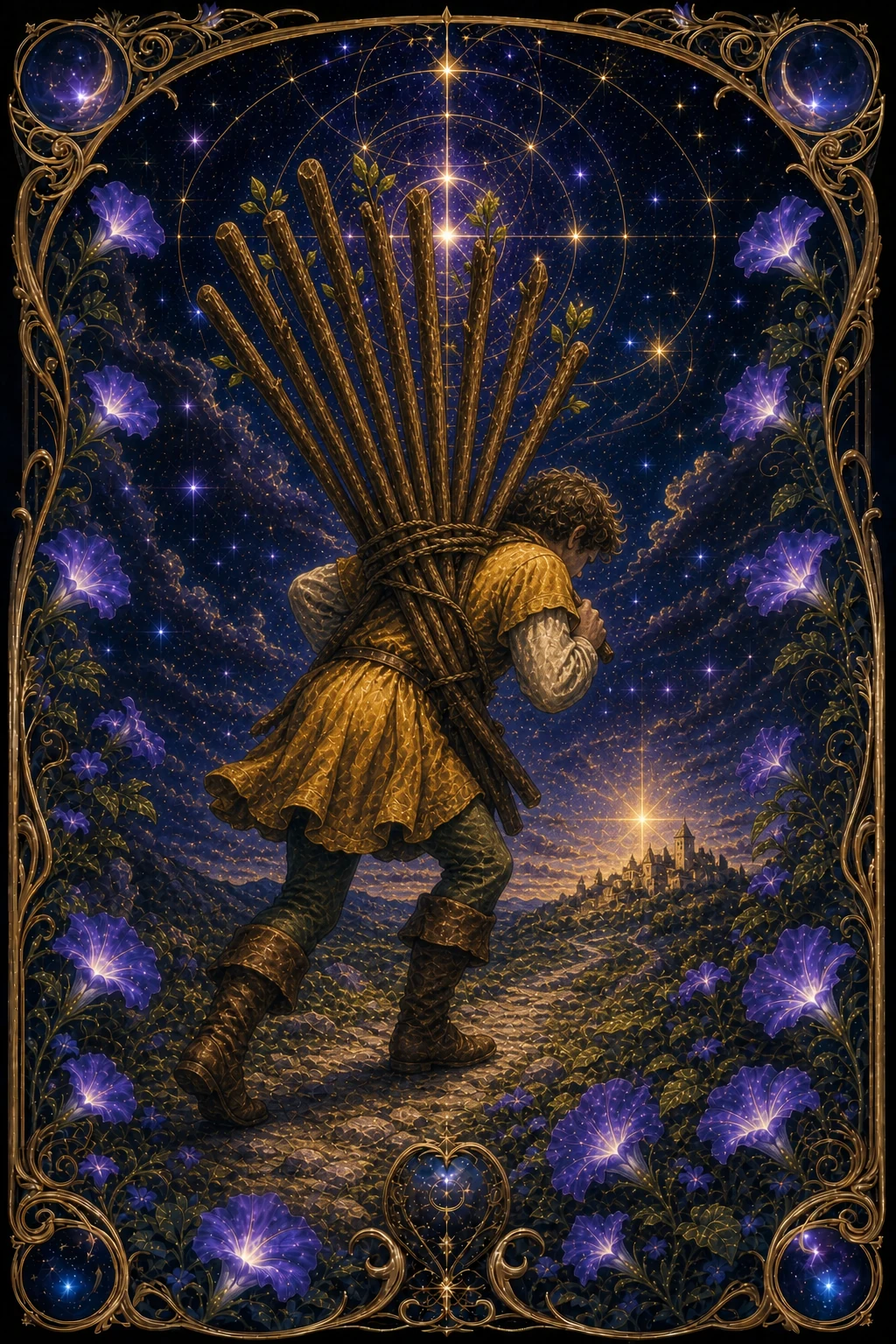
A figure walks bent double under ten staves gathered in both arms, the bundle so wide it hides the face and most of the view. A town stands a short distance ahead. The card asks what you agreed to carry, and how much of it is still yours.
Upright Ten of Wands
Nothing in this picture is dramatic. There is no antagonist, no storm, no cliff. There is only a person walking toward a town with more in their arms than they can comfortably see around, and the ordinariness is exactly what makes the card land. Loads are rarely handed over all at once. They accumulate one reasonable yes at a time, each of which was manageable on the day it was said. The reflection is about accounting. Most people can list their responsibilities and few have ever written them down together on one page, and the list is nearly always longer than the felt sense of it. A second detail in the drawing gets skipped regularly. The staves are held rather than tied. Nothing about the arrangement is efficient, and no one has suggested a cart. This is what happens when the person carrying is also the only one who knows how the load is stacked. Upright, the card sits with capability turned into obligation: the quiet process by which being good at something becomes being responsible for it, and then being assumed. The town ahead is close. Worth asking: what do you picture happening when you arrive, and have you ever tested it?
Reversed Ten of Wands
Reversed, the bundle comes apart or comes down. The traditional readings run in two directions and it is worth having both. In the first, this is release: something is set down, delegated, refused, or finally allowed to fail without heroic intervention, and what follows is relief mixed with a surprising quantity of discomfort. People whose identity has been built on carrying often find the first light week disorienting rather than pleasant. In the second, the reversal describes a load that has stopped being carried well — dropped things, missed details, the resentment that leaks out sideways at whoever asks the smallest question. Neither version is a moral failure and neither is a prophecy. What the reversed card does offer is an unusually practical prompt. Go through what you are holding and sort it three ways: what is genuinely yours, what you took on because it was faster than explaining, and what somebody else would now do adequately if you stopped. Most people find the middle category is the largest, and that discovery tends to be more uncomfortable than either of the others. Nothing about the sorting obliges you to act on it this week.
Ten of Wands in love and relationships
In close relationships, this card describes the invisible labour that keeps things running: the remembering, the arranging, the emotional weather-watching that somebody in every household does and nobody in that household has ever named. It is not a scoreboard and it works badly as one. Still, there is a reflection in noticing whether the carrying in your life is shared, and whether the person doing more has been thanked in words or merely relied upon in silence. The card also raises a harder question for the carrier. Being needed is a genuine pleasure, and some of us take on more than we can hold because the alternative is finding out whether we would still be wanted with our arms empty. That thought is worth turning over slowly rather than resolving. Nobody reaches an honest answer about it in a single evening.
Ten of Wands in work and study
For work and study, the Ten is the card of the person things default to. Every organisation has one, and the position is rarely assigned in writing. It accumulates because you answered promptly once, or because you fixed the thing nobody else understood, and now the understanding lives with you and cannot be given back without a conversation nobody wants to start. There is a reflection here about visibility. Loads carried invisibly tend to be valued invisibly, and the discovery of this usually arrives at an inconvenient moment. Writing down what you actually do — not the job description, the real inventory — is an unglamorous exercise this card supports. It changes nothing on its own. It does, however, make the size of the thing legible to you, which is a precondition for any conversation you might later choose to have about it.
Resources and security
Security, in this card, is a matter of obligation rather than abundance. Commitments have a way of compounding quietly: the standing costs, the things you cover for other people, the arrangements agreed to in a more expansive season and never revisited. As reflection only, there is value in seeing the whole set at once rather than one line at a time, since the felt weight and the actual list are seldom the same shape. Nothing here amounts to guidance about your circumstances, and any decision belongs with you and with people properly qualified to help.
Attention and wellbeing
The experience this card draws is carrying more than you can see around, which is as much about attention as effort. When the load is wide enough, the view narrows to the next few steps, and it becomes genuinely hard to tell whether things are going well. That is a description, not a diagnosis. If you recognise it, the most useful thing the card offers is company rather than instruction — the acknowledgement that this state is common, and that people inside it usually underestimate how long they have been there. Talking to somebody you trust is a reasonable next move, and where the weight has been heavy for a long time, qualified support exists and using it is unremarkable.
Yes or no?
No
No, or more precisely not on top of everything else. The card leans away from adding rather than away from the thing itself. If the question is worth a yes, it is probably worth clearing something first.
Symbolism in the card
The figure is drawn from behind and slightly to the side, bent forward with all ten staves clutched against the chest in an untidy sheaf. Smith arranges them as a fan that rises above the head, so the face is hidden from our view and the road ahead is hidden from theirs — a single compositional decision that carries most of the card's meaning. A ploughed field lies to one side and a cluster of buildings sits on the horizon, close enough to reach and far enough to matter. Waite read the card as oppression, and also, more curiously, as a man carrying his own success, a reading later commentators have found sharper than the plain burden interpretation. The older baton pips of the Italian decks arranged ten staves in a lattice with no figure at all, so the walker, the field and the town are Smith's invention. The staves still show leaves. Whatever is being carried here is not dead wood, which is exactly what makes it hard to put down.
Ten of Wands as today's card
This one works best as an inventory rather than a mood. Take the things currently sitting on you, write them somewhere outside your head, and look at the length of the list without editing it into something more reasonable. That is the whole exercise. Some people find the list shorter than the feeling, which is its own relief. Others find it longer, which explains the week. Nothing about the card asks you to solve it before lunch. If the day already has too much in it to do even this, that response is legible enough on its own, and the card will still be in the deck tomorrow.
In a three-card spread
In the past position, the Ten often refers to a stretch you carried and have never fully credited yourself for, or to the moment a role was handed to you without discussion. Both are worth stating in plain words. In the present, the load is current, and the cards beside it frequently suggest where the weight originates or who else is standing nearby. In the future position, decline to read it as a warning of more work. Hold it instead as a question of design: if this continued for another year, what arrangement would make it bearable, and what would somebody need to hear you say in order to arrange it?
Keywords
- Burden
- Responsibility
- Effort
- Pressure
Journal prompts
- Written on one page, what are you actually holding at the moment?
- Which part of your load did you take on because it was quicker than explaining?
- What do you imagine will be waiting in the town, and who told you that?
Cards read alongside Ten of Wands
- Nine of Wands — Resilience, persistence, boundaries, and the final stretch.
- Eight of Cups — Walking away, seeking truth, withdrawal, and transition.
- Four of Swords — Rest, recovery, contemplation, and quiet renewal.
- The Hermit — Soul-searching, introspection, being alone, inner guidance.
- All 78 tarot card meanings — the full major and minor arcana in one place.
Combinations with Ten of Wands
- Nine of Wands and Ten of Wands tarot combination
- Ten of Wands and Page of Wands tarot combination
- Eight of Wands and Ten of Wands tarot combination
- Ten of Wands and Knight of Wands tarot combination
- Seven of Wands and Ten of Wands tarot combination
- Ten of Wands and Queen of Wands tarot combination
- All 2,772 minor arcana combinations
Ten of Wands by position
- Ten of Wands as feelings tarot meaning
- Ten of Wands as intentions tarot meaning
- Ten of Wands as outcome tarot meaning
- Ten of Wands as advice tarot meaning
- Ten of Wands as an obstacle tarot meaning
- Ten of Wands as action tarot meaning
- Ten of Wands as a person tarot meaning
- Ten of Wands as how someone sees you tarot meaning
- Ten of Wands for a yes or no question tarot meaning
- All card meanings by position
Curious what Ten of Wands means for your question? Turn a card on the home page — no account needed.
Draw a card freeOne card, one honest question, most evenings.
Start your free daily readingFree · One card a day · No credit card needed
Go deeper than one card
A personalized deep reading works a full spread around your question — Ten of Wands included, if it falls to you. Deep readings run from the $1.99 Single Card Illumination and the $7 Three-Card Path, delivered straight away, to the $19 Five-Card Compass and the $29 Celtic Cross Atlas, composed in depth and delivered within 2–4 hours.
The $7 Three-Card Path, three cards read as one movement → · All reading options →
Prefer a rhythm to a one-off? Sparkle Pro ($8.99/month or $59/year) draws a three-card past, present and future spread for you every day. There is also a free eight-phase moon ritual guide to pair with today's card.
To sit with this card longer, the tarot journaling guide has prompt sets for daily draws, moon phases, and more.
Tarot content is for entertainment and personal reflection, not professional advice.