Nine of Wands Tarot Card Meaning
 Start your free daily reading
Free · One card a day · No credit card needed
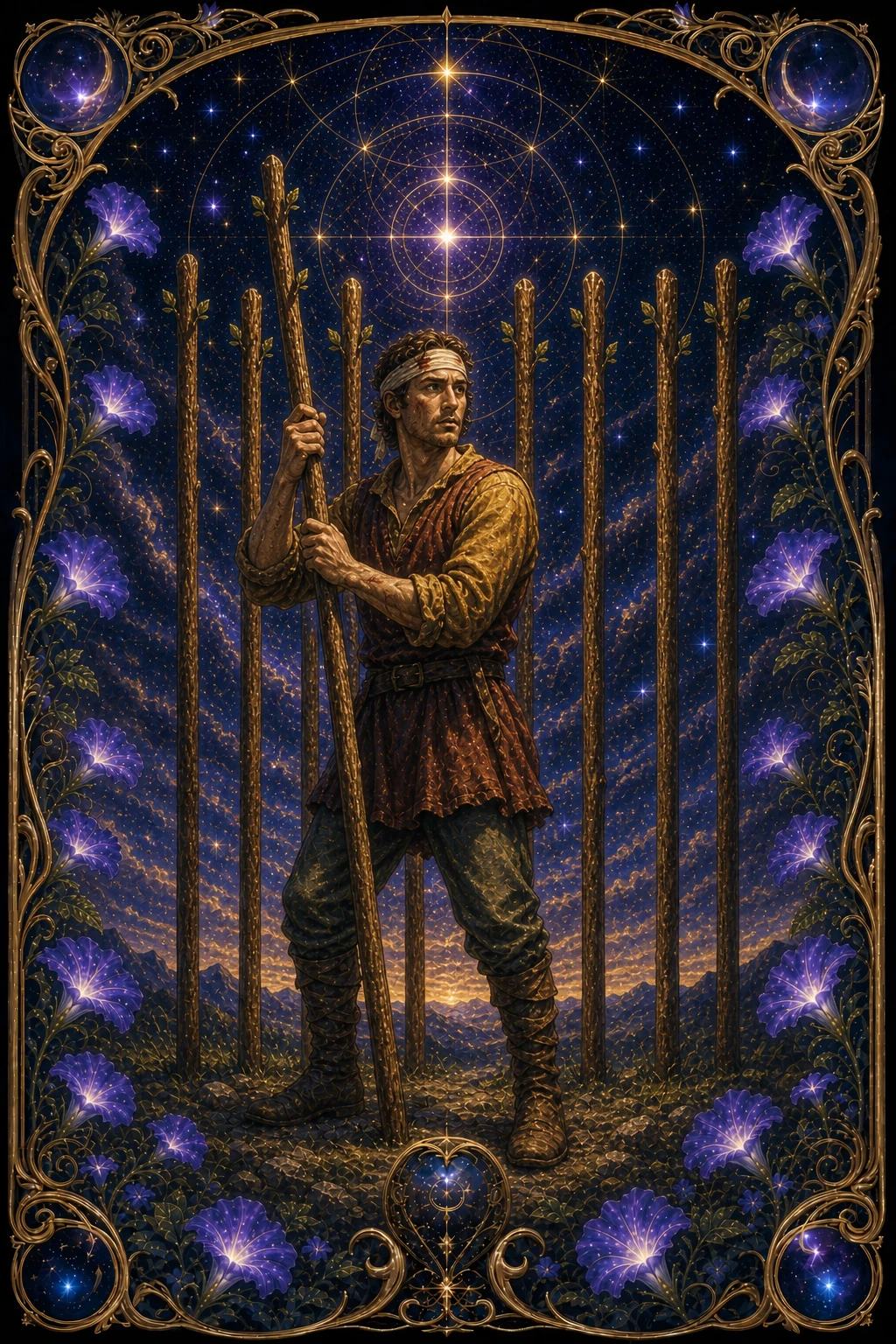
A figure with a bandaged head leans on one staff, eight more standing in a row behind like a fence. The body is turned slightly, as though something has been heard rather than seen. The card asks what your guardedness has been protecting, and how long it has been on duty.
Upright Nine of Wands
Here is a picture of someone who has been through it and is still standing, which the tradition tends to celebrate rather more than the figure in the drawing appears to. Look at the posture. The weight is on the staff, not on the legs. The head is wrapped, so the wound has already been dressed by somebody, possibly by the same person now standing watch. Resilience is real and it is not free, and the Nine is unusual in the deck for showing both halves at once. What the card raises, sat with honestly, is the difference between vigilance that is still doing something and vigilance that has become a habit of the shoulders. The eight staves behind form a line the figure has already established. Whether that line is a defence or a fence depends on what stands on the other side of it, and the picture declines to show us. Older readings emphasise the last stretch, the point where only a little more is required. That framing has its uses, and it can also be the exact sentence that keeps someone going long past the point of wanting to. Upright, the card is neither congratulation nor warning. It is a fair look at what continuing has been costing, held without any obligation to do something about it today.
Reversed Nine of Wands
Reversed, the guard comes down, or else it goes up so far that nothing gets through at all. Both readings live in this card and they look nothing alike. In the first, the fence stops being maintained; the effort that held the position runs out, and what follows is less collapse than a sort of flatness, the peculiar tiredness of no longer minding. That state is worth naming plainly, because from the inside it can feel like peace. In the second, the watch continues after the threat has gone. The person keeps scanning a horizon that has been empty for a year and treats every new arrival as the old one returning. If you have been answering someone in your present with the vocabulary of someone in your past, this is a gentle place to notice it. There is a third possibility the card holds. Sometimes the honest reading of a reversal is simply that carrying on is not currently available, and the sentence to say is that you cannot do this at the moment, rather than dressing the halt up as a refusal. Saying it to somebody who is fond of you is generally better than saying it to a deck of cards.
Nine of Wands in love and relationships
Around relationships, this card is about the guard rather than the affection. Everyone who has been hurt keeps something back, and most people do it so competently that they no longer notice the withholding as an action. The Nine sits with that: the version of you who arrives at connection already braced, listening for the tone that preceded the last ending. Being braced is not a failing, and nothing here suggests dismantling it on a schedule. What is worth considering is who is currently being defended against. If the answer is somebody who has done nothing, that is information about the past rather than about them. The card also has something to say to whoever is on the other side of the fence. Patience with a guarded person is a real form of care and it is not infinite, and both facts can be true in the same week.
Nine of Wands in work and study
For work and study, the Nine is the card of the long project in its unlovely stretch. Not the start, which had energy, and not the finish, which will have relief. The middle-late portion, where the interesting problems are solved and what remains is persistence in front of people who have stopped asking how it is going. There is a specific reflection here about defended territory. Many working lives include a position taken years ago — a standard, a boundary, a refusal — that is still being held out of consistency rather than conviction. It costs something to keep. It might still be worth keeping. The card only asks that you know which. And if you are close to the end of something demanding, it is fair to ask what you are planning to feel when it is over, since people who finish hard things often forget to arrange for that.
Resources and security
In the domain of security, this card describes reserves rather than income. The figure has eight staves standing behind and one in hand, which is a picture of provision made in a previous season by a version of you who thought ahead. It is worth noticing that person with some gratitude. Purely as reflection: consider what your own margin is for, and whether you would recognise the situation it was set aside for if it arrived, or whether the margin has quietly become something you defend for its own sake. That is a question about relationship rather than amount, and it says nothing about your actual arrangements.
Attention and wellbeing
This card sits closest to the experience of being depleted while still functioning, which is a common way to spend a month and a hard one to describe. Depletion rarely announces itself; it shows up as a shorter fuse, a heavier morning, an unwillingness to be asked one more small thing. Noticing it is not a diagnosis, and this card is no clinician. It is only a place to observe, without alarm, how long you have been running on the last portion of something. If the observation is uncomfortable, the people who know you well are a better place to take it than a page of text, and there is no obligation to have a plan before you speak.
Yes or no?
It depends
It depends, and the deciding factor is usually stamina rather than merit. The card leans toward continuing, but it declines to say whether continuing is what you want. Consider what a yes here would ask you to keep carrying.
Symbolism in the card
Smith gives the ninth wand to the figure and stands the other eight in a row behind, evenly spaced, close to a palisade. The head is wrapped in a white bandage, one of the few explicit injuries drawn anywhere in the deck, and the face is turned to the side with an expression readers have called wary, sullen or simply tired depending on the century. The ground is bare, the hills behind are low and pale, and there is nothing in the frame to indicate what the watch is for. Waite associated the card with strength in opposition and with the pause before a contest, while the older baton pips carried a general sense of prudence held in reserve. The bandage is Smith's own contribution and it changes the card considerably. Without it the figure is a sentry; with it, the sentry has already been in the fight. The staves themselves still sprout leaves, which is easy to miss in a picture this defensive, and which quietly insists that the thing being guarded is alive.
Nine of Wands as today's card
Drawn on an ordinary morning, this card tends to describe a stance rather than an event. It suits the days you enter braced without quite knowing why, and it makes a modest prompt: identify what you are expecting to have to defend today, then notice by evening whether it was ever asked of you. Often it is not, and the bracing was the whole of the expense. If today genuinely does require holding a line, the card is decent company for it, mainly because it is honest about the tiredness rather than dressing it up as heroism. Either way, the useful noticing is where the readiness sits in you.
In a three-card spread
In the past, this card usually points to a period you got through by sheer continuation, and the honest work is admitting how much of it you have never actually put down. Survival tends to go unaccounted. In the present position, it describes an active watch: something is being held, and the cards on either side often reveal against what. In the future position, refuse the reading of an incoming fight. Better to hold it as a question about endurance — if this went on longer than you would like, what would you need in place, and who would you be willing to tell?
Keywords
- Resilience
- Persistence
- Boundaries
- Stamina
Journal prompts
- What are you still guarding against, and when did you last check whether it was there?
- Who dressed the wound, and did you thank them or change the subject?
- If you stopped being the person who copes, what are you worried might happen?
Cards read alongside Nine of Wands
- Seven of Wands — Challenge, perseverance, defense, and standing your ground.
- Ten of Wands — Burden, responsibility, hard work, and carrying too much.
- Four of Swords — Rest, recovery, contemplation, and quiet renewal.
- Strength — Strength, courage, persuasion, influence, compassion.
- All 78 tarot card meanings — the full major and minor arcana in one place.
Combinations with Nine of Wands
- Eight of Wands and Nine of Wands tarot combination
- Nine of Wands and Ten of Wands tarot combination
- Seven of Wands and Nine of Wands tarot combination
- Nine of Wands and Page of Wands tarot combination
- Six of Wands and Nine of Wands tarot combination
- Nine of Wands and Knight of Wands tarot combination
- All 2,772 minor arcana combinations
Nine of Wands by position
- Nine of Wands as feelings tarot meaning
- Nine of Wands as intentions tarot meaning
- Nine of Wands as outcome tarot meaning
- Nine of Wands as advice tarot meaning
- Nine of Wands as an obstacle tarot meaning
- Nine of Wands as action tarot meaning
- Nine of Wands as a person tarot meaning
- Nine of Wands as how someone sees you tarot meaning
- Nine of Wands for a yes or no question tarot meaning
- All card meanings by position
Curious what Nine of Wands means for your question? Turn a card on the home page — no account needed.
Draw a card freeOne card, one honest question, most evenings.
Start your free daily readingFree · One card a day · No credit card needed
Go deeper than one card
A personalized deep reading works a full spread around your question — Nine of Wands included, if it falls to you. Deep readings run from the $1.99 Single Card Illumination and the $7 Three-Card Path, delivered straight away, to the $19 Five-Card Compass and the $29 Celtic Cross Atlas, composed in depth and delivered within 2–4 hours.
The $7 Three-Card Path, three cards read as one movement → · All reading options →
Prefer a rhythm to a one-off? Sparkle Pro ($8.99/month or $59/year) draws a three-card past, present and future spread for you every day. There is also a free eight-phase moon ritual guide to pair with today's card.
To sit with this card longer, the tarot journaling guide has prompt sets for daily draws, moon phases, and more.
Tarot content is for entertainment and personal reflection, not professional advice.