Knight of Cups Tarot Card Meaning
 Start your free daily reading
Free · One card a day · No credit card needed
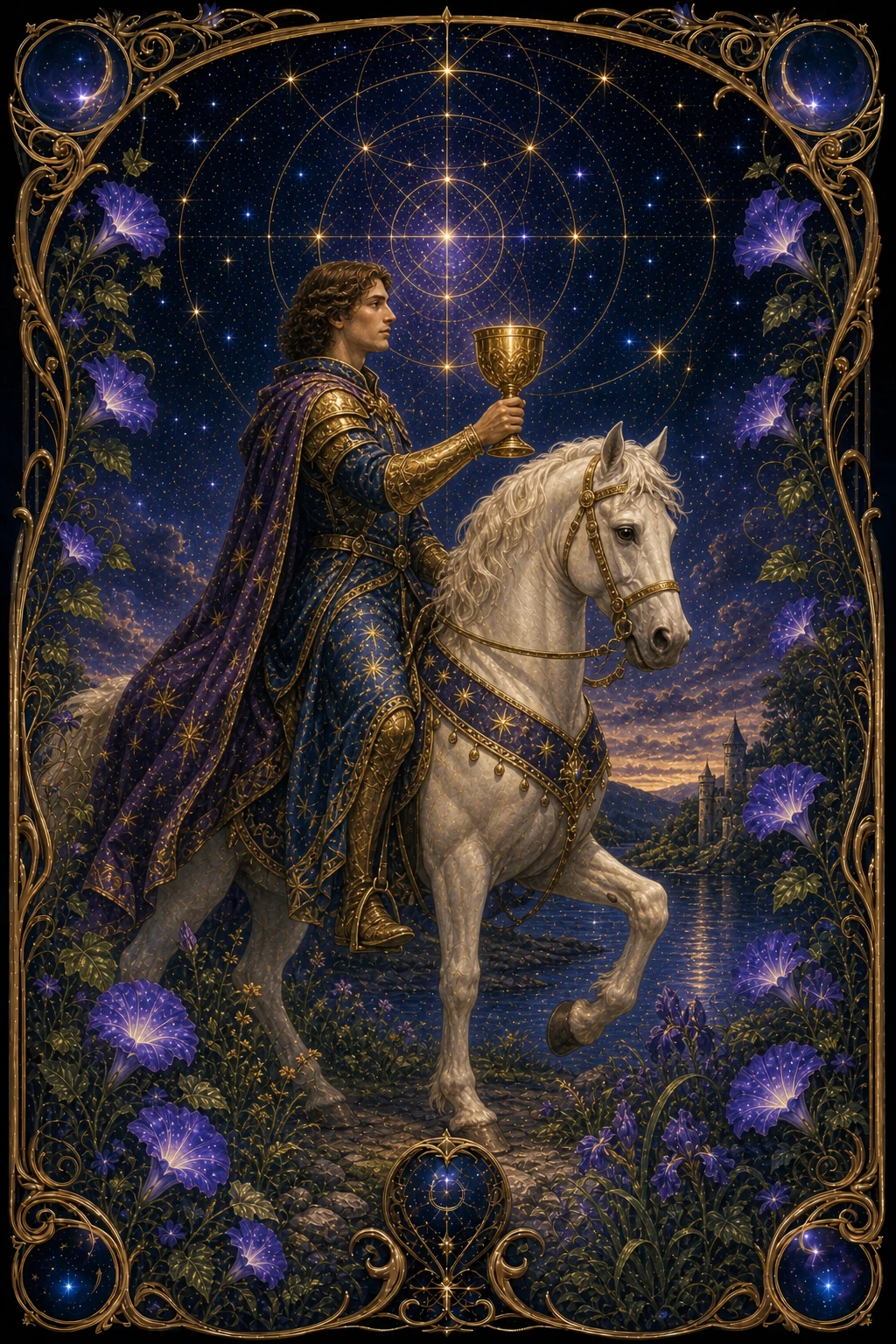
A knight in a winged helmet rides a grey horse at a walk, not a canter, holding a cup out ahead of him as though delivering it somewhere. The ground is bare, a small stream crosses his path, and low hills stand in the distance. Of the four knights, his is the only mount in no hurry. The card concerns the offer, and the distance between making one and meaning it.
Upright Knight of Cups
Everything about this figure is approach. He is not arriving and not departing; he is approaching something at a speed that lets you watch him do it, which is unusual in a rank of the deck otherwise devoted to charging about. The cup is held forward, level, unmistakably an offer. It is also, and this matters, entirely opaque from where we stand. Whatever is in it is his business until the moment of handing over. That is the card's central tension and it is not a cynical one. Offers are made in a form, and the form is never the same thing as the content, and a beautiful gesture can be perfectly sincere or perfectly hollow without changing its appearance at all. This is the deck's card for courtship in the wide sense: of a person, an idea, an audience, a project you are trying to talk yourself into. It rewards a plain question. When you approach something you want, how much attention goes into the approach and how much into what happens after you get there? Some people are superb at the ride and lost at the arrival. The card holds that lightly and without accusation.
Reversed Knight of Cups
Reversed, the gesture and the follow-through separate, and there are several shapes that takes. The best-known is the offer that never lands: the message beautifully composed and not sent, the invitation extended in a form vague enough to require nothing, the enthusiasm that is entirely real on Tuesday and entirely gone by Friday without anyone having lied. A gentler version is withdrawal for protection. Riding up with something in your hands is exposing, and plenty of people learn to keep the cup at their side and mention it casually so that a refusal can be absorbed as nothing much. A third reading concerns the person more attached to the state of longing than to any outcome, since longing is reliably beautiful and outcomes are mixed. None of these describes anyone in your life or predicts anybody's behaviour. Reversed, the honest use of the card is a look at your own offers: which ones have been made in a form that could actually be accepted, and which were shaped so that nothing would have to happen?
Knight of Cups in love and relationships
This is the deck's romantic card by reputation, and the reputation is fair as far as it goes. It sits with invitation, with the deliberate gesture, with attention paid in a way that is meant to be noticed. All of which is genuinely lovely and none of which is evidence of anything, which the tradition tends to gloss over. The card makes no claim about anyone's feelings, situation or intentions, and it cannot. What it can prompt is the distinction between being courted and being known, two experiences that overlap far less than the films suggest. Both are worth having and they run on different fuel. There is a question here for the offering side too. If you tend to lead with the gesture, it may be worth asking what it is standing in for, and whether the plainer version, said without any staging at all, would feel too exposed to attempt.
Knight of Cups in work and study
In working life this Knight is the pitch, the proposal, the presentation you have rehearsed until it flows. Persuasion is a real skill and this card does not sneer at it. What it raises is the aftermath. Charm opens doors into rooms that then need to be occupied for eighteen months, and the temperament that excels at winning the room is not always the temperament that enjoys staying in it. If you recognise a pattern of arriving somewhere brilliantly and losing interest around the third month, that is worth knowing about yourself in a neutral way rather than a self-critical one; it suggests things about how you might structure work, not about your character. The other reflection concerns taste. This is the court card most at home in aesthetic and imaginative work, where the quality of the offer genuinely is the product.
Resources and security
The Knight owns a horse, a helmet and a cup, and gives no sign of having considered the running costs of any of them. As reflection only, the card touches the money that goes into gestures: the dinner, the flowers, the trip arranged to make a particular impression. That spending is not foolish and the card does not say it is. It only notes that gestures have prices, that the price often goes unexamined because the gesture is filed under feeling rather than expenditure, and that noticing this changes nothing unless you want it to. There is no financial guidance in any of that. Choices of the sort sit with you, and with anyone qualified you consult.
Attention and wellbeing
The horse is the part to sit with. Grey, unhurried, moving through shallow water at a pace it could keep all day. Considered strictly as a question of pacing, and with nothing medical about it, this card favours sustainable tempo over intensity, which is an unglamorous preference for a figure so decorated. People who work in bursts tend to know a great deal about their bursts and very little about their walking pace. Finding out what yours is, on an ordinary week with nothing at stake, is the practical suggestion here. The card also has a mild view about enthusiasm as a resource: it is real, it is finite, and treating it as infinite is how people end up with eleven abandoned beginnings and a reputation for flakiness they did not intend.
Yes or no?
It depends
It depends on whether the question is about the offer or about what follows it. The card is confident on the first and quiet on the second. That is a reflection on the image, not a statement about your circumstances.
Symbolism in the card
Smith gives this knight a winged helmet and small wings at the heels, borrowing directly from the iconography of Mercury and, behind him, Hermes: the messenger, the crosser of boundaries, the god of eloquence and of persuasion that is not always straightforward. His tunic is patterned with fish, tying him to his suit. The horse is grey and its head is lowered, in pointed contrast to the rearing and galloping mounts of the other three knights. A narrow stream cuts across the foreground and the hills beyond are dry and unremarkable, so that the only water in the picture is the little he is actually crossing. Knights in the older decks are cavaliers, ranked between the page and the queen, and the Marseille cavalier of cups simply rides with his vessel and no scenery to speak of. Waite's associations for the card run toward arrival, invitation and the bearer of a proposal, and Smith's staging keeps that meaning while quietly slowing everything down.
Knight of Cups as today's card
Taken as the card for a day, this one usually points at something you have been composing in your head. A message, an apology, a request, an invitation to somebody you like and have not contacted since spring. The suggestion is to make it in a form that could actually be answered, which generally means shorter, plainer and sooner than the version you have been polishing. That is the practical reading. There is a second, quieter one for days when nothing needs sending: pay attention to the manner of the ordinary approaches you make, to how you greet people and ask for things. Nothing about this card promises that anyone offers you anything, and it is happier as a prompt about your own conduct.
In a three-card spread
For what has already happened, this Knight often marks an approach that mattered, made by you or to you, and it is worth being specific about which. The details of those moments tend to be remembered as more graceful than they were. In the middle seat he describes an offer currently in motion, or one being drafted and redrafted while the moment for it thins out. The cards beside him usually indicate which. In the final position he predicts nothing, least of all anyone's arrival or intentions, and the responsible form is conditional. If this went the way you would like, what would you have needed to say, and in what tone, for it to have gone that way?
Keywords
- Romance
- Charm
- Imagination
- Invitation
Journal prompts
- Which of your offers were shaped so that nothing would have to happen?
- What do you enjoy more, the approach or the arrival? What does that arrange in your life?
- What is your walking pace, on a week with nothing at stake?
Cards read alongside Knight of Cups
- Two of Cups — Partnership, mutual attraction, unity, and connection.
- Knight of Wands — Passion, adventure, bold action, and impulsive energy.
- The Lovers — Love, harmony, relationships, and values alignment.
- Temperance — Balance, moderation, patience, purpose.
- All 78 tarot card meanings — the full major and minor arcana in one place.
Combinations with Knight of Cups
- Page of Cups and Knight of Cups tarot combination
- Knight of Cups and Queen of Cups tarot combination
- Ten of Cups and Knight of Cups tarot combination
- Knight of Cups and King of Cups tarot combination
- Nine of Cups and Knight of Cups tarot combination
- Knight of Cups and Ace of Swords tarot combination
- All 2,772 minor arcana combinations
Knight of Cups by position
- Knight of Cups as feelings tarot meaning
- Knight of Cups as intentions tarot meaning
- Knight of Cups as outcome tarot meaning
- Knight of Cups as advice tarot meaning
- Knight of Cups as an obstacle tarot meaning
- Knight of Cups as action tarot meaning
- Knight of Cups as a person tarot meaning
- Knight of Cups as how someone sees you tarot meaning
- Knight of Cups for a yes or no question tarot meaning
- All card meanings by position
Curious what Knight of Cups means for your question? Turn a card on the home page — no account needed.
Draw a card freeOne card, one honest question, most evenings.
Start your free daily readingFree · One card a day · No credit card needed
Go deeper than one card
A personalized deep reading works a full spread around your question — Knight of Cups included, if it falls to you. Deep readings run from the $1.99 Single Card Illumination and the $7 Three-Card Path, delivered straight away, to the $19 Five-Card Compass and the $29 Celtic Cross Atlas, composed in depth and delivered within 2–4 hours.
The $19 Five-Card Compass, five positions and a keepsake → · All reading options →
Prefer a rhythm to a one-off? Sparkle Pro ($8.99/month or $59/year) draws a three-card past, present and future spread for you every day. There is also a free eight-phase moon ritual guide to pair with today's card.
To sit with this card longer, the tarot journaling guide has prompt sets for daily draws, moon phases, and more.
Tarot content is for entertainment and personal reflection, not professional advice.