Five of Wands Tarot Card Meaning
 Start your free daily reading
Free · One card a day · No credit card needed
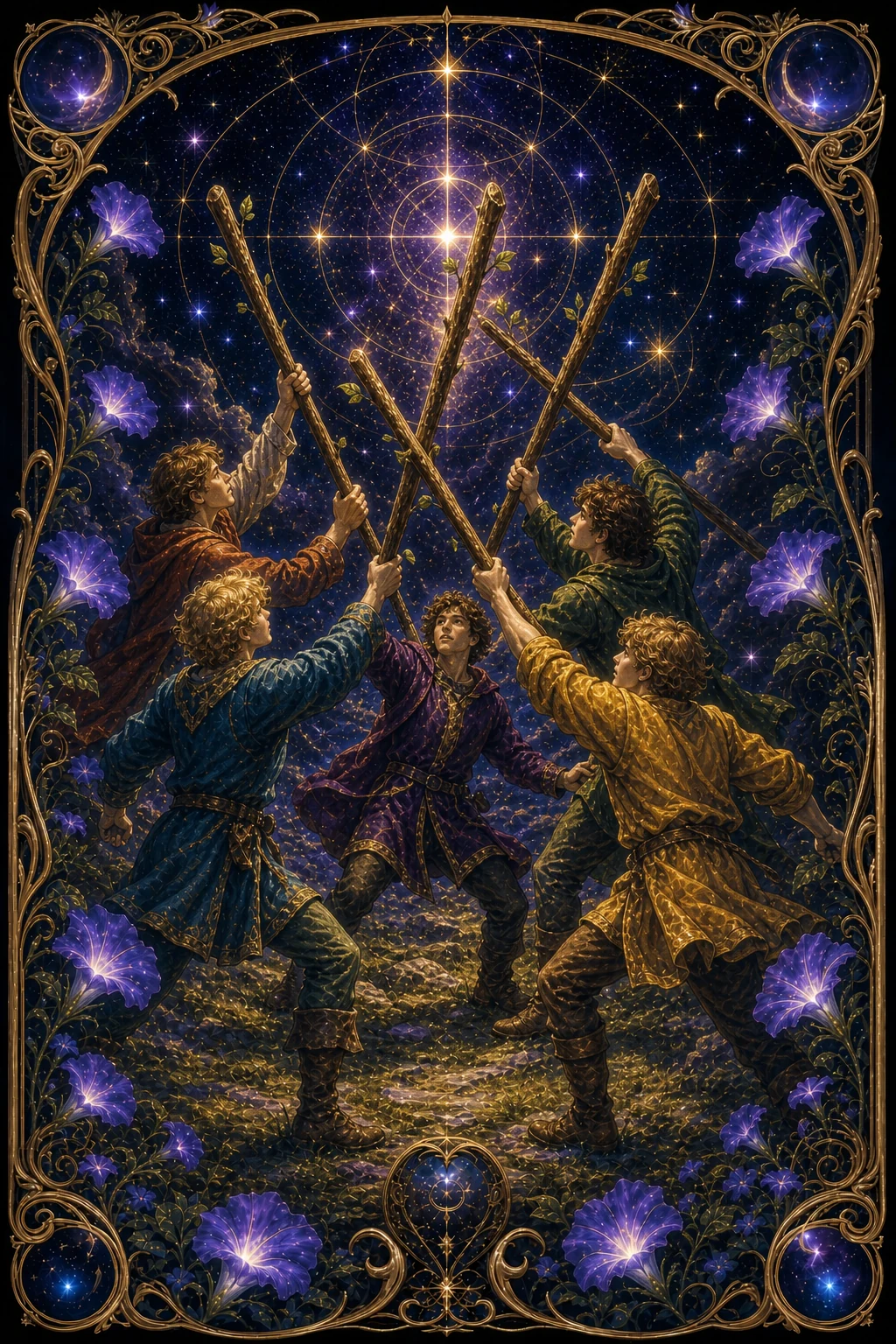
Five young men swing staves at each other on open ground, and nothing in the composition tells you whether this is a fight, a game or a rehearsal. Their clothes are all different colours. The card asks what you do when several wills meet in one place and none of them will move.
Upright Five of Wands
The first thing worth saying is that the picture is genuinely unclear, and the tradition has never resolved it. Nobody is bleeding. No blow appears to land. The staves cross at odd angles and the figures look more occupied than furious, which is why readers have called this everything from a brawl to a training bout to a badly run meeting. That ambiguity is the content. Friction is not the same as hostility, and much of what makes it exhausting is the difficulty of telling which one you are in. This card belongs to any situation where several people want incompatible things at the same time and all of them are acting in good faith. Committees. Households. Collaborations with no agreed method. Nothing is wrong with the participants, which is precisely what makes it hard to fix. Held as reflection, the Five raises a question about your own conduct in noise. Some people sharpen in it and rather enjoy the contest. Others go silent and call it keeping the peace. Neither is virtue and neither is failure, and the card predicts no encounter whatsoever. It only asks which one you become.
Reversed Five of Wands
Turned over, the scuffle changes character rather than stopping. A long-standing reading is friction pressed inward: disagreement that never gets said in the room and instead runs underneath everything, surfacing as tiredness and a strange, unplaceable irritation. That version costs more than the loud one, mostly because nothing can be answered when nothing has been stated. Another reading is avoidance rebranded as harmony. Groups can be extremely peaceful and entirely stuck, and the calm is sometimes bought by whoever decided their own preference was not worth the trouble of saying. If that description carries any weight, look at what you have been paying for the quiet. There is a third and more generous reading, in which the reversal describes a contest ending — energy going out of a rivalry, the argument that stopped mattering, the competitor you no longer measure yourself against. That is a real relief and deserves noticing rather than skipping past. None of these is a forecast about anybody's behaviour. They are descriptions of weather you may recognise.
Five of Wands in love and relationships
In connection, the Five sits with the ordinary abrasion of two people who both have preferences. Not crisis — abrasion. Who is right about the route, whose family at the holidays, whose version of the shared story gets told at dinner. The card treats this as normal rather than as a symptom, which is a useful correction, since a great deal of relationship anxiety comes from believing that friction indicates something rotten. It is worth asking how disagreement is conducted between you, and where you each learned to conduct it that way. Most people inherit a style from a kitchen table twenty or thirty years ago and have never examined it. The picture's small mercy is that the figures are still on the same field, upright, and playing with sticks rather than swords.
Five of Wands in work and study
In work and study, this is the card of competing claims — several teams needing the same week, several good ideas in one room, a field with more applicants than places. Tradition reads it as rivalry, and rivalry is real, but the more common experience is duplicated effort: five people solving one problem separately and none of them saying so. A reflection sits here about how you handle being one voice among several. Do you push, defer, or restate other people's points until your own quietly vanishes? The card also touches the useful side of contest. Some work only becomes good when it meets resistance, and a colleague who disagrees carefully is worth more than a room that nods. None of this says anything about how any particular situation resolves.
Resources and security
On the theme of security, the Five's subject is comparison. Financial unease is often less about a number than about a benchmark quietly borrowed from other people — a sibling, a cohort, a version of your own past. Taken as reflection alone: whose measure are you using when you decide whether you have enough, and when did you last check that you agree with it? That question has nothing to do with your circumstances and requires no decision. It simply tends to be more revealing than any figure, and it is one of the few parts of enough-ness kept entirely in your own hands. Borrowed benchmarks are heavy precisely because nobody recalls agreeing to carry them.
Attention and wellbeing
Sustained friction takes a toll that is easy to attribute to the wrong cause. Being braced — for the conversation, the meeting, the household negotiation — is a small continuous effort, and people generally notice it only once it has been running for a while. This card's suggestion concerns pace and nothing else: where in your week is there a stretch with no one to argue with, and does it currently exist? If it does not, that is worth seeing plainly. Unbraced time counts even when it is short, and shorter than you would think will generally do. None of this is a statement about health, and nothing in a card can speak to yours.
Yes or no?
It depends
It depends, mostly on how much noise you are prepared to stand in. The Five reads less like an obstacle than like a crowd. Consider whether other people's wants are sitting inside your question.
Symbolism in the card
Five youths in differently coloured tunics and hose stand on plain ground beneath a pale sky, each holding a leafy staff, the poles crossing without any two of them meeting cleanly. Nobody is wounded and no ground is being defended; the arrangement reads as much like play as combat, and Waite himself described it as mimic warfare, a sham fight. Later commentators leaned harder on competition and on the clash of ideas. The variety of colour is the detail most often overlooked: the deck rarely dresses a group so differently, and it makes a plain visual argument that these are five separate people rather than a mob. Fives across the four suits all deal with disruption of the settled state the fours established, and this one is the least grave of them. It descends from a long tradition of tournament and festival imagery, where mock combat was a public entertainment rather than a disaster.
Five of Wands as today's card
As a single card, the Five suits a day with several claims on it. Its most practical use is triage: write down what is actually competing, one line each, before the noise arranges your priorities for you. If a disagreement is live, this is not an instruction to enter it or to withdraw, and it certainly says nothing about what anyone else does. A gentler daily form is to notice your first move when something crosses you — voice, silence, humour, retreat — since that reflex is usually invisible from inside and entirely legible from outside. Crossed staves make a poor place to stand for long and an interesting one to look around from.
In a three-card spread
In the past position, the Five often points to a stretch of contest whose noise now looks smaller than it felt, and occasionally to a rivalry that shaped you more than you would admit. In the present, it describes competing pressures rather than any single opponent, and the flanking cards tend to say where the pressure originates. Read for what is ahead, keep it strictly reflective, since nothing here predicts anyone's conduct. The workable question is about your own position: if this stays contested for a while, what are you genuinely unwilling to concede, and what have you been defending out of habit? Those five different tunics are a standing reminder that a crowd is assembled from individuals.
Keywords
- Competition
- Tension
- Conflict
- Diversity
Journal prompts
- What becomes of you in a noisy room, and when did you learn to do that?
- Which disagreement in your life is genuinely about the thing being argued over?
- Where are you competing with someone who does not know it?
Cards read alongside Five of Wands
- Seven of Wands — Challenge, perseverance, defense, and standing your ground.
- Five of Swords — Conflict, hollow victory, tension, and walking away.
- Two of Pentacles — Balance, adaptability, priorities, and managing change.
- The Chariot — Control, willpower, success, action, and determination.
- All 78 tarot card meanings — the full major and minor arcana in one place.
Combinations with Five of Wands
- Four of Wands and Five of Wands tarot combination
- Five of Wands and Six of Wands tarot combination
- Three of Wands and Five of Wands tarot combination
- Five of Wands and Seven of Wands tarot combination
- Two of Wands and Five of Wands tarot combination
- Five of Wands and Eight of Wands tarot combination
- All 2,772 minor arcana combinations
Five of Wands by position
- Five of Wands as feelings tarot meaning
- Five of Wands as intentions tarot meaning
- Five of Wands as outcome tarot meaning
- Five of Wands as advice tarot meaning
- Five of Wands as an obstacle tarot meaning
- Five of Wands as action tarot meaning
- Five of Wands as a person tarot meaning
- Five of Wands as how someone sees you tarot meaning
- Five of Wands for a yes or no question tarot meaning
- All card meanings by position
Curious what Five of Wands means for your question? Turn a card on the home page — no account needed.
Draw a card freeOne card, one honest question, most evenings.
Start your free daily readingFree · One card a day · No credit card needed
Go deeper than one card
A personalized deep reading works a full spread around your question — Five of Wands included, if it falls to you. Deep readings run from the $1.99 Single Card Illumination and the $7 Three-Card Path, delivered straight away, to the $19 Five-Card Compass and the $29 Celtic Cross Atlas, composed in depth and delivered within 2–4 hours.
The $7 Three-Card Path, three cards read as one movement → · All reading options →
Prefer a rhythm to a one-off? Sparkle Pro ($8.99/month or $59/year) draws a three-card past, present and future spread for you every day. There is also a free eight-phase moon ritual guide to pair with today's card.
To sit with this card longer, the tarot journaling guide has prompt sets for daily draws, moon phases, and more.
Tarot content is for entertainment and personal reflection, not professional advice.