Death Tarot Card Meaning
 Start your free daily reading
Free · One card a day · No credit card needed
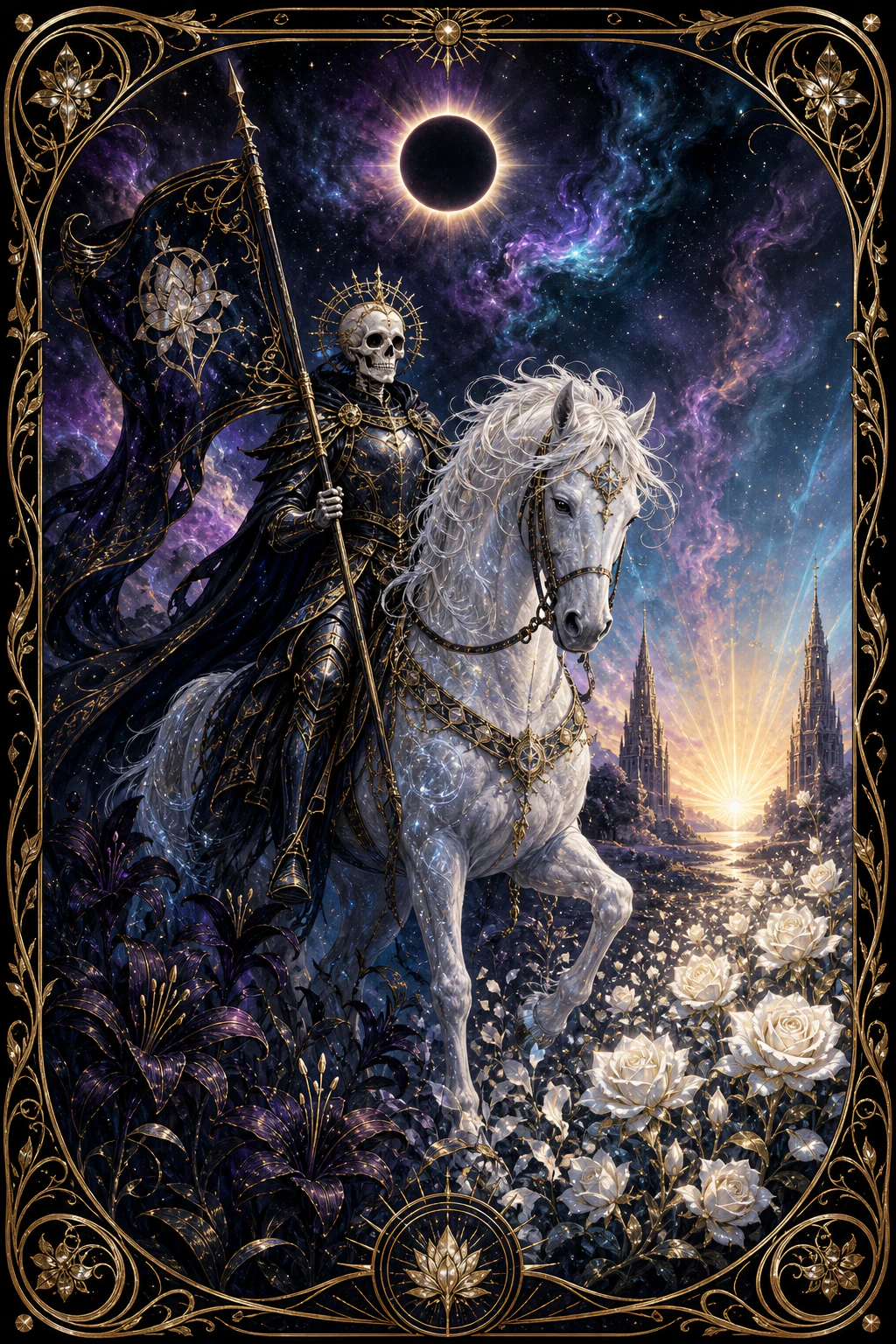
An armoured skeleton rides a white horse across a bare field, carrying a black banner with a white five-petalled rose. A bishop, a woman and a child stand in its path, and each of them is meeting it differently. This card asks what has quietly finished in your life, and whether you have admitted it yet.
Upright Death
Let one thing be said plainly before anything else. This card is not a forecast, it makes no statement about anyone's health or mortality, and a shuffled deck has no knowledge of your circumstances or of anybody else's. In eight centuries of use it has been read overwhelmingly as a card about endings in the ordinary sense: chapters closing, roles finishing, a version of yourself that has run its course. That is how it is offered here, and if the image is more than you want to sit with today, closing the page is a perfectly good reading of it. Taken as reflection, the subject is completion and the reluctance that gathers around it. Most things in a life do not end cleanly; they thin out, and we keep attending them out of loyalty to who we were when they mattered. The card is unusually direct about that gap. It asks which arrangement, ambition, friendship or self-description you are still maintaining chiefly because ending it would require saying so out loud. Note that the figure in the picture is moving steadily and is not depicted as cruel. The tradition treats this trump as a card of transition rather than catastrophe, and the sun rising between two towers in the distance is not an accident of composition.
Reversed Death
Reversed, readers have long taken this card as a description of resistance: the ending that is understood and not yet accepted, the door held shut with a shoulder against it. That state is exhausting and very common, and it rarely responds to being argued with. What sometimes helps is simply naming what has already concluded, without any requirement to act on the naming. A thing can be over for months before anyone says the word, and saying it changes remarkably little except the amount of energy spent pretending. There is a second reading about stagnation. When nothing is allowed to finish, nothing much can begin, and a life can accumulate a surprising number of half-closed matters that between them consume all the available attention. An inventory is the gentlest use of this reversal — not a cull, only a list. A third and softer possibility: reversal sometimes marks the slow part after an ending, the long unspectacular stretch where the event has passed and the adjustment has not. That stretch is not a failure to move on. It is what moving on actually consists of, and it takes considerably longer than most people allow for.
Death in love and relationships
Between people, this card touches change of form rather than loss. Relationships alter as the people in them do: a friendship becomes occasional, a partnership becomes something with different terms, a family role you were assigned at fourteen stops fitting at forty. Endings in this sense are frequently partial, and the difficulty lies in acknowledging that something has changed while the connection itself continues. Consider which relationship of yours is currently being conducted according to rules neither of you has revisited. It may not need ending at all; it may only need admitting. It matters to say clearly that a card cannot speak to real grief, real illness, or a situation that has become genuinely unsafe. If anything of that kind is present in your life, it belongs with people who know you and with proper support — a friend, a professional, someone who can actually sit in the room. Nothing on this page is a substitute for that, and it is not intended to be.
Death in work and study
At work, this figure sits with the role that is finished before the job is. Most people can name the moment their work stopped being interesting, and most people continue for a considerable period afterwards, for reasons that are usually practical and entirely legitimate. The card does not recommend leaving anything. It raises the narrower question of whether you have been honest with yourself about where you are, since the gap between knowing and admitting is where the tiredness collects. There is a second application concerning things you should stop doing rather than places you should stop being. Every working life accumulates tasks, meetings and obligations that survive purely by inertia — begun for a good reason that expired two reorganisations ago. Ending a few of those is unglamorous and immediately noticeable in the quality of the week. It is the least dramatic reading of the most dramatic card in the deck, and it is frequently the most useful one.
Resources and security
Asked about security, the card raises what would remain if a particular arrangement concluded. Not as a warning, and not as any suggestion that it might; simply as a question people rarely permit themselves. A surprising amount of ordinary anxiety comes from never having examined the worst outline, so that it stays enormous and unspecified in the background. Written down, such things are frequently smaller and duller than the dread implied. As reflection only: consider what part of your steadiness is arrangement and what part is you, and notice that the second category is generally larger than it feels at three in the morning. No part of this is guidance. What you do stays yours, and whatever matters belongs with someone qualified.
Attention and wellbeing
Where attention and habit are concerned, the card is about clearing. Routines accumulate the way possessions do, and most of us are running several that were adopted for a version of our life that no longer exists — the early alarm from a former commute, the evening ritual that stopped being restful some time ago. You might look at one week's habits and ask which of them are still doing the job they were hired for. Ending one is a small act with a disproportionate effect, mostly because it frees the attention that was going into half-noticing it. Nothing here concerns anyone's health, and no card has anything useful to say about that.
Yes or no?
It depends
It depends, though the card leans toward whatever is genuinely finished rather than whatever might be salvaged. It offers no forecast of any kind. Consider whether your question is really about starting or about stopping.
Symbolism in the card
Smith puts a skeleton in black plate armour on a pale horse, riding from right to left across level ground. The banner it carries is black, bearing a white rose of five petals, an emblem associated with the Tudor rose and more broadly with life and purity — an image deliberately at odds with the rider. Four figures occupy the foreground: a king already fallen beneath the hooves, a bishop in mitre standing to meet the horse with hands raised, a woman turning her face away, and a child kneeling with a posy of flowers, apparently untroubled. That range of responses is the argument of the picture. In the middle distance a river runs, a small boat drifts on it, and the sun rises between two towers on the horizon, the same twin towers that appear on the Moon. Waite, who numbered this trump thirteen, wrote about it with unusual caution, and Smith's composition follows him: the transformation is placed at the centre and the ruin is kept to the corner.
Death as today's card
Drawing this alone rattles most readers, and the first thing worth saying is that the unease sits in the picture and not in the day ahead of you. A card knows nothing about your morning. Used as reflection, it makes a modest prompt: find one small thing that is finished and finish it properly — delete the file, cancel the subscription, say the sentence that ends a conversation you have been leaving open. There is no requirement to do anything larger. If the image itself is more than you want today, put the deck away and come back another week; that is a legitimate response and not an avoidance. The card is thirteen out of twenty-two and it will still be there later.
In a three-card spread
In the position behind you, this trump usually refers to a chapter that closed and is now far enough away to be looked at whole, which is a different and easier thing than living through it was. In the middle position it describes something currently concluding, sometimes so gradually that only the surrounding cards make it visible. Where a spread points forward, it must be held strictly as reflection and never as an event, because nothing in a deck of cards can know what happens next and this trump in particular has frightened people unnecessarily for centuries. Ask instead: what would you like to have finished with, and what has been keeping it open?
Keywords
- Endings
- Change
- Transformation
- Transition
Journal prompts
- What in your life is already over that you have not said out loud?
- Which routine are you still running for a version of your life that has passed?
- When something last ended for you, what did the following six months actually consist of?
Cards read alongside Death
- Eight of Cups — Walking away, seeking truth, withdrawal, and transition.
- Judgement — Judgement, rebirth, inner calling, absolution.
- The World — Completion, integration, accomplishment, travel.
- Five of Cups — Loss, regret, grief, and noticing what still remains.
- All 78 tarot card meanings — the full major and minor arcana in one place.
Combinations with Death
- Death and The Hanged Man tarot combination
- Death and Temperance tarot combination
- Death and Justice tarot combination
- Death and The Devil tarot combination
- Death and Wheel of Fortune tarot combination
- Death and The Tower tarot combination
- All 231 major arcana combinations
Death by position
- Death as feelings tarot meaning
- Death as intentions tarot meaning
- Death as outcome tarot meaning
- Death as advice tarot meaning
- Death as an obstacle tarot meaning
- Death as action tarot meaning
- Death as a person tarot meaning
- Death as how someone sees you tarot meaning
- Death for a yes or no question tarot meaning
- All card meanings by position
Curious what Death means for your question? Turn a card on the home page — no account needed.
Draw a card freeOne card, one honest question, most evenings.
Start your free daily readingFree · One card a day · No credit card needed
Go deeper than one card
A personalized deep reading works a full spread around your question — Death included, if it falls to you. Deep readings run from the $1.99 Single Card Illumination and the $7 Three-Card Path, delivered straight away, to the $19 Five-Card Compass and the $29 Celtic Cross Atlas, composed in depth and delivered within 2–4 hours.
The $29 Celtic Cross Atlas, ten cards read position by position → · All reading options →
Prefer a rhythm to a one-off? Sparkle Pro ($8.99/month or $59/year) draws a three-card past, present and future spread for you every day. There is also a free eight-phase moon ritual guide to pair with today's card.
To sit with this card longer, the tarot journaling guide has prompt sets for daily draws, moon phases, and more — including journal prompts for every major arcana card.
Tarot content is for entertainment and personal reflection, not professional advice.